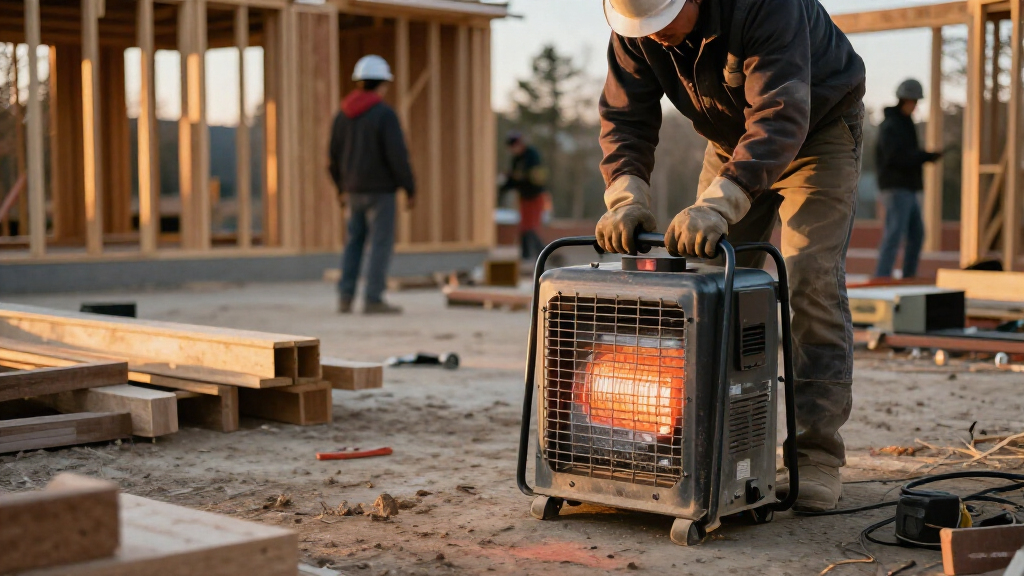
The DEWALT 150,000 BTU Forced Air Propane Heater is my best overall pick for open, well-ventilated sites where high heat output matters. For locations with dependable electrical service, the DEWALT DXH1000TS offers a substantial electric alternative, while the compact DEWALT 1.65 kW electric heater suits smaller work zones. The main tradeoff is between the strong, fuel-powered heat of propane and the simpler operation of electric models, which depend on available circuit capacity. I also weigh output against portability, work-area size, and the practical demands of ventilation and power access. Read on for the full comparison and guidance on matching a heater to your site.

Get business pricing on tools and workshop supplies
- Business-only prices and quantity discounts
- Tax-exempt purchasing
- Multiple users, one account, clear invoices
Complete the kit


Key Takeaways
- Propane leads for high heat output: The 150,000 BTU DEWALT is the strongest-output pick in this group, but its forced-air operation calls for an open, well-ventilated work area.
- Electric models depend on site power: The DXH1000TS draws 7,000–10,000 W, so circuit capacity and power distribution matter as much as its heating performance.
- Small electric heaters fill a different role: The 1.65 kW DEWALT and 4,800 W Stelpro suit smaller or power-served spaces; neither is a direct substitute for high-output propane heat.
- Output figures need context: The DEWALT 68,000 BTU and GASLAND 75,000–125,000 BTU propane models sit between the lineup’s high-output and compact options, with coverage depending on site conditions.
- The right pick follows the jobsite: Fuel access, ventilation, circuit capacity, and the space being heated separate these recommendations more than brand or portability alone.


| construction site portable heater | Model | Coverage | Weight | Heat output |
|---|---|---|---|---|
| DEWALT 150,000 BTU Forced Air | DXH150FAV | Up to 3,750 sq. ft. | 22.5 lb | 100,000–150,000 BTU |
| DEWALT DXH1000TS Forced Air El | DXH1000TS | 850 sq. ft. | 25.4 lb | — |
| DEWALT 68,000 BTU/h 1,700 sq. | — | Up to 1,700 sq. ft. | — | 68,000 BTU/h |
| GASLAND Portable Propane Force | FH12FB | Up to 3,100 sq. ft. | 13 lb | 75,000–125,000 BTU |
| DEWALT Forced Air Electric Con | DXH165 | 150 sq. ft. | 15.3 lb | 5,630 BTU |
| Stelpro ASCH48T Portable Const | ASCH48T | — | 13 lb | — |
More Details on Our Top Picks
DEWALT 150,000 BTU Forced Air Propane Heater with Quiet Burner Technology
The 150,000 BTU adjustable output gives this DEWALT the widest listed coverage in this batch, making it a stronger fit for large, open work areas than the 68,000 BTU DEWALT propane model. Its output can be reduced to 100,000 BTU, so crews can match the heat to changing conditions instead of running at full power. Quiet Burner Technology is a useful distinction when a loud heater would compete with nearby work, while the split-barrel design supports cleaning and maintenance. It arrives with a 20-foot hose and regulator, offering more reach than the GASLAND heater’s 10-foot hose. The tradeoff is the need for propane and a well-ventilated space; its high output is also excessive for small enclosed work areas.
Pros:- Adjustable 100,000–150,000 BTU output suits changing heat needs across large work areas.
- Quiet Burner Technology reduces operating noise by up to 50%.
- 20-foot hose and regulator are included.
- Split-barrel design supports cleaning and maintenance.
Cons:- Requires a propane tank and a well-ventilated work area.
- Its high output is a poor match for small or enclosed spaces.
- At 22.5 pounds, it is heavier than the 13-pound GASLAND model.
Best for: Crews heating large, well-ventilated construction areas who want adjustable high output and extra hose reach.
Not ideal for: Tradespeople working in small interiors, spaces without strong ventilation, or sites without a propane supply.
- Model:DXH150FAV
- Fuel:Propane
- Heat output:100,000–150,000 BTU
- Coverage:Up to 3,750 sq. ft.
- Heating method:Forced air
- Hose length:20 ft.
- Weight:22.5 lb
Our verdict“Choose this DEWALT for large, ventilated sites where high adjustable heat and a long hose matter more than compact size.”
DEWALT DXH1000TS Forced Air Electric Construction Heater, 7,000–10,000 W
Where propane models such as the DEWALT 150,000 BTU heater suit ventilated, open areas, the DXH1000TS is aimed at indoor workspaces with a suitable electrical supply. Its two-stage 7,000–10,000 W output and adjustable thermostat help crews manage heat in garages, workshops, and jobsite interiors without a fuel tank. The listed coverage of 850 square feet is far below the large DEWALT propane model’s, so this is a room heater rather than a choice for broad, open construction zones. The key constraint is electrical: it requires 240 V and up to 50 A, which many temporary circuits cannot provide. Recessed controls and a carrying handle help with handling, but they do not offset the need to confirm site power first.
Pros:- Two heat stages provide 7,000–10,000 W output.
- Adjustable thermostat supports steadier indoor temperatures.
- No propane tank is needed.
- Carrying handle and recessed controls suit jobsite handling.
Cons:- Requires a 240 V supply and circuit capacity up to 50 A.
- Listed coverage of 850 sq. ft. is limited compared with the large propane models.
- Intended for indoor use.
Best for: Crews warming an indoor garage or workshop with an available 240 V, 50 A circuit.
Not ideal for: Teams on sites without high-capacity 240 V power or those heating large, open areas.
- Model:DXH1000TS
- Power output:7,000–10,000 W
- Voltage:240 V
- Maximum amperage:50 A
- Coverage:850 sq. ft.
- Thermostat range:25–95 °F
- Weight:25.4 lb
Our verdict“Pick this electric DEWALT when a powered indoor workspace needs controlled heat and the required 240 V circuit is available.”
DEWALT 68,000 BTU/h 1,700 sq. ft. Forced Air Propane Heater
With 68,000 BTU/h and listed coverage of 1,700 square feet, this DEWALT occupies the middle ground between the compact indoor DXH165 electric heater and the much larger 150,000 BTU propane model. That makes it a plausible fit for crews warming a moderately sized, ventilated work area that does not call for the biggest heater in the lineup. The forced-air design is intended to distribute heat through the space, while propane keeps it independent of the 240 V circuit required by the DXH1000TS. The supplied data gives no hose length, weight, thermostat, or safety feature details, so buyers have less to confirm about setup and handling than with the better-specified GASLAND. Propane use and ventilation needs remain practical limits.
Pros:- 68,000 BTU/h output is below the largest DEWALT propane model’s, making it better scaled to mid-size areas.
- Listed coverage reaches up to 1,700 sq. ft.
- Forced-air heating is suited to distributing warmth across a work area.
Cons:- Requires propane and a well-ventilated space.
- Provided product data does not specify hose length or weight.
- Provided product data does not list thermostat or safety features.
Best for: Crews seeking propane forced-air heat for a moderately sized, well-ventilated jobsite area.
Not ideal for: Buyers who need detailed handling or control specifications, or who work in spaces without ventilation or propane access.
- Fuel:Propane
- Heat output:68,000 BTU/h
- Coverage:Up to 1,700 sq. ft.
- Heating method:Forced air
- Heater type:Forced-air propane heater
- Brand:DEWALT
Our verdict“Consider this DEWALT for a ventilated mid-size site where propane heat is useful and the missing setup details can be confirmed.”
GASLAND Portable Propane Forced-Air Heater, 75,000–125,000 BTU
The GASLAND brings a useful combination of adjustable 75,000–125,000 BTU output and a 13-pound listed weight. That makes it easier to move between work areas than the 22.5-pound DEWALT 150,000 BTU model, though it gives up some peak heat and listed coverage. Its 3,100-square-foot rating still targets substantial spaces, and electronic ignition plus overheat detection and a thermoelectric safety valve add practical safeguards. The included 10-foot hose is shorter than DEWALT’s 20-foot one, which can limit tank placement. GASLAND lists about five hours on low from a 20-pound tank, but the product still needs propane and good ventilation. The specified electrical draw is 2 A at 115 V, so plan for power as well as fuel.
Pros:- Adjustable 75,000–125,000 BTU output covers a broad range of heating needs.
- 13-pound listed weight is lighter than the large DEWALT propane model.
- Electronic ignition, overheat detection, and thermoelectric safety valve are specified.
- Hose and regulator are included.
Cons:- 10-foot hose offers less reach than the 20-foot hose included with the large DEWALT.
- Requires propane and a well-ventilated space.
- Needs 115 V power in addition to propane.
Best for: Crews who need substantial adjustable propane heat in a lighter unit that can be moved around a ventilated site.
Not ideal for: Buyers who need the DEWALT 150,000 BTU model’s higher peak output or a longer hose for tank placement.
- Model:FH12FB
- Fuel:Propane
- Heat output:75,000–125,000 BTU
- Coverage:Up to 3,100 sq. ft.
- Weight:13 lb
- Hose length:10 ft.
- Safety features:CSA certified, overheat detection, thermoelectric safety valve
- Runtime:Approximately 5 hours on low with a 20 lb propane tank
Our verdict“Choose GASLAND for portable, high-output propane heat when lighter handling matters more than maximum BTU or hose reach.”
DEWALT Forced Air Electric Construction Heater, 1.65 kW
The DXH165 is the lineup’s small-space choice: its 5,630 BTU output and listed 150-square-foot coverage suit a compact room or garage more than a broad construction zone. Compared with the 7,000–10,000 W DXH1000TS, it needs ordinary 115/120 V power and draws 13.5 A, making the electrical setup less demanding, though its heating reach is far smaller. An adjustable 25–95 °F thermostat, recessed controls, and an LED fault indicator give crews useful control and status information in a portable cabinet. The tradeoff is limited capacity: it cannot stand in for the propane heaters when a large, open area needs warming. Its indoor-only rating also narrows where it belongs.
Pros:- Standard 115/120 V corded power avoids the 240 V circuit required by the DXH1000TS.
- Thermostat adjusts from 25°F to 95°F.
- LED fault indicator provides a status cue.
- Recessed controls help shield switches and knobs.
Cons:- Listed coverage is limited to 150 sq. ft.
- Lower output is unsuitable for large or open construction areas.
- Specified for indoor use.
Best for: Tradespeople warming a small indoor room or garage who have standard corded power and do not need broad-area heat.
Not ideal for: Crews heating large, open, or outdoor work areas, where its 150-square-foot coverage and 5,630 BTU output fall short.
- Model:DXH165
- Heat output:5,630 BTU
- Power:1,500 W
- Voltage:115/120 V
- Amperage:13.5 A
- Coverage:150 sq. ft.
- Thermostat range:25–95 °F
- Weight:15.3 lb
Our verdict“Buy the DXH165 for a small indoor work area where standard power and thermostat control matter more than high heat output.”
Stelpro ASCH48T Portable Construction Heater, 4800 W, Red
The Stelpro ASCH48T suits garages, workshops, and smaller job sites that have the right 240 V connection and need portable electric heat. Its 4,800 W output at 240 V is below the DEWALT DXH1000TS at 7,000–10,000 W, so it is a more modest choice for heating demand rather than a substitute for a high-output unit. The built-in manual thermostat lets workers adjust heat on the unit, while the 13 lb body and carrying handle make it easier to move between work areas. Steel housing and thermal protection add practical durability, though the cool-touch exterior does not remove the need to follow safe placement and clearance guidance. The main limitation is access: it requires a dedicated 30 A, 250 V outlet, so it will not plug into a standard household socket.
Pros:- Provides 4,800 W at 240 V for localized workspace heating
- Built-in manual thermostat offers on-unit temperature adjustment
- 13 lb portable design with a carrying handle
- Steel housing and thermal protection
Cons:- Requires a dedicated 30 A, 250 V outlet and cannot use a standard household plug
- Single speed setting offers limited airflow control
- Output is lower than the 7,000–10,000 W DEWALT DXH1000TS
Best for: Tradespeople heating a smaller garage or workshop that already has a dedicated 240 V, 30 A outlet
Not ideal for: Crews without a compatible outlet or those needing the higher output of the DEWALT DXH1000TS
- Model:ASCH48T
- Power:4,800 W at 240 V; 3,600 W at 208 V
- Voltage:240 V
- Amperage:20 A
- Power source:Dedicated 240 V / 30 A outlet
- Heating method:Forced air
- Temperature range:32–104 °F
- Dimensions:9.63 × 12.25 × 10.5 in (D × W × H)
- Weight:13 lb
Our verdict“Choose the Stelpro for portable electric heat in a smaller work area with a compatible 240 V outlet; skip it if you need higher output or standard-plug convenience.”

How We Picked
I compared the six heaters on heat output, power or fuel requirements, portability, and practical fit for construction work. Propane models ranked higher for open sites that need substantial heat without relying on high-capacity electrical service; electric models gained ground where power access and simpler fuel handling are priorities. I also weighed whether each heater appears suited to a broad work area or a smaller zone, while treating stated output and coverage as guides that must be checked against actual site conditions.
The 150,000 BTU DEWALT leads for its high output and clear fit for large, open work areas. The DXH1000TS ranks as the strongest electric alternative, while the 68,000 BTU DEWALT and variable-output GASLAND offer different middle-ground propane choices. The smaller DEWALT and Stelpro round out the list for targeted heating where electrical service is available. These rankings reflect distinct use cases; buyers should confirm ventilation, required clearances, electrical specifications, and manufacturer instructions before choosing.
| construction site portable heater | Model |
|---|---|
| DEWALT 150,000 BTU Forced Air | DXH150FAV |
| DEWALT DXH1000TS Forced Air El | DXH1000TS |
| DEWALT 68,000 BTU/h 1,700 sq. | — |
| GASLAND Portable Propane Force | FH12FB |
| DEWALT Forced Air Electric Con | DXH165 |
| Stelpro ASCH48T Portable Const | ASCH48T |
Factors to Consider When Choosing Best Construction Site Portable Heater
Choosing a jobsite heater starts with the site itself. I would first match the heater to the work area, available utilities, and operating conditions, then compare portability and upkeep. These checks can prevent buying a powerful heater that the site cannot safely or practically support.
Match heat output to the space and the work
A large open structure loses heat differently from a small enclosed work zone, so BTU or wattage alone cannot predict comfort. Drafts, ceiling height, insulation, door openings, and how many people need warmth all affect the result. Avoid choosing by the highest output figure if your work area is modest; excess capacity may make the space uncomfortable and waste fuel or electricity. Conversely, a compact heater may only warm the immediate area rather than the whole site. Use the manufacturer’s coverage guidance as a starting point and account for site conditions before buying.
Check ventilation and heater placement
Combustion heaters need appropriate ventilation and must be operated according to their manuals, especially where people are working nearby. A heater that suits a large open build may be unsuitable for an enclosed or poorly ventilated room. Plan where exhaust and heated airflow will go, and keep required clearances from materials, equipment, and people. Forced air can move heat across a broad area, but it may also stir dust or create an uncomfortable draft at close range. If the site cannot meet the heater’s placement and ventilation requirements, select a suitable electric model or another compliant heating approach.
Confirm electrical capacity before choosing electric
Electric heat avoids on-site fuel combustion, but high-wattage units can place a heavy load on temporary power. Check the heater’s voltage, amperage, plug, and circuit requirements against the site’s actual distribution setup before purchase. Do not assume that a standard outlet or a long extension cord can support a construction heater safely. Multiple tools and heaters on the same circuit can cause interruptions or overloads. For a small work zone, lower-wattage equipment may be easier to accommodate; for a high-output electric unit, plan the power connection with the site electrician.
Compare fuel logistics with power logistics
Propane heaters can deliver strong heat where electrical service is limited, but the crew must manage fuel supply, cylinder changes, and safe storage. Electric heaters shift that burden to the power system, which may be simpler when reliable capacity is already present. Consider how long the heater must run each day, how far the work area is from fuel or power, and who will handle setup. A heater that is easy to fuel but awkward to position can slow work just as surely as one that repeatedly trips a circuit. Include the site’s day-to-day operating routine in the purchase decision.
Think about portability, durability, and maintenance
“Portable” can mean a heater is movable, but it does not tell you whether one person can reposition it or how well it handles rough jobsite conditions. Check the weight, handle or wheel arrangement, cord or hose needs, and the stability of the unit on the surfaces where it will sit. Dust and debris can affect equipment, so review the manufacturer’s cleaning and inspection instructions and consider how accessible service parts are. A compact heater may be easier to move between small tasks, while a larger unit can require more room for setup and storage. Buy for the crew’s real handling conditions, not just the product’s portability label.
Decide when more output is worth the added demands
Higher output makes sense when a large, drafty area needs heat and the site can support the fuel, ventilation, and placement requirements. It is less useful when work is concentrated in one small area or the heater cannot be positioned near the task. Paying for a high-capacity electric model also makes little sense if the site lacks the required circuit. Compare the full operating setup, including fuel availability or electrical infrastructure, instead of judging by heater output alone. A lower-output model may be the better purchase when it fits the work zone and can run reliably through the shift.
Frequently Asked Questions
Should I choose a propane or electric construction heater?
I would start with site utilities and ventilation. Propane is a strong fit for open work areas where high heat is needed and fuel can be managed safely; electric can suit sites with adequate circuit capacity and a preference for avoiding on-site combustion. High-wattage electric heaters still require careful power planning. If the work area is enclosed or ventilation is limited, check the manual and applicable site requirements before considering any combustion heater. The right choice is the one the site can support throughout the workday.
Can I run a high-wattage electric heater from a regular outlet?
Do not assume that you can. The DXH1000TS is specified at 7,000–10,000 W, and the required voltage, current, and circuit configuration must match the site supply. Check the product manual and have a qualified site electrician confirm the available circuit and distribution equipment. An extension cord does not increase a circuit’s capacity and may introduce additional limits. If the required supply is unavailable, consider a heater compatible with the power already on site.
How much heater output do I need for a construction site?
There is no single output figure that fits every site because drafts, ceiling height, insulation, open doors, and the heated area all change the demand. Start with the manufacturer’s coverage guidance, then account for the conditions where the crew will actually work. A high BTU rating can be useful in a large, open area, while a smaller unit may be a better match for a localized task. Avoid sizing from square footage alone when the space is unusually drafty or has high ceilings. If the site conditions are complex, ask the manufacturer or a qualified heating professional to help size the equipment.
Is a forced-air propane heater suitable for an enclosed work area?
Do not treat a forced-air propane heater as suitable for an enclosed space by default. Combustion, ventilation, clearances, and placement requirements depend on the specific heater and the worksite conditions. Read the manufacturer’s instructions and follow applicable safety rules before operating one around workers. If the space cannot meet those requirements, choose an appropriate alternative, such as an electric heater with a compatible power supply. The strongest-output model is not the right choice when the site cannot support its operating conditions.
Which type is easier to move between changing work areas?
Portability depends on more than the heater’s size: fuel cylinders, hoses, power cords, and access routes all affect how quickly a crew can reposition it. A compact electric model can be convenient for small tasks if a suitable outlet is nearby. A larger propane unit may suit broader open spaces, but its complete setup takes more room and handling. Check the product’s weight and moving features, then consider the distance between the heater and its fuel or power source. The best option is the one the crew can move and set up safely in its actual work sequence.
Conclusion
For a large, open site that needs substantial heat, I recommend the DEWALT 150,000 BTU propane heater as best overall. The GASLAND 75,000–125,000 BTU is my value-minded choice for buyers who want adjustable propane output, while the DEWALT DXH1000TS is the premium electric pick for sites with the right power supply. Beginners with a small work area and suitable electrical access may find the DEWALT 1.65 kW heater easier to match to targeted heating. For a specific mid-size electric need, consider the Stelpro 4,800 W; for a lower-output propane option, the DEWALT 68,000 BTU may be a better fit than the 150,000 BTU model. Choose only after matching the heater’s requirements to your site’s ventilation, power, and work area.
Fall yard work Picks
leaf blowers
As an affiliate, we earn on qualifying purchases.