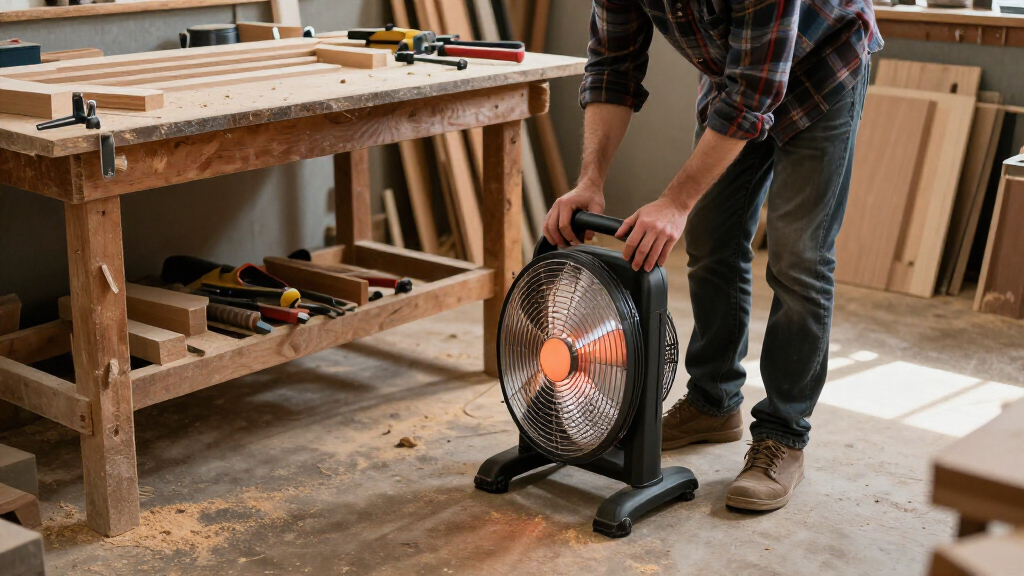
The best portable jobsite heater fan depends on whether your site can support propane or high-wattage electricity. I’d put the Mr. Heater MHC125FAV first for high-output heating where propane ventilation requirements can be met; the DEWALT 68,000 BTU cordless propane heater is a more mobile alternative, while the DEWALT DXH1000TS suits sites with adequate electrical service. The main tradeoff is heat output versus power access, portability, and the ventilation and safety needs of fuel-burning heaters. Smaller electric models may suit a nearby work zone but are not substitutes for high-output heaters in large, drafty spaces. Read on for how the eight options compare and which type of jobsite each fits.

Get business pricing on tools and workshop supplies
- Business-only prices and quantity discounts
- Tax-exempt purchasing
- Multiple users, one account, clear invoices
Complete the kit



Key Takeaways
- The Mr. Heater MHC125FAV and Mr. Heater 125,000 BTU portable forced-air heater offer the lineup’s highest stated outputs, but propane use brings ventilation, fuel-supply, and safe-placement requirements.
- The DEWALT DXH1000TS is the electric choice for sites that can provide its 7,000–10,000-watt draw; a standard household outlet is not a substitute for the required supply.
- The DEWALT 68,000 BTU cordless propane heater trades some output for greater mobility, making it more suited to moving between work areas than a high-draw electric unit.
- The 1.65 kW DEWALT and 5,120 BTU Dura Heat are better matched to localized warmth than to heating a large, open jobsite.
- The Big Buddy Pro Series offers a different format from forced-air models, so buyers should weigh its heating pattern and intended setting rather than compare its BTU figure alone.
| Mr. Heater MHC125FAV 125,000 BTU Forced Air Propane Heater |  | Best for Maximum Heat Output | Fuel type: Propane | Heat output: 75,000–125,000 BTU | Heating coverage: Up to 3,125 sq ft | VIEW LATEST PRICE | See Our Full Breakdown |
| DEWALT DXH1000TS Forced Air Electric Construction Heater, 7,000–10,000 W |  | Best for Indoor Construction Sites | Power output: 7,000–10,000 W | Voltage: 240 V | Amperage: 50 A | VIEW LATEST PRICE | See Our Full Breakdown |
| DEWALT DXH2003TS Forced Air Electric Construction Heater |  | Best for Large Electrified Work Areas | Power output: 13,000 or 20,000 W | Heating area: Up to 1,725 sq ft | Heating method: Forced air | VIEW LATEST PRICE | See Our Full Breakdown |
| Dura Heat EUH1465 Electric Forced Air Heater with Pivoting Base, 5,120 BTU, Yellow |  | Best Compact Plug-In Pick | Heating power: 1,500 W | Heat output: 5,120 BTU | Heating method: PTC ceramic | VIEW LATEST PRICE | See Our Full Breakdown |
| DEWALT 68,000 BTU Cordless Portable Forced Air Propane Heater |  | Best for Flexible Power Options | Model: DXH70CFAV | Fuel type: Propane | Heat output: 27,000–68,000 BTU | VIEW LATEST PRICE | See Our Full Breakdown |
| DEWALT Forced Air Electric Construction Heater, 1.65 kW |  | Best for Small Indoor Work Areas | Model: DXH165 | Heating output: 5,630 BTU | Power: 1,500 watts | VIEW LATEST PRICE | See Our Full Breakdown |
| Mr. Heater Big Buddy Pro Series 18,000 BTU Propane Heater |  | Best for Flexible Propane Heating | Model: MH18B | Fuel type: Propane | Heat output: 4,000 / 9,000 / 18,000 BTU | VIEW LATEST PRICE | See Our Full Breakdown |
| Mr. Heater Portable Propane Forced Air Heater, 125,000 BTU |  | Best for Large Outdoor Work Zones | Model: F228128 | Heat output: 125,000 BTU/hr | Heating coverage: Up to 3,125 sq. ft. | VIEW LATEST PRICE | See Our Full Breakdown |
| portable jobsite heater fan | Heating coverage | Weight | Heating method | Fuel type |
|---|---|---|---|---|
| Mr. Heater MHC125FAV 125,000 B | Up to 3,125 sq ft | 19.7 lb | Forced air | Propane |
| DEWALT DXH1000TS Forced Air El | 850 sq ft | 25.4 lb | Forced air | — |
| DEWALT DXH2003TS Forced Air El | — | 48 lb | Forced air | Electric |
| Dura Heat EUH1465 Electric For | 250 sq ft | — | PTC ceramic | — |
| DEWALT 68,000 BTU Cordless Por | Up to 1,700 sq ft | 15.1 lb | — | Propane |
| DEWALT Forced Air Electric Con | 150 sq. ft. | 15.3 lb | — | — |
| Mr. Heater Big Buddy Pro Serie | Up to 450 sq. ft. | 14.1 lb | Radiant and convection | Propane |
| Mr. Heater Portable Propane Fo | Up to 3,125 sq. ft. | 19.4 lb | Forced air | Propane |
More Details on Our Top Picks
Mr. Heater MHC125FAV 125,000 BTU Forced Air Propane Heater
The Mr. Heater MHC125FAV is the strongest fit here when a large, well-ventilated work area needs substantial heat quickly. Its adjustable 75,000–125,000 BTU output and stated coverage of up to 3,125 square feet exceed the DEWALT 68,000 BTU Cordless Portable Forced Air Propane Heater, making this the better match for bigger open sites. The included 10-foot hose and regulator simplify setup around a propane tank, while its 19.7-pound weight keeps it more manageable to reposition than the 48-pound DEWALT DXH2003TS electric heater. The tradeoff is a narrow use case: it requires propane and ventilation, and the product is specified for outdoor use. I’d skip it for enclosed rooms or smaller jobs where the Dura Heat EUH1465’s 120V plug-in format is easier to place.
Pros:- Adjustable 75,000–125,000 BTU output suits changing heat needs across large areas.
- Rated to heat spaces up to 3,125 square feet, the broadest coverage listed in this batch.
- Includes a 10-foot hose and regulator for propane connection.
- High-limit safety switch and thermoelectric safety valve add protective shutdown features.
Cons:- Requires a well-ventilated area and is specified for outdoor use.
- Propane dependence makes it a poor fit for sites without fuel access.
- Its high output can be excessive for small or partially enclosed work areas.
Best for: Crews heating large, open construction areas, barns, or workshops where propane and strong ventilation are available.
Not ideal for: Workers needing heat inside enclosed or poorly ventilated spaces, or anyone whose jobsite needs a compact heater for a small work zone.
- Fuel type:Propane
- Heat output:75,000–125,000 BTU
- Heating coverage:Up to 3,125 sq ft
- Heating method:Forced air
- Weight:19.7 lb
- Dimensions:9 × 25.25 × 17 in
- Included components:10 ft hose and regulator
- Safety features:High-limit safety switch and thermoelectric safety valve
Our verdict“Choose the MHC125FAV for large, ventilated jobsites where maximum listed heat output matters more than indoor flexibility.”
DEWALT DXH1000TS Forced Air Electric Construction Heater, 7,000–10,000 W
For a jobsite with dependable 240V, 50A power, the DEWALT DXH1000TS offers controlled electric heat without propane. Its two output levels and thermostat spanning 25°F to 95°F make it better suited to maintaining warmth in indoor work areas than the Mr. Heater MHC125FAV, which is intended for well-ventilated outdoor use. The 850-square-foot coverage also places it between the compact Dura Heat EUH1465 and the larger DEWALT DXH2003TS. At 25.4 pounds, its handle helps with repositioning, though it is not a lightweight carry-around heater. The main limitation is site infrastructure: a standard outlet will not power this unit. I’d choose it over the propane models for a powered indoor workspace, but not for remote sites or locations without the required electrical supply.
Pros:- Two-stage 7,000–10,000 W output allows heat level adjustments.
- Thermostat range of 25°F–95°F supports temperature control.
- Forced-air electric operation avoids propane fuel handling.
- Ergonomic handle supports moving the 25.4-pound unit around a work area.
Cons:- Requires a 240V, 50A electrical connection.
- Coverage is limited to 850 square feet, below the DEWALT DXH2003TS and Mr. Heater MHC125FAV.
- The 25.4-pound weight is less convenient for frequent carrying than the Dura Heat EUH1465.
Best for: Contractors working in indoor spaces up to 850 square feet with access to a compatible 240V, 50A connection.
Not ideal for: Crews on remote or temporary jobsites without 240V, 50A power, or buyers who need a fuel-powered heater they can move between unpowered areas.
- Power output:7,000–10,000 W
- Voltage:240 V
- Amperage:50 A
- Heating coverage:850 sq ft
- Heating method:Forced air
- Temperature range:25°F–95°F
- Weight:25.4 lb
- Dimensions:12.4 × 23.23 × 18.54 in (D × W × H)
Our verdict“Pick the DXH1000TS when you need thermostat-controlled electric heat indoors and your jobsite can supply its 240V, 50A power.”
DEWALT DXH2003TS Forced Air Electric Construction Heater
The DEWALT DXH2003TS is the electric choice for a larger indoor work zone that can provide its demanding 50A supply. With selectable 13,000- or 20,000-watt output and coverage up to 1,725 square feet, it reaches farther than the DXH1000TS, which is rated for 850 square feet. A thermostat and fan-only mode add flexibility when active heating is not needed, while the included wheel kit helps move the 48-pound unit between nearby work areas. That weight is the cost of its greater capacity: it is much less convenient to lift or carry than the DEWALT 68,000 BTU Cordless Portable Forced Air Propane Heater at 15.1 pounds. This model makes sense when electric operation is preferred and the supply is available, but it is a poor match for crews moving between remote, unpowered sites.
Pros:- Selectable 13,000- or 20,000-watt output serves a larger area than the DXH1000TS.
- Rated for heating areas up to 1,725 square feet.
- Thermostat range of 23°F–95°F allows temperature adjustment.
- Fan-only mode and included wheel kit add utility beyond heating and aid repositioning.
Cons:- Requires a 50A electrical supply, limiting use on sites without compatible power.
- At 48 pounds, it is heavy to lift or carry.
- The wheel kit helps with rolling but does not solve transport across rough or stair-filled routes.
Best for: Crews heating indoor work areas up to 1,725 square feet who have a suitable 50A electrical supply and can roll the heater between locations.
Not ideal for: Workers needing a heater for remote jobsites, or anyone who must frequently lift and carry equipment rather than wheel it.
- Power output:13,000 or 20,000 W
- Heating area:Up to 1,725 sq ft
- Heating method:Forced air
- Fuel type:Electric
- Thermostat range:23°F–95°F
- Amperage:50 A
- Weight:48 lb
- Included feature:Wheel kit
Our verdict“Choose the DXH2003TS for broad-area electric heating when a 50A connection and wheeled transport are practical.”
Dura Heat EUH1465 Electric Forced Air Heater with Pivoting Base, 5,120 BTU, Yellow
The Dura Heat EUH1465 is the most compact option in this group, designed for a small indoor work zone rather than whole-site heating. Its 1,500W ceramic element runs on 120V power, so it avoids the 240V connection required by the DEWALT DXH1000TS and the 50A supply needed by the DXH2003TS. At 8.5 inches high and 8 pounds wide by 7 inches deep, it is easy to place near a bench or focused task area; the pivoting base and fan-only setting add some flexibility. Its stated coverage of 250 square feet is far below the larger heaters, including the DEWALT 68,000 BTU Cordless Portable Forced Air Propane Heater. This is a supplementary spot heater, not a solution for warming a broad, drafty jobsite. The cord also limits placement.
Pros:- Compact dimensions suit benches and small work areas.
- Runs on 120V power rather than the higher-voltage connections required by the larger DEWALT electric heaters.
- Heat and fan-only settings provide a use beyond active heating.
- Overheat shut-off adds a safety feature.
Cons:- Coverage is limited to 250 square feet, well below every large-area heater in this lineup.
- The 6-foot cord restricts placement around a worksite.
- Its 1,500W output is not suited to warming large or poorly insulated spaces.
Best for: Tradespeople who need a small, corded heater for a bench, compact workshop, or indoor work zone up to 250 square feet.
Not ideal for: Crews heating large or drafty spaces, or workers who need cordless placement away from a 120V outlet.
- Heating power:1,500 W
- Heat output:5,120 BTU
- Heating method:PTC ceramic
- Heating coverage:250 sq ft
- Voltage:120 V
- Amperage:12.5 A
- Power cord:6 ft
- Safety feature:Overheat shut-off
Our verdict“Choose the EUH1465 for portable, plug-in warmth at a small indoor work area, not as a primary heater for a large jobsite.”
DEWALT 68,000 BTU Cordless Portable Forced Air Propane Heater
The DEWALT DXH70CFAV earns its place for crews who need meaningful forced-air heat without depending on a single power setup. It uses propane for heat and can run its fan from a 20V MAX or FlexVolt battery, or 120V power, a useful advantage over the Mr. Heater MHC125FAV, which is the better choice when greater heat output and coverage are the priority. The DEWALT’s variable 27,000–68,000 BTU range covers up to 1,700 square feet, and its 15.1-pound weight is the lightest among the larger forced-air models here. Quiet Burner Technology is specified to reduce noise compared with similar standard units. The compromise is that it still needs propane plus a battery or outlet, and it is intended for well-ventilated areas. It is not an indoor, all-electric alternative to the DEWALT DXH1000TS.
Pros:- Fan can run from a 20V MAX or FlexVolt battery or a 120V power supply.
- Variable 27,000–68,000 BTU output supports adjustment to the job.
- At 15.1 pounds, it is lighter than the Mr. Heater MHC125FAV and DEWALT DXH2003TS.
- Includes a 10-foot hose and regulator, plus high-limit switches and a thermoelectric valve.
Cons:- Propane is still required for heat, along with a battery or 120V supply for operation.
- Requires a well-ventilated area, limiting use in enclosed workspaces.
- Its 68,000 BTU maximum and 1,700-square-foot coverage are below the Mr. Heater MHC125FAV.
Best for: Mobile crews who need a lighter propane forced-air heater and want the choice of DEWALT battery or 120V fan power.
Not ideal for: Workers needing electric-only heat, a heater for enclosed spaces, or maximum output for areas beyond its 1,700-square-foot coverage.
- Model:DXH70CFAV
- Fuel type:Propane
- Heat output:27,000–68,000 BTU
- Heating coverage:Up to 1,700 sq ft
- Power source:20V MAX or FlexVolt battery, or 120V power supply
- Weight:15.1 lb
- Hose length:10 ft
- Runtime:Approximately 13 hours on a 20 lb propane tank
Our verdict“Pick the DXH70CFAV when lighter transport and battery-or-outlet flexibility matter more than the highest heat output in the group.”
DEWALT Forced Air Electric Construction Heater, 1.65 kW
The DEWALT DXH165 is the compact electric choice for a garage corner, small workshop, or enclosed jobsite area where propane is not a fit. Its 5,630 BTU output and listed coverage of 150 square feet suit localized heating, while the thermostat gives more control than a simple on/off heater. Recessed controls help shield the settings from bumps, and the illuminated switch includes a fault indicator. Compared with the DEWALT DXH1000TS, it is far less powerful, but it also avoids that model’s higher electrical demand. The tradeoff is limited reach: it needs a 120-volt outlet and will not warm a large or drafty work zone quickly. I’d choose it for smaller indoor spaces, not as a substitute for a high-output construction heater.
Pros:- 5,630 BTU output is suited to smaller indoor areas
- Thermostat adjusts from 25°F to 95°F
- Recessed controls help protect switches and knobs from accidental bumps
- Illuminated power switch includes an LED fault indicator
Cons:- Lower output than larger construction heaters, limiting its usefulness in open spaces
- Requires access to a 120-volt outlet
- At 13.5 A, it can use much of the capacity of a typical household circuit
Best for: Tradespeople and homeowners who need corded heat for an enclosed garage, small workshop, or work area up to about 150 square feet.
Not ideal for: Crews heating large, open, or drafty jobsites, or anyone working where a 120-volt outlet is unavailable.
- Model:DXH165
- Heating output:5,630 BTU
- Power:1,500 watts
- Voltage:115V–120V
- Amperage:13.5 A
- Thermostat range:25°F–95°F
- Heating coverage:150 sq. ft.
- Dimensions:8.82 × 12.32 × 14.17 in
- Weight:15.3 lb
Our verdict“Choose the DXH165 for controlled electric heat in a small indoor work area; pick a higher-output model for larger or draftier spaces.”
Mr. Heater Big Buddy Pro Series 18,000 BTU Propane Heater
The Big Buddy Pro Series suits buyers who need more heat than a small electric unit can provide but do not need a large forced-air heater. Three settings from 4,000 to 18,000 BTU let you scale output for changing conditions, and radiant plus convection heat can make it useful for a defined work area. Its built-in fan helps move warmth beyond the immediate heater, unlike a basic radiant-only unit. Compared with the DEWALT DXH165, it can cover a much larger stated area and does not depend on a 120-volt outlet; compared with the 125,000 BTU Mr. Heater forced-air model, it is a lower-output, less jobsite-scale option. Propane supply is the main tradeoff, and safe operation depends on following the instructions and using approved accessories.
Pros:- Three output settings provide a range from 4,000 to 18,000 BTU
- Rated to heat spaces up to 450 square feet
- Combines radiant and convection heat with a built-in fan
- Includes an oxygen depletion sensor, thermal shutoff, and tip-over switch
Cons:- Requires propane cylinders or a compatible tank and hose
- Lower output than the 125,000 BTU Mr. Heater forced-air option for large work areas
- The manufacturer warns that unauthorized accessories can cause injury and void the warranty
Best for: People working in spaces up to 450 square feet who want adjustable propane heat and do not have convenient electrical access.
Not ideal for: Crews heating large open work zones, or buyers who want a plug-in heater without fuel cylinders, hose considerations, or combustion-related precautions.
- Model:MH18B
- Fuel type:Propane
- Heat output:4,000 / 9,000 / 18,000 BTU
- Heating coverage:Up to 450 sq. ft.
- Heating method:Radiant and convection
- Heat settings:3
- Safety features:Oxygen depletion sensor, thermal shutoff, tip-over switch
- Weight:14.1 lb
- Dimensions:18.5 × 18 × 11.4 in
Our verdict“Choose the Big Buddy for adjustable propane warmth in a medium-sized work area when a larger forced-air heater would be excessive.”
Mr. Heater Portable Propane Forced Air Heater, 125,000 BTU
When the job calls for broad, high-output heat, this 125,000 BTU forced-air heater is in a different class from the DXH165 and Big Buddy. Its listed coverage reaches 3,125 square feet, making it suited to large garages, workshops, and outdoor work areas rather than personal spot heating. The 10-foot hose and regulator are included, and adjustable temperature plus overheat protection add practical control. At 19.4 pounds, the heater itself remains portable, but that figure does not include the required propane supply. It needs a tank of at least 40 pounds, and the product is described for outdoor use, so it is not the choice for an enclosed indoor workspace. Compared with the Big Buddy, it offers far more output but gives up its lower-output flexibility for smaller spaces.
Pros:- 125,000 BTU/hr output is suited to large work zones
- Rated coverage of up to 3,125 square feet
- Includes a 10-foot hose and regulator
- Adjustable temperature and overheat protection
Cons:- Requires a propane tank of at least 40 pounds, adding fuel logistics and bulk
- Described for outdoor use, limiting suitability for enclosed indoor work
- Its high output is excessive for small spaces compared with the Big Buddy
Best for: Contractors or workshop owners heating large outdoor work areas who can supply a propane tank of at least 40 pounds.
Not ideal for: Anyone needing heat for a small area, a cord-free personal heater, or an enclosed indoor jobsite where outdoor-use equipment is unsuitable.
- Model:F228128
- Heat output:125,000 BTU/hr
- Heating coverage:Up to 3,125 sq. ft.
- Fuel type:Propane
- Heating method:Forced air
- Runtime:Up to 11.5 hours
- Tank requirement:40 lb minimum
- Weight:19.4 lb
- Dimensions:9.84 × 25.83 × 15.28 in
Our verdict“Choose this model for large outdoor work areas where high forced-air output justifies carrying a 40-pound-minimum propane tank.”

How We Picked
I ranked these heaters around the decisions that shape jobsite use: heat output and coverage, power or fuel requirements, portability, and how well each format fits a real work area. A high BTU figure matters only when the space, airflow, and available fuel support it; a smaller electric heater can be the more practical pick for a nearby work zone if the right circuit is available. I also weighed usability factors such as moving the heater between tasks, aiming heat, and the operational demands of propane.
The ranking favors options with a clearer fit for common jobsite needs, not raw output alone. The MHC125FAV leads for high-output propane heating, while the cordless DEWALT earns a separate place for mobility and the DXH1000TS represents a strong electric option when site power can handle its load. Lower-output electric models rank as focused-area solutions, and the Big Buddy is judged as a distinct propane format rather than treated as a forced-air equivalent. Product-specific safety instructions and site conditions should guide final selection.
| portable jobsite heater fan | Fuel type | Heating method | Model |
|---|---|---|---|
| Mr. Heater MHC125FAV 125,000 B | Propane | Forced air | — |
| DEWALT DXH1000TS Forced Air El | — | Forced air | — |
| DEWALT DXH2003TS Forced Air El | Electric | Forced air | — |
| Dura Heat EUH1465 Electric For | — | PTC ceramic | — |
| DEWALT 68,000 BTU Cordless Por | Propane | — | DXH70CFAV |
| DEWALT Forced Air Electric Con | — | — | DXH165 |
| Mr. Heater Big Buddy Pro Serie | Propane | Radiant and convection | MH18B |
| Mr. Heater Portable Propane Fo | Propane | Forced air | F228128 |
Factors to Consider When Choosing Best Portable Jobsite Heater Fan
Before choosing a heater, match its demands to the worksite rather than starting with the largest output number. These factors help narrow the field and avoid buying a unit that cannot be powered, placed, or used appropriately where the work happens.
Match Heat Output to the Space
Open, drafty areas lose heat quickly, so a compact heater may warm only the people or materials directly beside it. Enclosed or divided work zones can benefit from a smaller unit, especially when the goal is to take the chill off a specific task area rather than heat the whole site. Ceiling height, air leakage, insulation, and outdoor temperature all change how much usable warmth a heater provides. A common mistake is treating BTU ratings as a direct measure of comfort without accounting for those conditions. Start by defining the area you need to warm and whether the heater will run continuously or intermittently. If the space is large and unsealed, plan for heat loss rather than expecting a portable unit to maintain indoor-room comfort.
Check Electrical Supply Before Choosing an Electric Heater
Electric jobsite heaters can avoid on-site propane handling, but high-wattage models place substantial demands on the electrical system. Confirm voltage, circuit capacity, wiring, and any generator limits before purchasing; do not assume an available outlet can safely support the heater. Extension-cord length and gauge can affect performance and create a hazard if the cord is undersized or damaged. Lower-wattage units are easier to accommodate but generally suit more localized heating. If several tools share a circuit, account for their combined load rather than calculating the heater alone. When the site cannot provide the specified supply, a powerful electric model is not a practical upgrade.
Treat Propane Ventilation as a Site Requirement
Propane forced-air heaters can deliver substantial heat without a heavy electrical connection, but their use depends on safe operating conditions. Follow the manufacturer’s instructions for ventilation, clearances, fuel connections, and placement, and check local rules and site policies. Never assume that a large doorway or occasional air exchange makes an enclosed space suitable. Fuel cylinders also need secure storage and careful handling, which can affect daily setup and transport. These demands may be manageable on an open or appropriately ventilated site, but they can rule out propane in some indoor work areas. Choose the fuel source only after checking the actual location where the heater will run.
Decide How Much Mobility You Really Need
Portability is not just a handle or a compact body; it also includes the equipment and supplies needed to run the heater. A corded electric unit may be easy to move physically but limited by outlet placement and cable routing. A cordless propane model can move more freely between work zones, though fuel still has to travel with it. Larger forced-air heaters may make sense when one location needs steady heat, but repeated repositioning can become a nuisance. Think about whether the heater will stay in one area, follow a crew, or move from site to site. This distinction can matter more than a modest difference in output.
Choose Forced Air or a More Local Heating Pattern
Forced-air heaters move heated air across an area, which can help when workers need warmth beyond the immediate reach of the unit. A compact heater or a model with a different heating pattern may be more useful for a bench, small work zone, or nearby task. Air movement can also stir dust or feel uncomfortable when aimed directly at workers, so placement matters. Buyers sometimes choose forced air because it sounds more powerful, even when a focused source better fits the job. Consider where people stand, what materials are nearby, and whether airflow could disrupt the work. The right format depends on the task and layout, not just the heater’s headline rating.
Plan for Daily Setup, Fuel, and Upkeep
A heater that is easy to operate at the start of a shift can still require fuel checks, cord management, safe storage, and regular inspection. Factor in how often the crew will move or store it and who will be responsible for setup. For propane units, include cylinder availability and connection checks in the work plan; for electric models, inspect cords and confirm the power source remains suitable. Keep clear space around the heater and follow its maintenance instructions rather than improvising repairs. Paying more for mobility or greater output makes sense only if those traits solve a recurring site problem. For occasional localized warmth, a simpler, lower-output option may be easier to manage.
Frequently Asked Questions
Can I run a 7,000–10,000-watt jobsite heater from a regular household outlet?
Do not assume a standard household outlet can power a heater in this range. Check the exact model’s voltage and current requirements, then compare them with the circuit, wiring, and generator available at the site. A circuit shared with tools or lighting may not have enough capacity even if the outlet fits. Avoid using an undersized extension cord or adapting the connection to make it work. If the supply does not meet the manufacturer’s specifications, select a heater suited to the power available.
Is a 125,000 BTU propane heater a good choice for an enclosed workshop?
Its output alone does not make it suitable for an enclosed workshop. Propane forced-air heaters have ventilation and clearance requirements that must be followed, along with the manufacturer’s instructions and applicable site rules. A tightly enclosed area may not provide appropriate conditions, even if it feels cold or the heater can physically fit. Check the heater documentation and the workshop’s ventilation before choosing it. If safe operation cannot be confirmed, consider an electric model that matches the available circuit instead.
Should I choose a cordless propane heater or a corded electric heater for a changing jobsite?
Choose based on what limits movement at your sites. A cordless propane model can be easier to reposition when outlets are scarce, while a corded electric heater can avoid carrying fuel if suitable electrical service is available near the work. The propane option still requires safe cylinder handling and appropriate ventilation; the electric option needs a compliant power source and careful cord routing. Consider how frequently the heater moves and whether the crew can safely manage its fuel or electrical setup. Neither format is automatically more portable once its operating needs are included.
Will a 1.65 kW or 5,120 BTU heater warm an entire construction site?
These lower-output options are better approached as localized heaters than whole-site solutions. Their usefulness depends on how enclosed the work area is, how much air leaks out, and how close the heater can be placed to the task. A large, open or drafty site can lose heat faster than a compact unit supplies it. For a single station or small work zone, a modest heater may be a sensible fit if its placement and power requirements work. For broader coverage, compare higher-output models while accounting for fuel or electrical demands.
How should I compare a Big Buddy heater with a forced-air model?
Do not compare the two formats by BTU rating alone. Forced-air heaters actively move heated air, while the Big Buddy is a different style of propane heater with a different heating pattern and intended use. The better choice depends on the space, how heat needs to reach workers, and the manufacturer’s rules for where the unit can operate. Check ventilation, placement, and fuel requirements for either option before buying. If you need air movement across a work zone, a forced-air model may fit better; for a more focused setup, the Big Buddy may be worth comparing on its own terms.
Conclusion
For most buyers seeking a high-output portable jobsite heater fan, I’d start with the Mr. Heater MHC125FAV, provided propane use is appropriate for the site. The best value for a mobile crew is the DEWALT 68,000 BTU cordless propane heater, since it prioritizes movement between work areas; for electric heat, the DEWALT DXH1000TS is the premium high-output pick when the site can supply its demanding load. Beginners with a small, defined work zone may find the Dura Heat EUH1465 easier to match to a localized heating need, while the 1.65 kW DEWALT suits buyers who want a compact electric option and can accept limited coverage. Choose the Big Buddy for a distinct propane heating format, and compare the two 125,000 BTU Mr. Heater models by their specific setup and operating requirements. The best choice is the one your site can safely power or fuel and that fits the area you actually need to warm.