
For construction crews that need to run demanding tools, my best overall pick is the Westinghouse 14,500-Watt Dual-Fuel Generator, which pairs high output with a choice of gasoline or propane. The GENMAX GM15000ET is a strong fit when tri-fuel flexibility matters, while the WEN DF1100T offers a lower-output route for crews with lighter loads. The main tradeoffs are power capacity versus transport burden, and fuel flexibility versus the simplicity of a single-fuel setup. A generator that can run several tools on paper may still struggle with their startup surges, so matching capacity to the actual job matters. Continue reading for the full breakdown and help choosing the right option for your worksite.

Get business pricing on tools and workshop supplies
- Business-only prices and quantity discounts
- Tax-exempt purchasing
- Multiple users, one account, clear invoices
Complete the kit


Key Takeaways
- The 14,500-watt Westinghouse dual-fuel model leads this lineup for crews seeking substantial output with gasoline and propane flexibility; its size and weight make frequent solo moves less practical.
- The GENMAX GM15000ET and Westinghouse 14,500-watt tri-fuel model stand apart for fuel choice, which can help when a site has access to different fuel supplies, though the added flexibility does not reduce their transport demands.
- The WEN DF1100T and DuroStar DS13000MX target crews with substantial power needs who want dual-fuel operation at a different output tier than the highest-capacity options.
- The WEN DF475T, WGen5300cv, and WGen3600cv suit lighter-duty work better; they are easier fits for smaller tool loads, but crews should not expect them to power several demanding tools at once.
- CO sensors and electric or remote starting improve convenience and awareness, but they do not replace safe outdoor placement, suitable extension cords, or checking each tool’s startup demand.
| Westinghouse 14,500-Watt Dual-Fuel Portable Home Backup Generator | 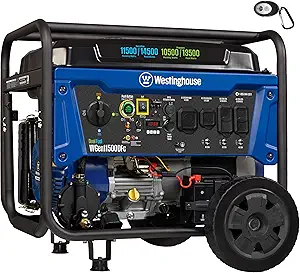 | Best for Long Gasoline Runtime | Gasoline output: 14,500 peak watts; 11,500 running watts | Propane output: 13,500 peak watts; 10,500 running watts | Fuel types: Gasoline and propane | VIEW LATEST PRICE | See Our Full Breakdown |
| DuroStar DS13000MX 13,000-Watt Dual-Fuel Portable Generator |  | Best for Rugged Site Use | Model: DS13000MX | Power output: 13,000 watts | Engine displacement: 500cc | VIEW LATEST PRICE | See Our Full Breakdown |
| Westinghouse WGen5300cv Portable Generator with CO Sensor |  | Best for Smaller Tool Loads | Running power: 5,300 watts | Peak power: 6,600 watts | Fuel: Gasoline | VIEW LATEST PRICE | See Our Full Breakdown |
| Westinghouse 14,500-Watt Tri-Fuel Portable Home Backup Generator |  | Best for Three-Fuel Flexibility | Fuel types: Gasoline, propane, and natural gas | Gasoline output: 14,500 peak watts; 11,500 running watts | Propane output: 13,500 peak watts; 10,500 running watts | VIEW LATEST PRICE | See Our Full Breakdown |
| GENMAX GM15000ET 15,000W Tri-Fuel Portable Generator |  | Best for Flexible Starting | Model: GM15000ET | Peak power: 15,000 watts | Running power: 11,000 watts | VIEW LATEST PRICE | See Our Full Breakdown |
| WEN DF475T Dual-Fuel Portable Generator with Wheel Kit and Electric Start |  | Best for Smaller Crews | Gasoline output: 4,750 surge watts; 3,800 running watts | Propane output: 4,350 surge watts; 3,500 running watts | Voltage: 120V/240V | VIEW LATEST PRICE | See Our Full Breakdown |
| Westinghouse WGen9500DF Dual Fuel Portable Generator, 12,500-Watt Peak, Remote Electric Start |  | Best for Remote Starting | Gasoline output: 9,500 running watts; 12,500 peak watts | Propane output: 8,500 running watts; 11,200 peak watts | Engine: 457cc 4-stroke OHV | VIEW LATEST PRICE | See Our Full Breakdown |
| Westinghouse WGen14500DFc Dual Fuel Portable Generator with Remote Electric Start and CO Sensor |  | Best for High-Demand Job Sites | Gasoline output: 18,000 peak watts; 14,500 running watts | Propane output: 16,000 peak watts; 13,000 running watts | Engine: 713cc Westinghouse V-twin OHV | VIEW LATEST PRICE | See Our Full Breakdown |
| Westinghouse WGen3600cv Portable Generator with CO Sensor, 3,600 Running Watts |  | Best for Light-Duty Tasks | Running output: 3,600 watts | Peak output: 4,650 watts | Engine: 212cc 4-stroke OHV | VIEW LATEST PRICE | See Our Full Breakdown |
| WEN DF1100T 11,000-Watt Dual-Fuel Portable Generator with Electric Start and Wheel Kit |  | Best Midrange Workhorse | Gasoline output: 11,000 surge watts; 8,300 running watts | Propane output: 9,500 surge watts; 7,500 running watts | Voltage: 120V/240V | VIEW LATEST PRICE | See Our Full Breakdown |
| portable generator for construction | Engine | Fuel tank | Gasoline output | Propane output |
|---|---|---|---|---|
| Westinghouse 14,500-Watt Dual- | 550cc 4-stroke OHV | 9.5 gallons | 14,500 peak watts; 11,500 running watts | 13,500 peak watts; 10,500 running watts |
| DuroStar DS13000MX 13,000-Watt | — | — | — | — |
| Westinghouse WGen5300cv Portab | 274cc 4-stroke OHV | 4.7 gallons | — | — |
| Westinghouse 14,500-Watt Tri-F | 550cc 4-stroke OHV | 9.5 gallons | 14,500 peak watts; 11,500 running watts | 13,500 peak watts; 10,500 running watts |
| GENMAX GM15000ET 15,000W Tri-F | — | 10.56 gallons | — | — |
| WEN DF475T Dual-Fuel Portable | 224cc four-stroke OHV | 4 gallons | 4,750 surge watts; 3,800 running watts | 4,350 surge watts; 3,500 running watts |
| Westinghouse WGen9500DF Dual F | 457cc 4-stroke OHV | 6.6 gallons | 9,500 running watts; 12,500 peak watts | 8,500 running watts; 11,200 peak watts |
| Westinghouse WGen14500DFc Dual | 713cc Westinghouse V-twin OHV | — | 18,000 peak watts; 14,500 running watts | 16,000 peak watts; 13,000 running watts |
| Westinghouse WGen3600cv Portab | 212cc 4-stroke OHV | 4 gallons (15 L) | — | — |
| WEN DF1100T 11,000-Watt Dual-F | 457cc 4-stroke OHV | — | 11,000 surge watts; 8,300 running watts | 9,500 surge watts; 7,500 running watts |
More Details on Our Top Picks
Westinghouse 14,500-Watt Dual-Fuel Portable Home Backup Generator
For crews that need substantial portable power through a long workday, this Westinghouse pairs 11,500 running watts on gasoline with up to 19 hours of runtime from its 9.5-gallon tank. That combination can reduce refueling interruptions compared with the DuroStar DS13000MX, whose runtime details are not provided. Remote electric start is useful when the generator sits at a staging area, while low-THD output suits sensitive electronics alongside job-site equipment. It also runs on propane, giving crews another fuel option when gasoline is unavailable. The tradeoff is the weight typical of this high-output class, which makes frequent repositioning harder than with the smaller Westinghouse WGen5300cv. Propane runtime is listed at up to seven hours on a 20-pound tank, so extended shifts may call for a larger supply or fuel changes.
Pros:- 11,500 running watts on gasoline for substantial job-site loads
- Up to 19 hours of gasoline runtime from a 9.5-gallon tank
- Remote electric start reduces effort at a staging location
- Low-THD output is suitable for sensitive electronics
Cons:- High-output format is less convenient to move frequently than the WGen5300cv
- Propane runtime is up to seven hours on a 20-pound tank
- Dual-fuel setup does not include natural gas capability
Best for: Construction crews running several power-hungry tools at a fixed or semi-fixed site who value long gasoline runtime and remote starting.
Not ideal for: Solo contractors who regularly load and reposition a generator, or crews that need documented all-day propane runtime from a small tank.
- Gasoline output:14,500 peak watts; 11,500 running watts
- Propane output:13,500 peak watts; 10,500 running watts
- Fuel types:Gasoline and propane
- Gasoline runtime:Up to 19 hours
- Fuel tank:9.5 gallons
- Engine:550cc 4-stroke OHV
- Starting:Remote electric start
- Power quality:Low THD
Our verdict“Choose this Westinghouse for high-demand sites where long gasoline runtime matters more than easy repositioning.”
DuroStar DS13000MX 13,000-Watt Dual-Fuel Portable Generator
The DS13000MX makes a practical case for crews who want dual-fuel flexibility in a generator with a rugged steel frame. Its 13,000-watt output is positioned for substantial job-site demands, and the 50-amp transfer-switch-ready outlet also supports backup use beyond the worksite. Compared with the Westinghouse 14,500-watt dual-fuel model, the DuroStar offers less stated output, but adds automatic shutdown when its carbon monoxide detector senses dangerous levels. Electric start avoids relying on a recoil pull to get going. The main planning gap is that the supplied product data gives no runtime or fuel-consumption figures, making it harder to estimate refueling needs across a shift. This pick fits crews that prioritize a sturdy frame and built-in CO response; buyers choosing around documented endurance should look at the Westinghouse instead.
Pros:- Runs on gasoline or propane
- Rugged steel frame suits demanding site handling
- CO detection triggers automatic shutdown
- 50-amp transfer-switch-ready outlet
Cons:- Runtime and fuel-consumption figures are not provided
- Stated output is lower than the Westinghouse 14,500-watt dual-fuel model
- Product data does not specify power quality for sensitive electronics
Best for: Contractors who want a steel-framed dual-fuel generator with electric start and automatic carbon monoxide shutdown for a job site.
Not ideal for: Crews that need to plan refueling intervals or compare fuel efficiency using published runtime data.
- Model:DS13000MX
- Power output:13,000 watts
- Engine displacement:500cc
- Fuel types:Gasoline or propane
- Starting:Electric start
- Outlet:50-amp, transfer-switch ready
- Safety:CO detection with automatic shutdown
- Frame:Steel
Our verdict“Pick the DuroStar when frame durability and automatic CO shutdown rank ahead of published runtime details.”
Westinghouse WGen5300cv Portable Generator with CO Sensor
At 5,300 running watts, the WGen5300cv is the lineup’s more manageable choice for crews powering a limited set of tools rather than several large loads at once. Its 4.7-gallon tank runs for up to 14.5 hours, while the wheels and grip handle help with repositioning. That makes it easier to move around a compact site than the heavy-duty Westinghouse 14,500-watt dual-fuel generator, though the tradeoff is far less power capacity. The 120/240V selector and 30-amp transfer-switch-ready outlet add flexibility, and a separate TT-30R outlet serves RV use. CO sensing and low-oil shutdown add safeguards, but this model runs only on gasoline and requires manual recoil starting. Crews planning to run multiple high-draw tools should step up to the DuroStar or larger Westinghouse models.
Pros:- 5,300 running watts suit more modest tool loads
- Up to 14.5 hours of runtime from a 4.7-gallon tank
- Wheels and grip handle aid movement around a site
- Includes CO sensing, low-oil shutdown, and a 30-amp transfer-switch-ready outlet
Cons:- Lower output than the DuroStar DS13000MX and larger Westinghouse models
- Gasoline-only operation
- Manual recoil starting
Best for: Small crews or solo contractors powering a modest tool load who need a wheeled generator that can serve job-site and RV needs.
Not ideal for: Construction teams running several high-draw tools simultaneously or anyone who needs dual-fuel operation and electric starting.
- Running power:5,300 watts
- Peak power:6,600 watts
- Fuel:Gasoline
- Engine:274cc 4-stroke OHV
- Fuel tank:4.7 gallons
- Maximum runtime:Up to 14.5 hours
- Voltage:120/240V selector
- Outlets:5–20R 120V 20A duplex, TT-30R 30A RV-ready, L14-30R 30A transfer-switch-ready
Our verdict“Choose the WGen5300cv for lighter site loads and easier movement when high wattage and electric start are not priorities.”
Westinghouse 14,500-Watt Tri-Fuel Portable Home Backup Generator
Fuel access can vary between projects, and this Westinghouse can run on gasoline, propane, or natural gas. Its gasoline rating matches the dual-fuel Westinghouse at 11,500 running watts, while natural gas delivers 9,500 running watts for sites with a compatible supply. Remote electric start and low-THD output add convenience and support for sensitive electronics. Compared with the GENMAX GM15000ET, this model lists running output for each fuel and up to 19 hours on gasoline, giving buyers clearer operating figures. That flexibility comes with the same substantial, harder-to-reposition format as the dual-fuel model, and propane runtime is up to seven hours on a 20-pound tank. Crews without access to natural gas may get less practical value from the third fuel option.
Pros:- Three fuel options include natural gas
- 11,500 gasoline running watts and 9,500 natural-gas running watts
- Up to 19 hours of gasoline runtime
- Remote start and low-THD output
Cons:- Large high-output format can be cumbersome to reposition
- Propane runtime is up to seven hours on a 20-pound tank
- Third fuel option adds little value where natural gas is unavailable
Best for: Contractors working across sites with changing fuel access, especially crews that can use a compatible natural gas supply.
Not ideal for: Buyers who only need gasoline or propane and prefer a lighter generator for frequent moves between work areas.
- Fuel types:Gasoline, propane, and natural gas
- Gasoline output:14,500 peak watts; 11,500 running watts
- Propane output:13,500 peak watts; 10,500 running watts
- Natural gas output:12,000 peak watts; 9,500 running watts
- Engine:550cc 4-stroke OHV
- Fuel tank:9.5 gallons
- Gasoline runtime:Up to 19 hours
- Starting:Remote electric start
Our verdict“Choose this model when natural gas access or fuel flexibility across projects justifies a large, high-output generator.”
GENMAX GM15000ET 15,000W Tri-Fuel Portable Generator
The GM15000ET combines three fuel choices with three ways to start: one-button, remote, or recoil. That range can suit crews whose generator sits in different positions or whose starting preference changes by job. Its 15,000-watt peak rating and 120/240V output put it in the high-output group alongside the Westinghouse 14,500-watt tri-fuel model, though the supplied data lists 11,000 running watts and does not break output down by fuel. A digital display makes operating information easier to check, while CO detection adds a safety feature. The 10.56-gallon tank is larger than the Westinghouse’s 9.5-gallon tank, but no runtime figure is supplied, so tank size alone cannot establish shift endurance. This is a fit for buyers drawn to flexible starting and controls; crews needing documented fuel-specific output and runtime have clearer data from Westinghouse.
Pros:- Supports gasoline, LPG, and natural gas
- One-button, remote, and recoil starting methods
- 120V/240V output with a digital display
- Includes CO detection
Cons:- Runtime and noise level are not specified
- Fuel-specific running wattage is not provided
- Despite a 10.56-gallon tank, endurance cannot be gauged from the supplied data
Best for: Contractors who want gasoline, LPG, and natural gas options plus remote, one-button, and recoil starting choices.
Not ideal for: Crews that need confirmed runtime estimates or fuel-specific running wattage to plan long shifts and demanding loads.
- Model:GM15000ET
- Peak power:15,000 watts
- Running power:11,000 watts
- Fuel types:Gasoline, LPG, and natural gas
- Fuel tank:10.56 gallons
- Starting methods:One-button, remote, and recoil
- Voltage:120V/240V
- Features:Digital display, CO detection, 2-wire automatic start/stop, LED flexible rope light
Our verdict“Choose the GM15000ET for three-fuel operation and varied starting options if you can work with limited runtime details.”
WEN DF475T Dual-Fuel Portable Generator with Wheel Kit and Electric Start
The WEN DF475T suits crews that need 120V/240V power and fuel flexibility without stepping up to a much larger generator. Its gasoline output is 3,800 running watts, well below the WEN DF1100T’s 8,300 running watts, so it fits lighter tool loads and smaller work areas rather than several demanding tools at once. Switching to propane can help when gasoline supply is inconvenient, though it also lowers running output to 3,500 watts. Electric start and the included wheel kit simplify setup, while the stated 11-hour runtime applies at half load on gasoline. I’d choose this for modest site power needs; crews planning to run multiple high-draw tools should move up to a higher-output option.
Pros:- Runs on gasoline or propane for fuel flexibility
- Switchable 120V/240V output supports a range of compatible equipment
- Electric start reduces effort at startup
- Wheel and handle kit, LPG hose, and oil are included
Cons:- Lower running output than larger job-site options such as the WEN DF1100T
- Propane running output drops to 3,500 watts
- The 11-hour runtime figure is specified only at half load on gasoline
Best for: Small construction crews running a few moderate-load tools that need 120V/240V output and a propane backup option
Not ideal for: Crews powering several high-draw tools or larger site equipment, since its 3,800-watt gasoline running output is far below the WEN DF1100T
- Gasoline output:4,750 surge watts; 3,800 running watts
- Propane output:4,350 surge watts; 3,500 running watts
- Voltage:120V/240V
- Engine:224cc four-stroke OHV
- Starting method:Electric start
- Fuel tank:4 gallons
- Runtime:Up to 11 hours at half load on gasoline
- Warranty:2 years
Our verdict“Choose the DF475T for smaller crews that value dual-fuel flexibility and 120V/240V output over the capacity to run many demanding tools.”
Westinghouse WGen9500DF Dual Fuel Portable Generator, 12,500-Watt Peak, Remote Electric Start
The Westinghouse WGen9500DF pairs job-site-level output with three ways to start: remote electric, electric, and recoil. That remote option can save a trip to the generator when it is positioned away from the work area, while 9,500 running watts on gasoline support heavier loads than the WEN DF1100T’s 8,300 running watts. Propane remains a useful alternative, though output falls to 8,500 running watts. The 6.6-gallon tank is listed for up to 12 hours, but the supplied specifications do not state the load for that figure, so I would not use it to estimate a full workday under demanding loads. Its 50A outlet and display add practical connection and monitoring options, at the cost of a bulky unit that needs some assembly.
Pros:- 9,500 running watts on gasoline exceed the WEN DF1100T’s listed 8,300
- Remote, electric, and recoil starting provide multiple startup options
- Includes a 120/240V 50A outlet for compatible connections
- Display reports voltage, frequency, and operating hours
Cons:- Bulky design can make movement around a changing job site difficult
- Some assembly is required
- The listed runtime does not specify the load
Best for: Crews that want strong 120V/240V output and remote starting when the generator will sit away from the operator
Not ideal for: Workers who need a compact generator that is easy to reposition frequently, or who need a runtime estimate at a specified load
- Gasoline output:9,500 running watts; 12,500 peak watts
- Propane output:8,500 running watts; 11,200 peak watts
- Engine:457cc 4-stroke OHV
- Fuel tank:6.6 gallons
- Runtime:Up to 12 hours
- Starting methods:Remote electric, electric, and recoil
- Outlets:Two 120V 20A GFCI; 120V L14-30R 30A; 120/240V 14-50R 50A
- Warranty:3-year limited warranty
Our verdict“Pick the WGen9500DF if remote starting and higher gasoline output matter more than compact size or a load-specific runtime estimate.”
Westinghouse WGen14500DFc Dual Fuel Portable Generator with Remote Electric Start and CO Sensor
For a site with substantial power demands, the Westinghouse WGen14500DFc offers the highest stated running output in this batch: 14,500 watts on gasoline and 13,000 on propane. That gives it more headroom than the WGen9500DF for running multiple loads, while low-THD output under 5% is suited to sensitive electronics alongside compatible tools. The tradeoff is scale: its 713cc V-twin engine, 10.5-gallon tank, and 74 dBA stated noise level make this a large, loud machine to place and move around a site. The 16-hour runtime figure is measured at just 25% load, so heavier use will change expectations. I’d reserve this for crews that can use its capacity and manage its footprint.
Pros:- 14,500 running watts on gasoline and 13,000 on propane provide substantial capacity
- Low-THD output under 5% suits sensitive electronics
- Remote and push-button electric start simplify startup
- CO shutdown sensor and automatic low-oil shutdown are included
Cons:- Large design can be difficult to move around a job site
- Stated operating volume is as low as 74 dBA, which may be disruptive
- The 16-hour runtime figure applies at only 25% load
Best for: Larger crews that need high running output for several loads, including sensitive electronics, and can accommodate a large generator
Not ideal for: Small crews with modest tool loads or sites where moving and placing a large, loud generator is impractical
- Gasoline output:18,000 peak watts; 14,500 running watts
- Propane output:16,000 peak watts; 13,000 running watts
- Engine:713cc Westinghouse V-twin OHV
- Gas tank:10.5 gallons
- Runtime:Up to 16 hours at 25% load
- Total harmonic distortion:Less than 5%
- Noise level:As low as 74 dBA
- Starting method:Push-button and remote electric start
Our verdict“Choose the WGen14500DFc when your crew can use its high output and low-THD power and has room for a large, loud generator.”
Westinghouse WGen3600cv Portable Generator with CO Sensor, 3,600 Running Watts
The Westinghouse WGen3600cv is the light-duty pick here: 3,600 running watts can cover modest site needs, but it sits below the WEN DF475T’s 3,800 running watts and far below the larger dual-fuel generators in this batch. Its 14-hour runtime from a 4-gallon tank is appealing for longer stretches between refills, though the provided specs do not identify the load for that figure. Household outlets, an RV outlet, and an L5-30R give it several connection options; automatic low-oil and carbon monoxide shutdown add useful safeguards. The limits are clear for construction use: it runs only on gasoline, starts by recoil, and has no included wheel kit. I’d pick it for lighter, stationary work rather than a crew that needs frequent repositioning or heavier loads.
Pros:- 3,600 running watts cover modest power needs
- Listed runtime is up to 14 hours from a 4-gallon tank
- Household, TT-30R RV, and L5-30R outlets offer varied connections
- Automatic low-oil and carbon monoxide shutdown are included
Cons:- Gasoline-only operation offers less fuel flexibility than the WEN DF475T
- Recoil starting requires manual effort
- Wheel kit is not included, making frequent relocation less convenient
Best for: Solo tradespeople or small crews powering a few lighter loads from a mostly stationary setup
Not ideal for: Crews that need dual-fuel operation, electric starting, included wheels, or enough output for multiple demanding tools
- Running output:3,600 watts
- Peak output:4,650 watts
- Engine:212cc 4-stroke OHV
- Fuel type:Gasoline
- Fuel tank:4 gallons (15 L)
- Runtime:Up to 14 hours
- Starting method:Recoil start
- Safety features:Automatic low-oil and carbon monoxide shutdown
Our verdict“The WGen3600cv fits lighter, mostly stationary work where its outlet mix and listed runtime matter more than dual-fuel operation or easy relocation.”
WEN DF1100T 11,000-Watt Dual-Fuel Portable Generator with Electric Start and Wheel Kit
The WEN DF1100T lands between the smaller DF475T and the high-output Westinghouse WGen14500DFc: its 8,300 gasoline running watts can serve broader tool loads without reaching the latter’s 14,500-watt capacity. Propane operation adds fuel flexibility but reduces output to 7,500 running watts, so crews should account for that difference when choosing what to connect. Electric start, 120V/240V output, and a 50A outlet make it a practical fit for compatible job-site equipment. The wheel kit and long LPG hose help with setup, but do not erase the burden of moving a generator whose weight is not provided here. Its stated 8.5-hour gasoline runtime is at half load, a useful benchmark that still leaves refueling part of a long shift.
Pros:- 8,300 running watts on gasoline provide a step up from the WEN DF475T
- Gasoline and propane operation offer fuel choice
- Electric start and 120V/240V output support practical job-site use
- Wheel and handle kit, oil, and 47-inch LPG hose are included
Cons:- Propane running output falls to 7,500 watts
- Runtime is up to 8.5 hours at half load on gasoline
- The provided specifications do not state the generator’s weight
Best for: Small and midsize crews that need more capacity than a light-duty generator and want gasoline or propane operation
Not ideal for: Crews with sustained heavy loads beyond 8,300 running watts on gasoline, or anyone who needs verified weight before planning transport
- Gasoline output:11,000 surge watts; 8,300 running watts
- Propane output:9,500 surge watts; 7,500 running watts
- Voltage:120V/240V
- Engine:457cc 4-stroke OHV
- Gas tank:6.6 gallons
- Runtime:Up to 8.5 hours at half load
- Outlets:Four 120V GFCI 5-20R; 120V L5-30R 30A; 120/240V 14-50R 50A; 12V DC
- Warranty:2 years
Our verdict“Choose the DF1100T for midrange job-site loads that benefit from dual fuel and 120V/240V output, while accepting its half-load runtime limit.”

How We Picked
I ranked these generators for construction use by looking first at whether their stated output can support jobsite tools, including the extra demand some tools draw at startup. I then weighed fuel flexibility, starting and operating convenience, portability, and features such as CO sensors. These factors matter differently by crew: a stationary work area may benefit from higher output, while a small crew moving between locations may value a more manageable unit.
The high-output Westinghouse dual-fuel model takes the lead because it combines a substantial power class with two fuel options. The GENMAX and Westinghouse tri-fuel model follow for crews that place a premium on fuel choice. The remaining models rank by how clearly their output and features fit narrower workloads, from substantial dual-fuel capacity to lighter-duty tools. Generator wattage alone does not establish compatibility with a specific set of tools, so I treat these rankings as a starting point for checking load requirements.
| portable generator for construction | Runtime |
|---|---|
| Westinghouse 14,500-Watt Dual- | — |
| DuroStar DS13000MX 13,000-Watt | — |
| Westinghouse WGen5300cv Portab | — |
| Westinghouse 14,500-Watt Tri-F | — |
| GENMAX GM15000ET 15,000W Tri-F | — |
| WEN DF475T Dual-Fuel Portable | Up to 11 hours at half load on gasoline |
| Westinghouse WGen9500DF Dual F | Up to 12 hours |
| Westinghouse WGen14500DFc Dual | Up to 16 hours at 25% load |
| Westinghouse WGen3600cv Portab | Up to 14 hours |
| WEN DF1100T 11,000-Watt Dual-F | Up to 8.5 hours at half load |
Factors to Consider When Choosing Best Portable Generator For Construction
Choosing a jobsite generator starts with the tools and conditions you actually need to support. These factors can help narrow the field before comparing individual models.
Add Up Running Loads and Startup Surges
List the tools you expect to run at the same time and check each tool’s running wattage. Motors in saws, compressors, and pumps may draw more power briefly when they start, so their startup demand can be the limiting factor. Do not add every tool’s maximum rating if the crew will not use them together, but do account for likely overlap during busy work. A generator with enough capacity for steady operation can still trip or bog down when several motors start close together. Leave room for changes in the tool mix rather than sizing to a perfect, static scenario. When a tool’s surge figure is unavailable, check its manual or ask the manufacturer before relying on a close wattage match.
Plan Fuel Around the Site
Gasoline, propane, and natural gas each bring different supply and handling needs. Dual-fuel models let a crew switch between two sources, while tri-fuel models add another option that may suit sites with an existing natural gas supply. That flexibility can help when one fuel is difficult to obtain, but it does not mean every fuel is equally convenient or delivers the same output. Check the manual for fuel-specific wattage and runtime details before planning a load. Also consider how fuel will be stored, transported, and replenished during a long shift. A simpler single-source routine may be a better match when the crew already has a dependable fuel plan.
Treat Transport as Part of the Power Decision
Large output usually comes with a heavier machine, so consider how the generator will reach each work area. Wheel kits can help across suitable ground, but they do not make a heavy unit easy to lift into a vehicle or move over stairs, mud, or rough terrain. Think through loading, unloading, storage, and who will move the generator before choosing the highest-output option. If the generator stays near a central work zone, capacity may outweigh portability. For crews that change locations often, a smaller model may be more useful if it can still meet the tool load. Include the weight of fuel and any accessories in the move plan.
Match Starting Features to the Crew’s Routine
Recoil starting keeps the setup straightforward, while electric or remote starting can save effort when the generator is used repeatedly or sits in a less convenient spot. Those features add convenience, but they do not remove the need to follow the starting and maintenance instructions. Check what battery care the model requires and whether the crew can manage it during storage or downtime. A CO sensor can provide an added warning if dangerous carbon monoxide levels are detected, but it does not make indoor or enclosed operation safe. Place the generator outdoors, away from doors and windows, and follow the manufacturer’s clearance guidance. Choose convenience features that solve a real daily task rather than treating them as a substitute for safe setup.
Check Jobsite Distribution and Tool Compatibility
Available outlets and circuit ratings affect how easily a generator can serve a crew. Before buying, compare its receptacles with the plugs and voltage requirements of the tools and distribution equipment you plan to use. A high wattage figure does not guarantee compatibility with every tool, cord, or temporary power setup. Long or undersized extension cords can reduce performance and create hazards, so follow tool and generator guidance for cord type and length. If several workers will draw power at once, plan how loads will be divided across outlets and circuits. Confirm any site rules or electrical requirements with the responsible supervisor before bringing equipment onto the job.
Budget for Maintenance and Downtime
A generator’s jobsite value depends on reliable operation over repeated workdays, not just its peak output. Read the maintenance schedule for oil changes, air-filter care, spark plugs, and fuel-system upkeep, then consider whether the crew can complete that work on schedule. Stale fuel and poor storage practices can lead to starting problems after downtime. Check the manual for recommended storage steps and the parts or service support available for the model. A more powerful unit can be a poor fit if its upkeep and handling are difficult for the crew. Include maintenance time and backup power plans when estimating what a failure would mean for the job.
Frequently Asked Questions
How much generator output do I need to run construction tools together?
Add the running wattage of the tools you expect to use at the same time, then account for the largest motor startup surge in that group. Check tool manuals because startup demand can exceed the listed running load by a meaningful amount. Avoid assuming that the generator’s peak wattage is available continuously; compare your load with its rated running output. If the crew’s tool mix changes by task, size for the busiest realistic combination rather than every tool in the truck. A qualified electrician or the tool manufacturer can help clarify an uncertain load.
Is a dual-fuel or tri-fuel generator better for a changing jobsite?
Dual-fuel operation gives a crew two fuel choices, while tri-fuel adds another source that may be useful where the site can connect to natural gas. More fuel options can reduce dependence on one supply, but they add planning around storage, connections, and fuel-specific output. Check the rated wattage for each fuel because performance may differ. If the crew has reliable access to one fuel and values a simple routine, extra fuel capability may see little use. Choose based on actual site access and resupply logistics.
Can one portable generator power saws and an air compressor at the same time?
It depends on the running loads, startup surges, and whether both tools will start or cycle at once. An air compressor can draw a sharp surge when its motor starts, potentially overlapping with a saw’s demand. Compare the combined load with the generator’s running capacity and check the startup requirements for both tools. Some crews can reduce strain by sequencing tool starts or avoiding simultaneous use, but this should not replace proper sizing. If the generator or tool manuals do not make the combination clear, get qualified guidance before relying on it.
Does a generator with a CO sensor make it safe to use inside a building or trailer?
No. A CO sensor is an added warning feature, not permission to run a generator indoors, in a trailer, or in an enclosed or partly enclosed area. Carbon monoxide can build up quickly and can be fatal. Operate the generator outdoors and follow the manufacturer’s placement and clearance instructions, keeping exhaust away from doors, windows, and air intakes. Do not rely on an alarm as a substitute for safe placement or a proper site power plan. Follow local worksite rules as well.
Should I choose a higher-output generator if my crew may add tools later?
Some spare capacity can accommodate a changing tool list, but a much larger generator may bring extra weight, fuel use, storage needs, and handling work. First identify likely future tools and their running and startup demands rather than buying capacity without a plan. Consider whether added tools will run at the same time as the current load. A staged setup or separate power source may suit crews whose tasks happen in different areas. Compare the benefit of headroom with the effort of transporting and maintaining a larger machine.
Conclusion
For crews that need substantial output with two fuel options, my best overall choice is the Westinghouse 14,500-Watt Dual-Fuel Generator. The best premium fit for fuel flexibility is the GENMAX GM15000ET, while the Westinghouse 14,500-watt tri-fuel model also makes sense when access to three fuel sources matters. For a lower-output dual-fuel option, I would look at the WEN DF1100T or DuroStar DS13000MX after checking the actual tool load. Beginners with modest power needs may find the WEN DF475T a more approachable match than the largest machines, while the WGen5300cv and WGen3600cv suit lighter-duty setups. Choose by the tools you will run together and how the crew will move and fuel the unit.
Evergreen bestsellers Picks
bestsellers
As an affiliate, we earn on qualifying purchases.