
For most electricians, I recommend the Fluke 117 as the best digital multimeter for electricians because its non-contact voltage detection and LoZ mode suit common residential and commercial troubleshooting. The Fluke 117/323 combo is a stronger fit when clamp-based current measurement matters, while the Klein MM720 adds LoZ capability and True RMS measurement at the meter level. The main tradeoffs are whether you need a clamp meter, how much automation helps your workflow, and which safety ratings and measurement ranges your jobs require. A lower-cost meter can cover basic checks, but it may omit features that save time on varied electrical work. Read on for the full breakdown and a guide to choosing by job type.

Get tools and workshop supplies delivered free — and shop member deals
- Fast, free delivery on millions of items
- Access to Prime Big Deal Days deals on October 6–7
- Prime Video, Amazon Music and more included
Complete the kit


Key Takeaways
- The Fluke 117 is the strongest all-around fit for everyday electrician tasks in this lineup, with non-contact voltage detection and LoZ measurement aimed at practical troubleshooting.
- The 117/323 combo solves a different problem than a standalone meter: its clamp meter adds a way to measure current without breaking the circuit, but it means carrying a larger kit.
- True RMS is not exclusive to the premium picks. The Klein MM420, Klein MM720, AstroAI, and FNIRSI options include it, so compare safety, usability, and job fit rather than assuming the feature alone signals a better work meter.
- Manual ranging is a deliberate tradeoff. The Klein MM325 can suit users who prefer direct range control, while auto-ranging models reduce setup steps when measurements change often.
- These ten picks span distinct work needs rather than one universal winner: the MM320KIT packages test gear, the 15B+ and 17B+ are straightforward Fluke alternatives, and the FNIRSI DMT-99 emphasizes a high-count display and True RMS.
| Fluke 117 Digital Multimeter |  | Best Overall for Electricians | Measurement type: True RMS digital multimeter | Maximum operating voltage: 600 V | DC millivolts range: 600.0 mV | VIEW LATEST PRICE | See Our Full Breakdown |
| Fluke 117/323 Multimeter and Clamp Meter Combo Kit |  | Best Two-Tool Kit for Field Troubleshooting | Included instruments: Fluke 117 multimeter and Fluke 323 clamp meter | Clamp current capacity: 400 A AC | Measurement style: True RMS | VIEW LATEST PRICE | See Our Full Breakdown |
| Fluke 15B+ Digital Multimeter |  | Best for Higher-Voltage Measurement | Maximum voltage: 1000 V | Maximum current: 10 A | Measurement functions: AC/DC voltage and current, resistance, continuity, capacitance, diode testing | VIEW LATEST PRICE | See Our Full Breakdown |
| Klein Tools MM320KIT Digital Multimeter Electrical Test Kit |  | Best for Residential Inspection Work | Included tools: MM320 multimeter, NCVT-3P non-contact tester, ET45 voltage tester, RT210 GFCI receptacle tester | MM320 voltage range: Up to 600 V AC/DC | MM320 current range: 10 A DC | VIEW LATEST PRICE | See Our Full Breakdown |
| Klein Tools MM325 Manual-Ranging Digital Multimeter |  | Best for Hands-On, Budget-Conscious Troubleshooting | Ranging: Manual-ranging | Maximum AC/DC voltage: 600 V | Maximum DC current: 10 A | VIEW LATEST PRICE | See Our Full Breakdown |
| Klein Tools MM420 Auto-Ranging TRMS Digital Multimeter |  | Best All-Rounder for Everyday Electrical Work | Measurement type: Auto-ranging True RMS | Maximum voltage: 600V AC/DC | Maximum current: 10A AC/DC | VIEW LATEST PRICE | See Our Full Breakdown |
| AstroAI True RMS 6000-Count Auto-Ranging Digital Multimeter |  | Best Feature-Rich Budget Alternative | Display count: 6000 | Measurement functions: AC/DC voltage and current, resistance, capacitance, frequency, duty cycle, temperature, diode, and continuity | Maximum operating voltage: 1000V DC | VIEW LATEST PRICE | See Our Full Breakdown |
| Fluke 17B+ Digital Multimeter |  | Best for Safety-Rating Clarity | Voltage range: 100–1000 V | Maximum current: 10 A | Temperature range: Up to 400°C | VIEW LATEST PRICE | See Our Full Breakdown |
| FNIRSI DMT-99 Digital Multimeter 9999 Counts TRMS |  | Best Compact Meter for Electronics Work | Display: 2.4-inch HD TFT color screen | Counts: 9999 | Measurement technology: True RMS | VIEW LATEST PRICE | See Our Full Breakdown |
| Klein Tools MM720 Digital Multimeter, Auto-Ranging TRMS with Low Impedance (LoZ) | 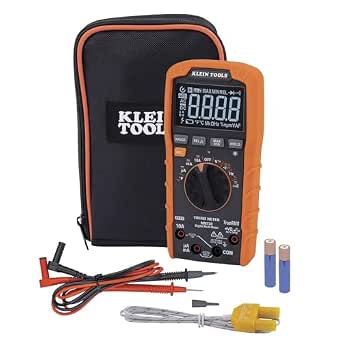 | Best for Higher-Voltage and Ghost-Voltage Checks | Voltage measurement: Up to 1000V AC/DC | Current measurement: Up to 10A AC/DC | Maximum resistance: 60 MΩ | VIEW LATEST PRICE | See Our Full Breakdown |
| digital multimeter for electrician | Weight |
|---|---|
| Fluke 117 Digital Multimeter | 689 g |
| Fluke 117/323 Multimeter and C | 550 g |
| Fluke 15B+ Digital Multimeter | 460 g |
| Klein Tools MM320KIT Digital M | 1.6 lb |
| Klein Tools MM325 Manual-Rangi | 13.92 oz |
| Klein Tools MM420 Auto-Ranging | — |
| AstroAI True RMS 6000-Count Au | 492 g |
| Fluke 17B+ Digital Multimeter | 470 g |
| FNIRSI DMT-99 Digital Multimet | 6.72 ounces |
| Klein Tools MM720 Digital Mult | 345 g |
More Details on Our Top Picks
Fluke 117 Digital Multimeter
I’d put the Fluke 117 first for electricians who want one meter ready for routine commercial troubleshooting. Its VoltAlert non-contact detection speeds up initial voltage checks, while AutoVolt selects AC or DC and LoZ helps reject misleading ghost-voltage readings. True RMS measurement is useful around non-linear loads, where an average-responding meter may give less reliable results. Compared with the Fluke 15B+, the 117 gives up the higher stated voltage ceiling but adds a more electrician-focused workflow, including non-contact detection and a bright backlight. That convenience comes with a narrower fit for buyers who need the 15B+’s listed 1000 V capability, and its functions may be more than basic home jobs require. I’d choose it for frequent field work, not occasional simple checks.
Pros:- VoltAlert non-contact voltage detection supports quick preliminary checks.
- True RMS readings suit measurement on non-linear loads.
- LoZ reduces false readings caused by ghost voltage.
- Large white LED backlight aids work in poorly lit panels.
Cons:- Its electrician-oriented features may be unnecessary for occasional household troubleshooting.
- Runs on alkaline batteries, which are not included.
Best for: Commercial and residential electricians who regularly troubleshoot energized circuits and value quick voltage checks, ghost-voltage rejection, and clear readings in dim work areas.
Not ideal for: Homeowners who only need occasional basic measurements, or electricians whose work requires a meter with a stated 1000 V maximum like the Fluke 15B+.
- Measurement type:True RMS digital multimeter
- Maximum operating voltage:600 V
- DC millivolts range:600.0 mV
- DC millivolts resolution:0.1 mV
- Functions:Resistance, continuity, frequency, capacitance, Min/Max/Average
- Battery life:400 hours typical
- Weight:689 g
- Dimensions:6.67 × 3.31 × 1.82 in
Our verdict“Choose the Fluke 117 for regular electrical troubleshooting where fast voltage checks and ghost-voltage rejection matter more than a 1000 V measurement ceiling.”
Fluke 117/323 Multimeter and Clamp Meter Combo Kit
The Fluke 117/323 kit suits electricians who often need both voltage readings and current measurements without opening a circuit. Its 117 multimeter handles voltage troubleshooting, while the 323 clamp meter measures AC current up to 400 A; the included case keeps the instruments and leads together between jobs. Compared with buying the Fluke 117 alone, this kit adds a practical way to check current at the conductor, making it more versatile for service calls. The tradeoff is bulk: carrying two instruments and a case is less convenient than bringing a single meter, and the 323’s stated current capacity is AC rather than a broad AC/DC current capability. I’d favor this set for electricians who routinely need clamp readings, but skip it if most jobs call for voltage and continuity checks only.
Pros:- Combines a true RMS multimeter with a clamp meter rated for 400 A AC.
- Low input impedance helps reduce false ghost-voltage readings.
- Includes test leads and a carrying case for organized transport.
- Covers more current-measurement tasks than the standalone Fluke 117.
Cons:- Two instruments and the case make the kit bulkier to carry than a single meter.
- The listed 400 A clamp measurement is AC current, not stated AC/DC current.
- Alkaline batteries may need replacement more often under heavy use.
Best for: Service and maintenance electricians who regularly measure AC current at conductors as well as troubleshoot voltage, and want both instruments stored in one case.
Not ideal for: Electricians seeking a lightweight single-meter kit or those who need clamp-based DC current measurement, which is not specified for the included 323.
- Included instruments:Fluke 117 multimeter and Fluke 323 clamp meter
- Clamp current capacity:400 A AC
- Measurement style:True RMS
- Included accessories:Test leads and soft carrying case
- Power source:Alkaline batteries
- Weight:550 g
- Dimensions:9 × 30.48 × 3.5 in
- Warranty:2 years on material and workmanship
Our verdict“Pick this kit over the standalone Fluke 117 if your field work regularly calls for clamp-based AC current readings as well as multimeter troubleshooting.”
Fluke 15B+ Digital Multimeter
The Fluke 15B+ is a straightforward choice for electricians who need the listed 1000 V AC/DC range and a useful spread of everyday troubleshooting functions. It measures current up to 10 A and covers resistance, continuity, capacitance, and diode testing, so it can handle more than basic voltage checks. Its one-handed design is a practical advantage when a job calls for holding the meter while positioning leads, including with gloves. Compared with the Fluke 117, the 15B+ offers the higher stated voltage ceiling, while the 117 adds non-contact voltage detection, AutoVolt, and LoZ features aimed at faster electrical work. The 15B+ is the better fit when its range and core functions take priority; it is less compelling if quick non-contact checks or ghost-voltage suppression are central to your routine.
Pros:- Measures AC/DC voltage up to 1000 V and current up to 10 A.
- Includes resistance, continuity, capacitance, and diode testing.
- Designed for one-handed operation, including while wearing gloves.
- Includes TL75 test leads and lists multiple safety certifications.
Cons:- Does not list the Fluke 117’s non-contact voltage detection or AutoVolt features.
- No battery-life figure or included battery information is supplied in the product data.
Best for: Electricians who need a compact, one-handed meter with a stated 1000 V AC/DC range and common continuity, capacitance, and diode checks.
Not ideal for: Electricians who want non-contact voltage detection, automatic AC/DC selection, or LoZ ghost-voltage handling; those features are listed for the Fluke 117 instead.
- Maximum voltage:1000 V
- Maximum current:10 A
- Measurement functions:AC/DC voltage and current, resistance, continuity, capacitance, diode testing
- Included components:15B+ multimeter and TL75 test leads
- Power source:Battery powered
- Weight:460 g
- Dimensions:8.46 × 2.76 × 5.91 in
Our verdict“Choose the 15B+ when its 1000 V range and glove-friendly one-handed handling matter more than the Fluke 117’s electrician-focused detection features.”
Klein Tools MM320KIT Digital Multimeter Electrical Test Kit
The Klein Tools MM320KIT is built around coverage rather than a single standout meter: it pairs a multimeter with a non-contact voltage tester, a voltage tester, and a GFCI receptacle tester. That mix is useful for residential electricians checking outlets, spotting common wiring faults, and making preliminary voltage checks without assembling separate tools. The included RT210 receptacle tester can identify problems such as open ground and reverse polarity, a task the standalone Klein MM325 does not cover by itself. In exchange, this kit is heavier and less streamlined than carrying one meter, and the listed MM320 resistance range is only 2 ohm, limiting its usefulness for broader resistance troubleshooting. I’d choose it for outlet-focused service work, but not as the strongest single-meter option for varied electrical diagnostics.
Pros:- Includes a multimeter, non-contact voltage tester, voltage tester, and GFCI receptacle tester.
- RT210 checks for common outlet wiring faults, including open ground and reverse polarity.
- NCVT-3P includes a flashlight for dim work areas.
- Padded pouch and batteries are included.
Cons:- The MM320’s listed resistance range is limited to 2 ohm.
- At 1.6 pounds, the full kit is heavier than carrying a single meter.
- Multiple testers add bulk for electricians who mainly need general-purpose measurements.
Best for: Residential electricians and inspectors who regularly check receptacles, GFCI wiring, and voltage, and prefer a ready-to-carry set of complementary testers.
Not ideal for: Electricians who need one lightweight multimeter for varied resistance troubleshooting or who want a more capable standalone meter like the Fluke 117.
- Included tools:MM320 multimeter, NCVT-3P non-contact tester, ET45 voltage tester, RT210 GFCI receptacle tester
- MM320 voltage range:Up to 600 V AC/DC
- MM320 current range:10 A DC
- MM320 resistance range:2 ohm
- NCVT-3P detection range:12–1000 V AC / 70–1000 V AC
- ET45 voltage range:28–240 V AC / 32–330 V DC
- Weight:1.6 lb
- Power source:Battery powered; batteries included
Our verdict“Choose this Klein kit for residential outlet and wiring checks where several specialized testers are more useful than a compact, all-purpose meter.”
Klein Tools MM325 Manual-Ranging Digital Multimeter
The Klein Tools MM325 covers core electrician tasks—voltage, DC current, resistance, continuity, diode, and battery tests—while adding practical handling touches. Its lead placement indicator LEDs help flag an incorrect setup before a measurement, and the kickstand and rear lead holders make bench or outlet work easier to organize. Unlike the auto-select workflow of the Fluke 117, this meter is manual-ranging, so the user must choose the range. That can suit electricians who prefer direct control, but it slows checks when the expected value is unknown. The listed current capability is DC only, another limitation beside more broadly equipped options. I’d treat the MM325 as a practical basic meter for deliberate troubleshooting, not the best choice for fast-paced work that benefits from automatic ranging or AC current measurement.
Pros:- Measures AC/DC voltage up to 600 V and DC current up to 10 A.
- Lead placement indicator LEDs help guide proper test lead setup.
- Backlit display supports readings in dim locations.
- Kickstand and rear lead holders aid hands-free positioning and storage.
Cons:- Manual ranging requires the user to select a measurement range.
- The listed current measurement is DC; AC current capability is not specified.
- The listed maximum resistance of 2 MΩ may not suit every component-testing task.
Best for: Apprentices and electricians who want a basic, manually controlled meter for voltage, DC current, continuity, and component checks, with clear lead-placement cues.
Not ideal for: Electricians who need automatic ranging, AC current measurement, or a feature set geared toward rapid field troubleshooting like the Fluke 117.
- Ranging:Manual-ranging
- Maximum AC/DC voltage:600 V
- Maximum DC current:10 A
- Maximum resistance:2 MΩ
- Functions:Battery, diode, and continuity tests
- Display:Backlit LCD
- Weight:13.92 oz
- Dimensions:9.33 × 5.08 × 3.82 in
Our verdict“Choose the MM325 for basic, hands-on electrical checks if manual range selection and DC-only current measurement fit your work.”
Klein Tools MM420 Auto-Ranging TRMS Digital Multimeter
The Klein Tools MM420 is a versatile fit for electricians who want one meter for routine voltage and current checks plus temperature, capacitance, frequency, and duty-cycle readings. Its auto-ranging True RMS operation reduces setup steps and supports measurements on non-linear loads, while the lead-alert LEDs can help catch a misplaced probe before a reading. Compared with the Klein Tools MM720, the MM420 tops out at 600V rather than 1000V and lacks LoZ mode, so it is less suited to higher-voltage work or troubleshooting ghost voltage. It does, however, cover a wide range of everyday tasks and includes a thermocouple and a kickstand. The tradeoff is a relatively bulky body, and its 10A current ceiling limits use on higher-current circuits.
Pros:- Auto-ranging True RMS supports varied electrical measurements with fewer manual setup steps.
- Measures temperature, capacitance, frequency, and duty cycle in addition to voltage and current.
- Lead-alert LEDs, a backlit display, and a kickstand support practical field use.
- Rated to withstand drops up to 6.6 feet.
Cons:- 600V maximum is below the MM720’s 1000V rating.
- No LoZ mode for checking suspected ghost or stray voltage.
- Its listed dimensions and 14.56-ounce weight make it less compact than the FNIRSI DMT-99.
Best for: Electricians handling routine residential and light commercial troubleshooting who want broad measurement functions and temperature testing in one meter.
Not ideal for: Electricians who regularly work on circuits above 600V or need LoZ to sort out ghost voltages; the MM720 is a better fit for those tasks.
- Measurement type:Auto-ranging True RMS
- Maximum voltage:600V AC/DC
- Maximum current:10A AC/DC
- Maximum resistance:50 MΩ
- Additional measurements:Temperature, capacitance, frequency, and duty cycle
- Tests:Continuity and diodes
- Display:Backlit LCD
- Power:2 AAA batteries
Our verdict“Choose the MM420 for broad everyday electrical troubleshooting and built-in temperature measurement, but choose the MM720 for higher-voltage work or LoZ testing.”
AstroAI True RMS 6000-Count Auto-Ranging Digital Multimeter
The AstroAI True RMS 6000-Count packs a broad set of functions into a meter suited to electricians who want voltage, current, resistance, capacitance, frequency, duty cycle, temperature, diode, and continuity readings. Auto-ranging and True RMS reduce manual range selection and help with non-linear loads; data hold and a kickstand are useful when a display is hard to watch while probing. Compared with the Fluke 17B+, the AstroAI lists a higher maximum operating voltage of 1000V DC, but the supplied details do not state a CAT safety rating, so I would not treat that voltage figure as a substitute for verified installation-category suitability. Ceramic-fuse overload protection is a useful safeguard, though the test-lead caps must be removed before use. Inconsistent temperature limits in the product information also make that function harder to judge for field work.
Pros:- Combines True RMS and auto-ranging with a broad set of electrical measurements.
- Backlit display, data hold, and kickstand support readings in varied work positions.
- Ceramic fuses provide overload protection.
- Includes a battery, test leads, and a multi-function socket.
Cons:- The supplied product details do not specify a CAT safety rating.
- Temperature limits are listed inconsistently in the product information.
- Test-lead caps need to be removed before use.
Best for: Budget-conscious electricians and maintenance technicians who need a wide range of measurement functions for general troubleshooting and can verify the meter’s safety suitability for each job.
Not ideal for: Electricians who need a clearly stated CAT safety rating or dependable published temperature limits before choosing a meter for professional field measurements.
- Display count:6000
- Measurement functions:AC/DC voltage and current, resistance, capacitance, frequency, duty cycle, temperature, diode, and continuity
- Maximum operating voltage:1000V DC
- Measurement technology:True RMS and auto-ranging
- Protection:Overload protection with ceramic fuses
- Power:9V 6F22 battery
- Weight:492 g
- Included components:Battery, test leads, multi-function socket, and user manual
Our verdict“Pick the AstroAI for broad functions and practical display aids, but favor the Fluke 17B+ when a stated CAT III 600V rating matters to your work.”
Fluke 17B+ Digital Multimeter
The Fluke 17B+ stands out for electricians who want a clearly stated CAT III 600V safety rating alongside voltage, current, resistance, continuity, capacitance, frequency, duty-cycle, and temperature functions. Its included TL75 leads and K-type thermocouple make the package ready for varied troubleshooting tasks, and temperature readings extend to 400°C. Compared with the AstroAI 6000-Count, the Fluke provides a stated CAT category in the supplied specifications, while the AstroAI advertises a 1000V DC operating maximum without a listed CAT rating. The 17B+ is not the strongest option for every electrician: the product data does not specify True RMS or auto-ranging, and its current limit is 10A. That makes it a more straightforward choice for general electrical work than for buyers seeking advanced measurement behavior or higher-current testing.
Pros:- CAT III 600V safety rating is stated in the product details.
- Measures voltage, current, resistance, continuity, capacitance, frequency, and duty cycle.
- Includes TL75 test leads and a K-type thermocouple.
- Measures temperature up to 400°C.
Cons:- Temperature measurement is limited to 400°C.
- Maximum current measurement is 10A.
- The supplied specifications do not state True RMS or auto-ranging capability.
Best for: Electricians who prioritize a clearly specified CAT III 600V rating, included temperature probe, and a familiar set of general troubleshooting functions.
Not ideal for: Electricians who specifically need confirmed True RMS or auto-ranging operation, or who regularly measure current above 10A.
- Voltage range:100–1000 V
- Maximum current:10 A
- Temperature range:Up to 400°C
- Additional measurements:Resistance, continuity, capacitance, frequency, and duty cycle
- Included leads:TL75 test leads
- Included temperature probe:K-type thermocouple assembly
- Weight:470 g
Our verdict“Choose the Fluke 17B+ if a stated CAT III 600V rating and included temperature accessories matter more than confirmed True RMS or auto-ranging features.”
FNIRSI DMT-99 Digital Multimeter 9999 Counts TRMS
The FNIRSI DMT-99 is the compact specialist in this group, aimed more at electronics repair and automotive diagnostics than at being a conventional electrician’s primary meter. Its 9999-count color display, smart identification for voltage, resistance, and continuity, and waveform visualization can make small changes or fluctuations easier to inspect. At 6.72 ounces, it is far lighter than the Klein Tools MM420, and USB-C rechargeable power avoids routine battery swaps. Its fine test leads also suit tight circuits better than a typical general-purpose setup. The tradeoff is fit: the listed functions do not include temperature or duty cycle, both available on the MM420, and the product information gives no voltage limits or CAT safety rating. I would treat it as a secondary diagnostic tool, not assume it is suitable for every electrician’s installation work.
Pros:- 9999-count True RMS readings are paired with a 2.4-inch color screen.
- Smart identification and waveform visualization support detailed electronics troubleshooting.
- Rechargeable 1500mAh battery uses Type-C charging.
- Ultra-fine test leads suit tight circuits and small components.
Cons:- The supplied specifications do not list voltage limits or a CAT safety rating.
- Temperature and duty-cycle measurement are not listed.
- Its electronics-focused functions are less directly suited to general electrician field work than the Klein MM420.
Best for: Electronics repair technicians and automotive diagnosticians who value a compact meter, fine probes, rechargeable power, and visual waveform information.
Not ideal for: Electricians seeking a clearly specified CAT-rated meter for installation work or a single tool that also measures temperature and duty cycle.
- Display:2.4-inch HD TFT color screen
- Counts:9999
- Measurement technology:True RMS
- Measurements:AC/DC voltage, current, resistance, continuity, NCV, frequency, diode, and capacitance
- Battery:1500mAh rechargeable lithium battery
- Charging:Type-C
- Safety features:Dual ceramic fuses and anti-burn protection
- Weight:6.72 ounces
Our verdict“Choose the DMT-99 as a compact secondary tool for electronics or automotive diagnostics, not as a substitute for a meter with clearly stated installation safety ratings.”
Klein Tools MM720 Digital Multimeter, Auto-Ranging TRMS with Low Impedance (LoZ)
The Klein Tools MM720 is the most capable electrician-focused option here for higher-voltage checks and suspected ghost voltage. It combines 1000V AC/DC measurement with auto-ranging True RMS and LoZ mode, which can help distinguish an actual energized circuit from stray voltage that a high-impedance meter may display. That gives it a practical advantage over the MM420, which is limited to 600V and does not list LoZ. The reverse-contrast LCD is designed for visibility across lighting conditions, and the meter also covers temperature, capacitance, frequency, and diode testing. Its boundaries matter: current measurement remains capped at 10A, and the magnetic hanger is compatible but sold separately. At 345g, it is also less light than the FNIRSI DMT-99, though the two serve very different work needs.
Pros:- 1000V AC/DC measurement exceeds the MM420’s 600V maximum.
- LoZ mode helps identify ghost or stray voltage.
- Auto-ranging True RMS supports measurements on non-linear loads.
- Reverse-contrast LCD and temperature, capacitance, and frequency functions suit varied field tasks.
Cons:- Current measurement is limited to 10A AC/DC.
- Magnetic hanger is compatible but sold separately.
- At 345g, it is heavier than the compact FNIRSI DMT-99.
Best for: Electricians troubleshooting circuits up to 1000V who want True RMS readings, LoZ checks for suspected ghost voltage, and a high-visibility display.
Not ideal for: Buyers who need a lighter electronics-focused meter, regularly measure more than 10A, or expect a magnetic hanger to come in the package.
- Voltage measurement:Up to 1000V AC/DC
- Current measurement:Up to 10A AC/DC
- Maximum resistance:60 MΩ
- Measurement technology:Auto-ranging True RMS
- Additional mode:Low Impedance (LoZ)
- Additional measurements:Temperature, capacitance, frequency, and diode testing
- Display:Reverse-contrast LCD
- Weight:345 g
Our verdict“Choose the MM720 for higher-voltage electrician work and LoZ troubleshooting, provided its 10A current limit and separately sold magnetic hanger fit your needs.”

How We Picked
I ranked these meters around the needs of electricians: useful measurement functions for electrical troubleshooting, clear operation under routine job conditions, and practical differences such as clamp-current capability, auto-ranging, True RMS, LoZ, and included accessories. Safety ratings and suitability for the circuits a buyer works on deserve particular attention; a feature list cannot replace checking the exact rating and instructions for the meter and leads.
The Fluke 117 ranks first because its combination of electrician-focused functions supports a broad range of everyday checks without requiring a separate clamp meter. The combo kit ranks next for buyers who need clamp current measurement, while Klein’s MM720 and MM420 offer strong alternatives for those prioritizing LoZ or True RMS features. More basic, manual-ranging, kit-oriented, and display-focused models rank according to their narrower advantages and the tradeoffs buyers should accept. I do not treat brand, count display, or feature quantity alone as proof of better performance.
Factors to Consider When Choosing Best Digital Multimeter For Electricians
Before choosing a meter, I would match its capabilities to the circuits and measurements you handle most, then check that its safety category and accessories fit those jobs. A long feature list is less useful than a meter you can operate correctly and safely in the conditions you face.
Match the Safety Rating to the Work
Start with the meter’s stated CAT rating and voltage limits, and check that the test leads carry appropriate ratings too. Electrical work can involve transient surges that ordinary voltage-range figures do not describe, so selecting only by the maximum displayed voltage can be a mistake. Match the rating to the measurement point and the installation, following applicable workplace rules and the manufacturer’s guidance. Do not assume that a familiar brand or a higher count display makes a meter safe for every circuit. If your work spans different environments, choose for the most demanding measurement you actually perform rather than the easiest one. Replace damaged leads and keep the meter and probes within their stated limits.
Decide Whether You Need a Clamp Meter
A clamp meter measures current around a conductor, which can help when opening a circuit is impractical or undesirable. That makes the 117/323 combo’s clamp capability a meaningful distinction, not just an accessory bundled with a multimeter. A standalone meter may be easier to carry when voltage, resistance, and continuity checks dominate your day. Before buying a combo, confirm the clamp’s current type and range fit the loads you expect to measure; clamp models do not all cover the same tasks. Also consider whether your work allows safe access to a single conductor, since clamping around multiple conductors can produce an unusable reading. Choose the combo for a real current-measurement need, not simply because it has more pieces.
Choose Auto-Ranging and True RMS for Your Work
Auto-ranging can save repeated dial changes when you move between unknown measurements, while manual ranging gives direct control and may suit familiar, repeatable checks. Neither setting style makes a meter accurate by itself, so compare specifications and usability instead of treating automation as a quality guarantee. True RMS can matter when measuring signals that are not clean sine waves, including some loads controlled by electronic equipment. For routine measurements on conventional circuits, the need may be less frequent than the feature list suggests. Ask which signals you encounter and whether the meter’s stated bandwidth and accuracy cover them. Avoid choosing on the words “True RMS” alone if the instrument’s ratings and functions do not match your work.
Know When LoZ Helps—and When It Does Not
A low-impedance mode can help distinguish a real voltage from a ghost reading caused by capacitive coupling on an unenergized conductor. That can make the Fluke 117 and Klein MM720 appealing for troubleshooting, but LoZ is not a replacement for a proper voltage test or safe isolation procedure. Because the mode can load a circuit, use it only as the manufacturer directs and where it is appropriate for the connected equipment. Buyers who rarely encounter misleading induced voltage may gain more from a clamp meter or simpler controls. Check whether the mode is available on the meter you are comparing rather than assuming every electrician-oriented model includes it. Treat it as a targeted troubleshooting tool, not an all-purpose safety feature.
Factor in Leads, Accessories, and Daily Carry
The included test leads, case, and hanging options affect how ready a meter is for daily work, but bundles should be judged by what you will actually use. A kit can save the trouble of sourcing compatible basics, while extra components add bulk if they stay in the case. Inspect lead ratings, probe condition, and compatibility before relying on bundled accessories for a specific job. Think about where the meter will sit during measurements: a case or strap may be more useful on a ladder or in a crowded panel than another measurement feature. Also check battery access and the manufacturer’s maintenance instructions, since routine upkeep affects job readiness. Do not trade away suitable safety ratings to get a more complete-looking kit.
Pay for Capabilities You Will Use
When deciding whether to move up from a basic meter, identify the tasks that currently slow you down or require borrowing another instrument. Paying more can make sense for LoZ, clamp current measurement, or broader measurement capability if those features appear regularly in your work. A high-count display or extra modes may matter less if your typical checks are straightforward voltage and continuity readings. Conversely, choosing the least complex option can create a second purchase when your work expands. Compare each model’s documented functions, safety ratings, included equipment, and operating style against your actual job list. The best fit is the one that covers your needs without adding controls or kit you will rarely use.
Frequently Asked Questions
Is the Fluke 117/323 combo a better choice than the Fluke 117 by itself?
I would choose the combo when clamp-based current readings are part of your regular work and you want that capability alongside a multimeter. The standalone 117 is a simpler carry when you mainly need voltage, continuity, resistance, and its electrician-focused troubleshooting functions. The combo also brings extra gear, so it can take more space and may be unnecessary if you rarely measure current. Check the 323’s measurement capabilities and limits against the loads you handle. Neither option replaces checking instrument ratings and using safe measurement procedures.
Do I need a True RMS meter for residential electrical work?
Not every residential measurement calls for True RMS, but it can be useful when you encounter non-sinusoidal waveforms from electronic or variable-speed equipment. The lineup includes True RMS options at different feature levels, including the Klein MM420, MM720, AstroAI, and FNIRSI DMT-99. That means the decision need not be based on True RMS alone; compare safety ratings, LoZ, clamp needs, and ease of use too. Check the meter’s documentation for the signal conditions its True RMS readings cover. If your work is limited to conventional measurements, another feature may have more day-to-day value.
Should I buy a manual-ranging meter or an auto-ranging meter?
Auto-ranging is convenient when the value is unknown or measurements change often, since the meter selects a suitable range for you. Manual ranging can be a good match for electricians who repeat familiar checks and want to set the range directly, as with the Klein MM325. The tradeoff is speed and simplicity versus direct control; neither choice guarantees a more reliable reading. Think about who will use the instrument and how quickly they need to move between measurements. If several people share a meter, a straightforward interface may matter more than a preference for manual control.
Can I use LoZ mode as proof that a circuit is safe?
No. LoZ helps investigate ghost voltage by loading the circuit, but it is not a substitute for approved safe-work practices, suitable instruments, or the procedure your workplace requires. Use the mode only within the meter’s instructions, since its low input impedance can affect connected circuits. Verify the meter and leads are rated for the measurement point, and follow the required process for confirming absence of voltage. If you are unsure whether LoZ is appropriate for connected equipment, use the manufacturer’s guidance or qualified workplace procedures. A meter feature alone cannot establish that a circuit is safe to touch.
What should I check before buying a less familiar brand such as AstroAI or FNIRSI?
Look past the feature list and verify the exact CAT and voltage ratings for the meter and supplied leads, along with accuracy specifications and supported measurement functions. Confirm that the manual explains operation, limits, and maintenance clearly enough for the work you plan to do. True RMS and a high-count display do not establish suitability for electrical installation work by themselves. Consider whether replacement leads and other support are available for the model. If documentation or ratings do not answer your safety questions, choose a meter whose specifications you can verify before using it on the intended circuit.
Conclusion
For a single meter suited to a broad mix of electrician tasks, I would pick the Fluke 117 as best overall. The best value choice depends on which functions you need: the Klein MM325 fits buyers who want manual range control, while the MM320KIT appeals to someone who prefers a bundled test setup. For a best premium, clamp-focused option, choose the Fluke 117/323 combo if current measurement is part of the job; among standalone advanced picks, the Klein MM720 adds True RMS and LoZ. The best option for beginners is an auto-ranging model with clear documentation and appropriate ratings, such as the Klein MM420, rather than a meter chosen by display count alone. For specific needs, consider the MM720 for LoZ, the combo for clamp current, or the MM320KIT for included test gear—and verify ratings against your work before deciding.
Fall yard work Picks
leaf blowers
As an affiliate, we earn on qualifying purchases.