
TL;DR

Get business pricing on tools and workshop supplies
- Business-only prices and quantity discounts
- Tax-exempt purchasing
- Multiple users, one account, clear invoices
Rechargeable headlamps are hands-free lights worn on the head, leaving both hands available for tasks like wiring, repair, and inspections. For all-night jobsite work, judge them by sustained runtime at the mode you actually use, battery-swap or charge-while-working options, beam shape, comfort over 10+ hours, and jobsite-rated durability — not by advertised lumen peaks.
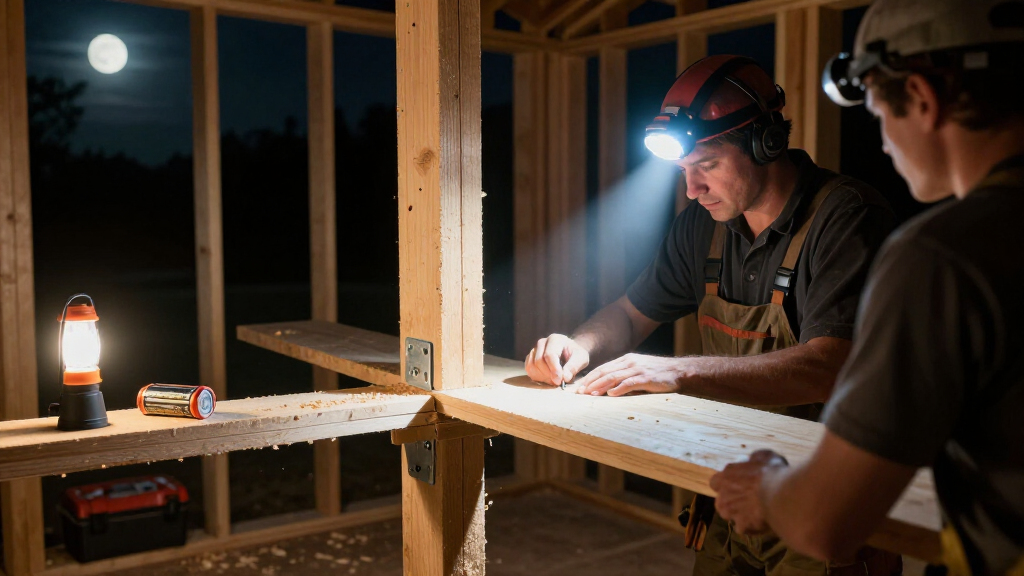
It’s 2 a.m. on a concrete pour that can’t stop, and your headlamp starts dimming to a dull yellow glow. That’s not an inconvenience — that’s a stop-work event. The crew stands around, the schedule slips, and someone’s fishing for AA batteries in a truck cab by feel.
Rechargeable headlamps are hands-free lights worn on the head, leaving both hands available for tasks — wiring, equipment repair, inspections, confined-space work. For overnight jobs, only three questions matter: can the lamp hold useful light for the whole shift, can it take the abuse of a jobsite, and can you recharge or swap power without shutting the work down.
This guide covers what to check before you spend crew budget on a rack of rechargeable headlamps for night jobsite tasks. No brand fluff. Just the specs and habits that keep a night crew lit until sunup.
Advertised runtime is measured on the lowest mode — verify runtime at your actual working brightness and derate 20-30% for cold, heat, and battery age.
Removable battery packs or hybrid rechargeable/disposable models keep an all-night shift moving; built-in batteries only work if the lamp runs while charging.
Beam shape beats lumens: flood for close work, spot for distance, and a low mode for labels and coworker courtesy.
IP ratings cover dust and water only — never impact resistance, and never hazardous-location approval. Match certification to the environment.
Test one lamp on one worker for a full shift before buying for the crew; comfort failures don’t show up in an hour.
Rechargeable Headlamps for All-Night Jobsite Tasks
It’s 2 a.m. on a concrete pour that can’t stop, and your headlamp dims to a dull yellow glow. That’s not an inconvenience — that’s a stop-work event. Judge headlamps by sustained runtime at the mode you actually use, battery-swap options, beam shape, comfort over 10+ hours, and jobsite-rated durability — not advertised lumen peaks.
Why Runtime Numbers Lie
Manufacturers quote the maximum runtime figure — almost always measured on the lowest mode. Crank the lamp to the setting you actually need, and runtime collapses. The same lamp, three different realities:
Identify working mode
Not the 30-second boost — the steady setting you’d run for hours. The whole shift hangs on it.
Find the runtime curve
Look for output-over-time graphs, not a single box number. The curve’s shape reveals your warning time.
Check step-down behavior
Gradual fade gives warning; regulated output cuts off abruptly at the worst possible moment.
Derate for conditions
Knock off 20–30% for cold, heat, or an aging battery. Capacity fades with every charge cycle.
Plan a buffer
Ten-hour shift? Buy proven runtime of twelve. The cost of being wrong is a stopped pour.
Built-In vs. Removable Batteries
For all-night work, the battery question is simple: when the light dies, how fast are you back to work? USB-C is now the crew standard — one cable across lights, radios, and phones. But don’t assume USB-C means run-while-charging: some lamps lock out the light to protect the charging circuit. Check before you buy.
A lithium-ion cell is good for a few hundred cycles. When it dies, the whole lamp is scrap — even if the LED and housing are fine. Removable-pack lamps amortize better over years of crew use.
Hybrid models accept both rechargeable cells and disposables. When the rechargeable runs flat at 2 a.m., a handful of AAs from the truck saves the shift — a fuel-based fallback power system.
What Keeps a Shift Moving
The side-by-side tradeoff between sealed-in simplicity and swap-in survivability:
| Factor | Built-In Battery | Removable Pack |
|---|---|---|
| Upfront cost | Lower | Higher — spares add cost |
| Mid-shift recovery | Only if it charges while running | Swap in seconds |
| End-of-life | Lamp dies with the battery | Lamp lives on with new packs |
| Loss / damage risk | None — nothing to misplace | Packs get left on chargers |
| Best for | Short tasks, planned charging | All-night shifts, cold weather |
Beam Shape Beats Lumens
Lumens describe total output; beam shape and distance determine whether that light is useful for the task. Match the beam to the work:
10+ Hour Wear Test
Weight, balance, strap adjustment, and helmet compatibility matter over a full shift. A heavy front-mounted battery gets tiring — rear-mounted or separate designs help. Comfort failures don’t show up in an hour; test one lamp, one worker, one shift.
Read the Rating Right
IP ratings cover dust and water only — never impact resistance, and never hazardous-location approval. Seals wear and can be compromised if the lamp is damaged. Match certification to the environment; an ordinary headlamp is not safe in explosive atmospheres.
Gloves & Glare
Large, easy-to-find buttons for gloved hands. A low mode preserves battery and reduces glare when reading labels or working close-up. Red light helps preserve dark adaptation but is no substitute for a proper white work beam. Aim down when talking to coworkers.
The All-Night Power Chain
ForemanBrief’s staging rule for crews running night tasks every week:
Buy for sustained output, not peak lumens. A steady 300 lumens for ten hours beats a 1,200-lumen flash that fades by midnight — because the work doesn’t care how bright the lamp was at the start, only whether it’s still lighting the task when you need it.
Why Runtime Numbers Lie — and How to Read Them Right
Rechargeable headlamps rarely deliver their advertised runtime at the brightness you actually work at. Manufacturers quote the maximum runtime figure, which is almost always measured on the lowest mode. Crank a lamp to its high setting — the one you need to see conduit runs across a dark slab — and runtime can drop by 70% or more. The reason is simple physics: brightness scales roughly with power draw, so a lamp pulling four times the current empties its battery in a quarter of the time. That means the headline number on the box is describing a mode you’ll never use for real work.
Worse, many rechargeable headlamps are built with unregulated output. The lamp starts bright, then fades steadily as the battery empties. Why this matters goes beyond annoyance: your eyes partially adapt to the decline, so you don’t notice how dim things have gotten until you’re misreading wire colors or missing defects. Others are regulated and hold full brightness, then cut off abruptly — which trades slow degradation for a hard stoppage at the worst possible moment. Neither approach is wrong, but they demand different backup plans: with a fading lamp you get warning, with a regulated one you don’t. Some models also step down output when the housing heats up, which happens fast in summer or inside a confined space with no airflow — a self-protection behavior that quietly shortens your effective runtime even when the battery is full.
Cold is the silent killer. Lithium-ion batteries lose meaningful capacity below freezing because their internal chemistry slows, so a lamp that runs 8 hours in the shop might give you 5 on a January night shift in the upper Midwest. This is why mid-winter purchases should be sized against cold-weather performance, not lab specs.
Here’s how to size runtime honestly:
- Identify your working mode. Not the boost mode you tap for 30 seconds. The steady setting you’d run for hours — this is the number your whole shift hangs on.
- Find the runtime curve at that mode. Look for test graphs or reviews showing output over time, not a single number on the box. The shape of the curve tells you whether you’ll get warning before failure.
- Check for step-down behavior. Does output hold flat and fall off a cliff, or fade gradually? Neither is wrong — but you need to know which you’re getting, because it determines whether your backup plan is proactive or reactive.
- Derate for conditions. Knock 20-30% off for cold, heat, or an aging battery. Batteries also lose capacity with every charge cycle, so a lamp that made it through last winter’s shifts may not make it through this one.
- Plan a buffer. If the shift is 10 hours, you want proven runtime of 12 — because the cost of being wrong isn’t a dim light, it’s a stopped pour and a crew standing around on the clock.
A runtime figure is meaningless without the brightness mode and test conditions attached to it. A “40-hour” headlamp on low is a 3-hour headlamp on high.
ForemanBrief’s rule of thumb: buy for sustained output, not peak lumens. A steady 300 lumens for ten hours beats a 1,200-lumen flash that fades by midnight — because the work doesn’t care how bright the lamp was at the start, only whether it’s still lighting the task when you need it.
Built-In vs. Removable Batteries: What Keeps a Shift Moving
For all-night work, the battery question is simple: when the light dies, how fast are you back to work? Built-in batteries charge easily and never get lost, but when they’re empty, the lamp is a paperweight until it’s plugged in. That’s the core tradeoff: built-ins trade shift-survivability for simplicity and lower cost, which is fine for a homeowner and wrong for a night crew. Removable battery packs cost more up front and need compatible spares, but a dead lamp becomes a 30-second fix — and on a jobsite, 30 seconds of downtime versus two hours of charging is the difference between keeping and losing the night.
USB-C has become the standard charging port on newer models, which is genuinely useful — one cable standard across the crew’s lights, radios, and phones means fewer chargers in the gang box and fewer excuses for a dead battery. But don’t assume USB-C means you can work while charging. Some rechargeable headlamps support run-while-charging from a power bank in a pocket; others lock out the light entirely, usually to protect the charging circuit or prevent overheating. Check before you buy, and check the full charge time too. A lamp that takes six hours to refill is useless on a 30-minute lunch break — which means its real recovery window is overnight, not mid-shift.
| Factor | Built-In Battery | Removable Pack |
|---|---|---|
| Upfront cost | Lower | Higher (spares add cost) |
| Mid-shift recovery | Only if it charges while running | Swap in seconds |
| End-of-life | Lamp dies with the battery | Lamp lives on with new packs |
| Loss/damage risk | None — nothing to misplace | Packs get left on chargers |
| Best for | Short tasks, planned charging | All-night shifts, cold weather |
Notice the end-of-life row — it’s the hidden cost of built-ins. A lithium-ion cell is good for a few hundred charge cycles before capacity falls off, and when it dies, the whole lamp is scrap even if the LED and housing are fine. Removable-pack lamps amortize better over years of crew use, which is why the higher sticker price often wins on total cost of ownership.
Hybrid models that accept both rechargeable cells and disposable batteries are the quiet winner here. When the rechargeable runs flat at 2 a.m., a handful of AAs from the truck saves the shift — effectively giving you a second, fuel-based power system as a fallback. For a crew running night jobsite tasks every week, ForemanBrief recommends one charged pack per lamp per shift, staged in the gang box, plus a written charging routine — same discipline as radio batteries. The routine matters because battery programs fail on process, not hardware: a pack that’s always charged when needed is a management achievement, not a product feature.
Lumens Don’t Light Your Work — Beam Shape Does
Lumens measure total light output, full stop. They say nothing about where that light goes. Beam shape and distance determine whether a lamp is useful for your task, and a broad flood beam at 300 lumens can outperform a tight 800-lumen spot for close work. Here’s why: lumens concentrated into a narrow cone put a blinding hot spot on a two-inch circle and leave everything else in shadow, while the same light spread evenly across your field of view actually raises the illumination where your hands and eyes are working. Marketing lumen counts are easy to print; useful beam engineering is what you’re actually paying for.
Think about the two jobs you actually do at night. Pulling wire in a panel? You need a flood beam — wide, even light at arm’s length, with a hot spot that doesn’t blow out white when you look at a label six inches away. Overdriven close work doesn’t just cause glare; it destroys contrast, which is exactly what you need to read wire markings or spot hairline cracks. Walking a site perimeter or checking grade stakes 100 feet out? You need a spot beam that throws, because light intensity falls off with the square of distance — reaching twice as far takes four times the concentrated output. The best rechargeable headlamps are the ones that offer both, separately or blended, so one lamp covers close-in work and distance checks without a crew member carrying two lights.
Also check whether the lamp pivots. A fixed beam forces you to crane your neck to aim light at your boots or a ceiling fixture. A ratcheting tilt lets you park the beam where the work is and keep your spine neutral — which matters more than it sounds by hour nine, when sustained awkward neck angles graduate from discomfort to genuine fatigue and, over months, to injury.
Practical guidance by task:
- Close inspection, wiring, panel work: flood-dominant beam, 200-400 lumens, plus a low mode for reading labels without glare. More output here actively hurts — it washes out detail and blinds you when it reflects off shiny surfaces.
- General site movement: mixed flood/spot, 400-600 lumens — enough throw to spot trip hazards ahead, enough spread to see your footing.
- Long-distance checks: spot-dominant beam; this is where higher output earns its keep, because distance is the only job that genuinely needs it.
- Shared spaces: drop to low mode — your coworkers will thank you, and you’ll stop nuking your own night vision every time someone else’s beam crosses you.
A low mode is not a gimmick. It stretches battery life dramatically — often multiplying runtime several-fold — kills the glare that blinds the guy holding the other end of the pipe, and lets eyes readjust after looking away. Red-light modes have a narrow use — preserving dark adaptation when you step away from task lighting — but they’re no substitute for a proper white work beam, because red light renders color poorly and makes wire-color identification unreliable.
Comfort on Hour Ten: Weight, Straps, and Helmet Fit
A headlamp that feels fine in the parking lot can become a torture device by hour ten. What matters overnight is weight, balance, and pressure points — and the biggest comfort killer is a heavy battery hanging off the front of your forehead. The parking-lamp-lot test fails because discomfort on a headlamp is cumulative: nothing hurts at minute five, and everything hurts at hour nine. That’s why a five-minute store trial tells you almost nothing about shift-long performance.
Front-heavy lamps make your neck do constant micro-corrections. Over a full shift, that turns into the kind of headache that makes a person sloppy — and sloppy is the last thing you want around live circuits or open edges. The tradeoff is real: front-mounted batteries keep everything in one tidy unit with no cables to snag, while rear-mounted or pocket-mounted packs distribute weight but add a cord that can catch on rebar or get pinched. Better designs move the battery to the rear of the strap or separate it into a pocket-mounted pack, splitting the weight across the head instead of cantilevering it off your brow — and putting mass over the rear of the skull, where the neck muscles are far better equipped to carry it.
Helmets change everything. Many rechargeable headlamps are designed for hard hat compatibility with clips or strap kits, but fit depends on your specific helmet, its accessory slots, and any required gear like face shields. The stakes go beyond comfort: if the lamp shifts the helmet’s position or interferes with its retention system, you’ve degraded the one piece of PPE most likely to save someone’s life. Confirm compatibility and follow the helmet manufacturer’s guidance — a lamp that compromises your hard hat’s fit or retention is a safety violation waiting to happen.
Check these before a full-shift commitment:
- Total weight and front/rear balance — under 6 ounces front-mounted is comfortable for most; heavier than that, look for rear battery placement, because neck strain scales with leverage, not just ounces.
- Strap material — sweat-soaked elastic stretches and loses grip, which means the lamp migrates all shift and you’re constantly re-aiming it; washable, replaceable straps win over the long haul.
- Glove-friendly controls — one big button you can find blind beats three small ones you can’t, because every fumbled mode change at 20 degrees means bare hands out of gloves.
- Lockout mode — prevents the lamp cooking itself to death in your tool bag, so the light works when you pull it out at shift start instead of arriving already dead.
Run a trial: have one worker wear the candidate lamp for a full shift before you buy a dozen. A ten-hour test tells you more than any spec sheet, because the failure modes that matter — hot spots, strap slip, neck fatigue — only appear at duration.
Durability Ratings Decoded: IP Numbers, Impacts, and Explosive Atmospheres
Jobsite headlamps live a hard life — dropped from scaffolds, sprayed with mud, rained on, stuffed in tool bags with sharp things. IP ratings tell you how well a lamp resists dust and water, and only that. An IP67 rating means tested protection against dust ingress and immersion under defined conditions. It tells you nothing about impact resistance, and it absolutely does not mean the lamp is approved for hazardous locations. This is the trap: a big “IP67” printed on the housing reads like a toughness badge, so crews assume it covers everything. It covers exactly one thing — and the gap between what buyers assume and what the rating certifies is where gear decisions go wrong.
That last point can kill someone. In a potentially explosive atmosphere — around fuel vapors, combustible dust, or in a classified area — equipment must carry the certification required for that specific environment. An ordinary headlamp, however tough, is not safe there, and the reason is invisible: a single electrical contact inside the switch or a hot LED driver can generate enough energy to ignite the right air-vapor mixture. The lamp can look and work identically to a certified one and still be a spark source. Check site rules and the applicable certification before use. No exceptions.
Also understand that seals wear. A lamp that shrugged off rain when new can leak at year two if the gaskets have hardened or the housing cracked from a drop — meaning an IP rating is a snapshot of the lamp as manufactured, not a permanent property. This is why inspection belongs in your routine rather than your purchase decision alone. Inspect seals and lenses as part of routine gear checks, and verify whether the battery, strap, and lens are user-replaceable. A lamp with available replacement parts is cheaper to own than a disposable one, even at a higher purchase price — the housing usually outlives the consumables by years, and being able to refresh them is the difference between a two-year and a six-year asset.
Quick durability checklist:
- Match the IP rating to real exposure — heavy rain and mud want IP66 or better, because pressurized spray and grit find weaknesses that still water doesn’t.
- Look for a stated drop-test rating (commonly 1-2 meters) separately from ingress protection — the two failure modes are unrelated, and jobsite drops are near-certain over a lamp’s life.
- Confirm hazardous-location certification if any work touches classified areas — this is a hard gate, not a preference.
- Inspect seals, straps, and charging contacts monthly; replace worn parts. Corroded charging contacts are the most common slow death of otherwise fine rechargeable lamps.
An IP rating is a pass/fail dust-and-water test under lab conditions. It is not a durability guarantee, and it is never a hazardous-area approval.
Crew Etiquette and Safety: Don’t Be the Guy Who Blinds Everyone
The fastest way to make enemies on a night crew is a headlamp beam at eye level. A high-output lamp pointed at someone’s face creates disabling glare — for a few seconds, they see nothing but the afterimage. Now imagine that guy is backing a pickup down your work zone. The underlying problem is that headlamps sit exactly at eye height and point wherever you look, so every social interaction becomes a potential flash event unless the habit exists to prevent it. Night vision takes ten-plus minutes to fully rebuild after a bright hit, which means one careless beam can quietly degrade a coworker’s ability to see hazards for the next quarter hour.
The fix is habit, not gear. Aim the beam at your work, not at people. When you walk up to talk to someone, drop your chin or click down to low mode. It takes a week to become automatic, and it changes the whole feel of a night crew — nobody’s flinching, nobody’s seeing spots. That cultural shift matters commercially too: crews that trust each other’s light discipline move faster and argue less, because people stop defensively watching for the next beam in their eyes instead of watching their work.
Glare toward traffic is a bigger deal. A headlamp at head height can read as a headlight to an approaching driver, hiding your body behind it — the silhouette effect makes you effectively invisible. That’s why hi-vis clothing is the answer for vehicle exposure, not brighter personal lights: retroreflective material identifies you as a person, while a bright point source identifies you as a vehicle. Use high-visibility clothing and properly placed area lighting for vehicle exposure, and let the headlamp do close work. For shared work zones, a battery-powered area light is almost always better than five headlamps pointed at the same pipe — one well-placed light lights everyone’s work, while five headlamps create five sets of shadows moving every time somebody turns their head.
Build these into the toolbox talk:
- Beam down when approaching coworkers or vehicles — it costs nothing and prevents the most common night-crew conflict.
- Low mode for conversation and label reading — full output is for tasks, not people.
- Task or area lighting for shared spaces and hazard exposure — distribute light where the work is instead of wearing it on five foreheads.
- Everyone carries or has access to a backup light — a dead lamp alone in the dark is a rescue, not an inconvenience, and rescue operations at night put more people at risk than the original task ever did.
And for electrical work specifically: headlamps leave both hands free, but they don’t replace lockout/tagout. The convenience of hands-free light can quietly encourage working de-energized-adjacent — seeing the panel clearly is not the same as confirming it’s dead. Kill the power, verify it’s dead, then work. The light shows you the panel; the procedure keeps you alive.
Frequently Asked Questions
Will a rechargeable headlamp last through an entire night shift?
Only if its runtime at your working mode covers the shift. Check the runtime spec for the brightness setting you’ll actually use, not the maximum runtime claim, and derate for cold weather. For long shifts, carry a spare battery pack, a second lamp, or use a model that charges during a break.
How many lumens do I need for jobsite work?
It depends on task distance and beam shape. Close inspection and panel work often need only 200-400 lumens of flood; distance checks need a spot beam and higher output. A useful, adjustable beam matters more than the highest lumen rating on the shelf.
Can I use a regular headlamp in a potentially explosive area?
No — only if it carries the certification required for that specific environment. IP ratings do not establish hazardous-location approval. Check site rules and the applicable certification before bringing any light into a classified area.
Is USB-C charging enough to keep working all night?
Not automatically. Confirm the lamp supports operation while charging, how long a full charge takes, and whether running a cable to a pocket power bank is practical for your task. Many lamps lock out the light while plugged in.
Are headlamps safe to wear with a hard hat?
Many are designed for helmet mounting, but fit depends on the specific helmet, clips, and strap system. Confirm compatibility and follow the helmet manufacturer’s guidance — a lamp that compromises hard hat fit or retention is a safety problem.
Should I choose a built-in or removable battery?
Built-in batteries are simple and cheap to charge but sideline the lamp when dead. Removable packs cost more and need compatible spares, but a swap takes seconds — which is why they’re the better choice for all-night shifts.
Conclusion
Buy the lamp that’s still bright at hour ten, not the one with the biggest number on the box. Check runtime at your working mode, plan a battery swap or charge strategy, and make beam-down etiquette part of the crew’s habits. Everything else is decoration.
The best night shift is the one where nobody thinks about their light once. Gear that disappears into the work — that’s the whole job.
Fall yard work Picks
leaf blowers
As an affiliate, we earn on qualifying purchases.