TL;DR

Get business pricing on tools and workshop supplies
- Business-only prices and quantity discounts
- Tax-exempt purchasing
- Multiple users, one account, clear invoices
The best two-way radios for jobsite communication depend on your site, not a flashy range number. Match VHF or UHF coverage to the environment, choose durable radios with loud audio and replaceable batteries, verify FCC requirements, and test every unit around concrete, steel, machinery, and required PPE before buying.
A radio that works perfectly in the parking lot can go silent behind a concrete stairwell. That gap between the advertised range and your crew’s real working range is where many jobsite communication plans fail.
The best two-way radios for jobsite communication give you instant group contact, hands-free options, and free communication without relying on cellular service. This guide shows you how to match radios to your site, noise level, crew size, safety plan, and budget.
You will learn which features matter, when VHF or UHF makes sense, how digital compares with analog, and how to run a practical full-shift test before you outfit the whole crew.
Test radios at the actual jobsite because concrete, steel, machinery, and underground areas can shrink advertised range to a few hundred feet.
Use VHF for many open outdoor operations and UHF for many indoor or urban environments, then confirm the choice with a site test.
Prioritize loud audio, glove-friendly controls, replaceable batteries, spare packs, and hearing-protection compatibility.
Verify FCC licensing, approved frequencies, digital protocols, and accessory compatibility before mixing radios or expanding a fleet.
Give every worker a simple channel plan, emergency procedure, and fallback method when the radio system fails.
Field guide / jobsite communications
Best Two-Way Radios for Jobsite Communication
Choose for the building, terrain, noise level, crew size, safety plan, and budget—not the biggest range number on the package. The right radio keeps instructions moving when phones, apps, and cellular coverage cannot.
Advertised range is idealized. Real coverage is earned on the actual site.
01 / Start with the operating reality
Why radios keep crews moving when phones fail
A push of the talk button can connect a foreman, crane operator, and ground crew in seconds. Everyone assigned to the channel hears the same instruction, reducing duplicated calls and conflicting directions.
A radio rated for miles in an open field may deliver only a few hundred feet through reinforced concrete, steel framing, elevators, underground levels, or dense urban blocks.
Instant push-to-talk
Share a direction with the whole work group without unlocking a phone, finding a contact, or waiting for a call to connect.
One shared channel
Critical changes become visible to everyone assigned to the task, including operators, spotters, supervisors, and delivery teams.
Less network dependence
Local radios can work in weak-cell areas and are easier to share across a crew than personal smartphones in dust, rain, or PPE.
02 / Decision framework
Pick the radio type that fits your crew and site
Coverage, durability, licensing, accessories, and operating cost matter more than the number printed on the package.
| Radio type | Best fit | Main strengths | Main tradeoff |
|---|---|---|---|
| Consumer FRS | Small, short-range crews | ✓ Low cost and simple setup | ✗ Limited range, audio, and durability |
| Business-band | Construction and industrial teams | ✓ Durable hardware, accessories, programmable channels | ~ Often requires FCC licensing |
| Professional digital | Large or high-noise operations | ✓ Clear audio, selective calling, data, fleet controls | ✗ Higher cost and more planning |
| Cellular push-to-talk | Distributed crews across cities or regions | ✓ Wide-area service and location tools | ✗ Depends on carrier coverage and subscriptions |
| Hybrid radio | Crews moving between local sites and wide-area networks | ✓ Combines radio, LTE, Wi-Fi, and sometimes Bluetooth | ✗ More complex setup and administration |
03 / Coverage engineering
Match VHF or UHF to the building, terrain, and work area
VHF often suits open outdoor operations. UHF often performs better inside buildings and around urban obstructions. The path a message must travel matters more than a broad rule.
Useful for roads, yards, utilities, and open areas where distance and fewer structural barriers dominate.
Often better suited to buildings, urban sites, multiple rooms, and tighter obstruction patterns.
Practical rule: a full-site test beats a general frequency rule. Walk the exact routes workers, operators, and supervisors must use before committing to a fleet.
Test on property04 / What to prioritize
Durability, audio, and battery life decide the shift
The best radio is the one workers can hear, operate with gloves, carry through a full shift, and repair without replacing the entire unit.
The bars represent buying priority for a typical noisy jobsite, not laboratory performance scores.
- Check IP water- and dust-resistance ratings.
- Look for drop and impact resistance separately from IP protection.
- Plan spare battery packs, vehicle charging, or multi-unit docks.
- Confirm speaker microphones, headsets, and hearing-protection compatibility.
- Remember that heavy use, cold weather, GPS, and poor signal reduce runtime.
- Use a simple channel plan with an emergency procedure and fallback method.
05 / Field validation
Run the test before you buy the fleet
A parking-lot demonstration cannot reveal what happens behind concrete stairs, steel framing, machinery, or underground walls. Test the radio where the work will actually happen.
Map the routes
Mark gates, floors, stairwells, loading zones, blind corners, and equipment areas.
Use real PPE
Test gloves, hearing protection, high-visibility clothing, and speaker accessories.
Stress the audio
Transmit beside machinery, traffic, ventilation, saws, and other expected noise.
Run a full shift
Measure battery runtime, charging logistics, handling, and failures over real hours.
06 / Compliance and interoperability
Verify the details that prevent expensive surprises
In the United States, some radios operate under license-free services such as FRS, while business-band systems may require an FCC license. Rules differ by country.
Use legal frequencies
Confirm whether a license is required, which frequencies are permitted, and what power limits apply.
Program consistently
Make sure every unit uses approved, compatible channels before radios are mixed or the fleet expands.
Do not confuse codes with encryption
Privacy codes can reduce unwanted audio, but they usually do not prevent others from hearing a transmission.
Traceability / from purchase to safe operation
A radio system is a chain, not a single product
Coverage, hardware, user behavior, and emergency planning must reinforce one another. A weak link can silence the whole communication plan.
Why Two-Way Radios Keep Crews Moving When Phones Fail
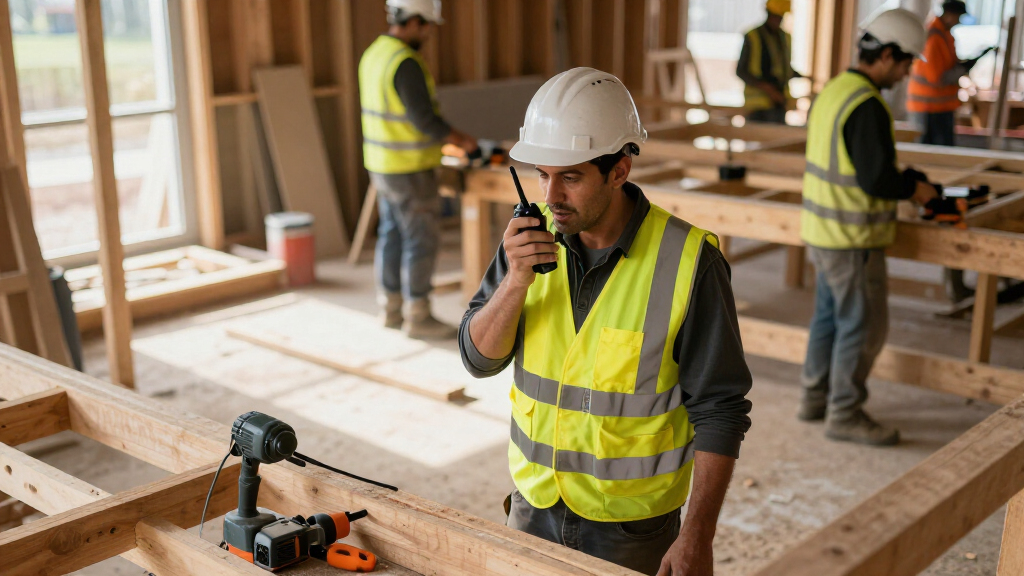
Best Two-Way Radios for Jobsite Communication give crews a faster way to share instructions when phones are buried in pockets, covered in dust, or outside network coverage. A push of the talk button can connect a foreman, crane operator, and ground crew in seconds, while a group channel keeps everyone working from the same information.
That speed matters when a delivery truck is backing toward a congested gate or an operator needs a spotter before lifting a load. Two-way radios provide instant push-to-talk contact, hands-free communication, and a common channel for emergencies. They also work in places where a phone shows one weak bar—or none.
The deeper advantage is not simply speed; it is shared awareness. A phone call creates a private conversation, so other people may continue working from outdated information. A radio channel lets everyone assigned to that task hear the same instruction at the same time. That can reduce duplicated calls, prevent conflicting directions, and make a change in plan visible to the whole crew.
Think of a radio system like a jobsite traffic signal. Everyone follows the same channel rules, messages move in a predictable direction, and fewer people stop work to make separate calls. A text message can sit unread beside a running saw; a clear radio call cuts through the noise.
Jobsite radios matter most when time, noise, and poor coverage make ordinary phone calls unreliable.
For example, a superintendent managing a three-building project may use one channel for the main crew, another for deliveries, and a priority channel for emergencies. That structure only helps if workers know which channel to use and when to yield it. A complicated plan can create its own delay, so the communication benefit must be weighed against the training and discipline required to maintain it.
UHF two-way radios for construction sites
As an affiliate, we earn on qualifying purchases.
As an affiliate, we earn on qualifying purchases.
Pick the Radio Type That Fits Your Crew and Site
Best Two-Way Radios for Jobsite Communication fall into four practical groups: consumer FRS units, business-band radios, professional digital radios, and cellular push-to-talk devices. Your choice depends on coverage, durability, licensing, and operating cost, not just the number printed on the package.
| Radio type | Best fit | Main strengths | Main tradeoff |
|---|---|---|---|
| Consumer FRS | Small, short-range crews | Low cost and simple setup | Limited range, audio, and durability |
| Business-band | Construction and industrial teams | Durable hardware, better accessories, programmable channels | Often requires FCC licensing |
| Professional digital | Large or high-noise operations | Clear audio, selective calling, data, and fleet controls | Higher cost and more planning |
| Cellular push-to-talk | Distributed crews across cities or regions | Wide-area service and location tools | Depends on carrier coverage and subscriptions |
| Hybrid radio | Crews moving between local sites and wide-area networks | Combines radio, LTE, Wi-Fi, and sometimes Bluetooth | More complex setup and administration |
A small remodeling crew working on one wood-frame house may be fine with license-free FRS radios. A steel erection crew spread across several structures usually needs professional business-band equipment, better antennas, and a plan for charging and repairs. The reason is operational risk: when workers are separated by structures or machinery, weak audio and short battery life create delays that can outweigh the initial savings.
Digital equipment can improve voice quality and fleet management, but clearer audio does not mean unlimited range. Digital systems may sound nearly perfect until the signal becomes unusable, whereas analog audio often becomes noisy gradually. That makes digital attractive for routine work in a noisy environment, but it also makes pre-purchase coverage testing especially important.
Cellular push-to-talk can solve a different problem: connecting crews across distant sites. Its tradeoff is dependence on carrier service, subscriptions, device management, and network availability. A local radio may continue working during a network outage, while a cellular system may offer location and dispatch features that local radios cannot.
Do not treat “privacy codes” as encryption. Those codes can reduce unwanted audio from other users, but they usually do not stop someone from hearing your transmission. If you discuss sensitive security or operational details, ask a qualified radio dealer about legal encryption options.
durable jobsite two-way radios with loud audio
As an affiliate, we earn on qualifying purchases.
As an affiliate, we earn on qualifying purchases.
Match VHF or UHF to the Building, Terrain, and Work Area
Best Two-Way Radios for Jobsite Communication use either VHF or UHF depending on the physical environment. VHF usually suits open outdoor areas, while UHF often performs better inside buildings and around urban obstructions, but your actual site test matters more than a general rule.
Concrete walls, steel framing, elevators, underground levels, hills, and dense city blocks absorb or scatter radio signals. A radio that reaches two miles across an open field may reach only a few hundred feet through a reinforced parking garage. Frequency, antenna design, transmit power, and interference all shape the result.
The practical implication is that frequency selection should follow the path a message must travel, not the label on the box. An outdoor road crew may need distance across open ground, while an interior crew may need a signal that can move through several rooms and floors. Even then, building materials and antenna placement can matter more than the broad VHF-versus-UHF distinction.
Picture your signal as a worker carrying a message through the site. In an open field, the worker walks straight across. Inside a building, the worker squeezes through doorways, climbs stairs, and stops at locked gates. The fewer obstacles in the path, the farther the message travels.
For example, VHF may serve a road crew spread along open pavement, while UHF may make more sense for a hospital renovation with multiple floors and thick walls. Neither choice replaces testing. Walk the actual route with radios in hand, including basements, stairwells, loading docks, and elevated work areas. Test both directions because a call that reaches the foreman may not return clearly from a lower-power portable radio.
If direct radio coverage cannot reach the entire property, a repeater can receive a transmission and send it back out from a higher location. Repeaters help on large campuses, mines, tunnels, utility projects, and multi-building sites, but they add equipment, programming, maintenance, and sometimes licensing costs. They may be cheaper than replacing an entire fleet, but they also create a new single point of failure, so the emergency plan should include what workers do if the repeater goes down.
VHF two-way radios for outdoor work
As an affiliate, we earn on qualifying purchases.
As an affiliate, we earn on qualifying purchases.
Choose Audio and Controls Your Crew Can Use in Real Noise
Best Two-Way Radios for Jobsite Communication need loud, intelligible audio and controls that workers can operate with gloves. A radio can have excellent coverage and still fail if a crane operator cannot hear the call over a diesel engine or find the talk button while wearing winter gloves.
Look for a front-facing speaker, noise suppression, automatic gain control, and a remote speaker microphone. A shoulder mic places the talk button near your collar, so you can answer without digging under a vest or reaching for a belt-mounted unit. These features reduce the number of physical actions required to communicate, which matters when a worker is climbing, spotting a load, or keeping one hand on equipment.
Noise suppression is useful when background sound is steady, but no circuit can recover speech that is completely masked by machinery. A louder speaker may improve audibility but can also increase fatigue or disturb nearby crews. The best setup balances volume with a microphone and earpiece arrangement that keeps speech close to the worker’s ear.
Test the radio beside the equipment that creates your real noise: compressors, concrete pumps, forklifts, saws, traffic, and ventilation fans. A quiet showroom tells you almost nothing. Have one worker call from the edge of the work zone while another stands beside the loudest machine. Note whether the listener can understand words, not merely detect that someone is speaking.
Hearing protection changes the equation. Many professional systems work with earpieces, headsets, and communication-ready hearing protection, but compatibility varies. Confirm that the accessory fits under a hard hat, does not interfere with eye protection, and lets the worker hear alarms and nearby hazards. A headset that improves radio clarity but blocks warning signals can create a different safety problem.
Voice-activated transmission can sound convenient, but it may trigger every time a saw starts or someone shouts nearby. In extremely noisy areas, a physical push-to-talk button is often more dependable. The right radio lets you speak clearly, hear the reply, and keep your hands where the work requires them; the feature list matters less than whether workers can use it without changing safe work habits.
two-way radio accessories for construction
As an affiliate, we earn on qualifying purchases.
As an affiliate, we earn on qualifying purchases.
Buy for a Full Shift, Not the Package Photograph
Best Two-Way Radios for Jobsite Communication should last through the full shift under real use, not just the manufacturer’s test cycle. Published battery life often assumes a light duty pattern of 5% transmitting, 5% receiving, and 90% standby, while a busy crew may talk far more often.
Heavy transmitting, cold weather, high-power settings, weak signals, GPS, and poor coverage can drain a battery faster. A radio that dies at 2:00 p.m. creates the same communication gap as a radio with poor range. Plan for replaceable batteries, spare packs, and centralized charging. The goal is not merely a battery that lasts on paper; it is a process that prevents one depleted unit from becoming a safety or coordination failure.
Use this purchasing sequence:
- Estimate daily talk time. Count how often each crew actually transmits during a normal shift. High talk time favors larger batteries or more frequent charging, while a mostly listening-based role may need less capacity.
- Test one complete shift. Run the radios from morning stretch-and-flex through cleanup, including the busiest work period. This exposes the difference between standby endurance and actual operating endurance.
- Check the charging plan. Confirm that every radio has a labeled charging slot and that spare batteries can charge before the next shift. Charging discipline is part of system reliability, not an administrative detail.
- Inspect the connectors and clips. Dust, mud, sweat, and repeated drops expose weak parts quickly. A durable battery is little help if a loose clip causes the radio to fall or a damaged contact prevents charging.
- Price the whole fleet. Add batteries, chargers, speaker mics, programming, licensing, repairs, and replacements. Accessories often determine whether a radio is usable in the field.
USB-C charging can simplify vehicle and field charging, while multi-unit docks make it easier to start each day with a ready fleet. Still, proprietary docks may provide better battery monitoring and fleet organization. Choose the setup your supervisors can maintain every day, because a theoretically flexible charging system is worthless if no one owns the charging routine.
A low-cost radio that needs two replacement batteries and a new belt clip every few months may cost more than a sturdier unit with available parts. The sticker price is only the first line of the budget; downtime, lost radios, replacement labor, and interruptions to work are part of the total cost.
Check Durability, Licensing, and Compatibility Before You Order
Best Two-Way Radios for Jobsite Communication must survive the worksite and operate legally. Check the radio’s IP water-and-dust rating, drop resistance, sealed controls, temperature limits, belt clip, and connector covers, then verify the FCC service and programming requirements before you place an order.
An IP rating describes protection from solids and water. It does not automatically promise resistance to drops, chemicals, vibration, or prolonged submersion. A radio marked for water resistance may still fail after a fall onto a concrete slab or exposure to solvent. This distinction matters because jobsite damage is often mechanical or chemical rather than simply water-related; choose the rating based on the hazards the radio will actually encounter.
In the United States, some FRS radios operate without an individual license, while many business-band systems require an FCC license. Power limits, approved frequencies, and programming rules apply. A dealer can help, but your business remains responsible for using authorized equipment and channels. Treat licensing as part of deployment time and cost, not as paperwork that can be resolved after the radios arrive.
Compatibility also requires more than matching a channel number. Radios need compatible frequencies, tones, modulation, and digital protocols. Two units may both say “Channel 3” and still fail to communicate. Digital radios using different standards may not work together even when they share a frequency band. Mixing fleets can therefore create a false sense of redundancy: workers may believe they have a backup radio when the backup cannot reach the assigned group.
Before mixing radios from different fleets, test calls, emergency alerts, headsets, channel access, and battery accessories. A contractor joining your site may bring equipment that looks familiar but cannot reach your priority channel. Write the approved channel plan on a quick-reference card and train every user on it. Clear documentation reduces the chance that a new worker changes settings or uses an unapproved frequency under pressure.
Power off equipment before servicing radio chargers or wiring, wear the PPE required for your area, and use licensed professionals for electrical work or permanent antenna and repeater installations.
Run a Jobsite Test Before You Commit to a Fleet
Best Two-Way Radios for Jobsite Communication should prove themselves on your property before you buy dozens. A practical test checks coverage, audio, battery life, ergonomics, and emergency functions under the same conditions your crew faces every day.
Use a small pilot group that includes a foreman, equipment operator, laborer, and safety lead. Give them radios for several shifts, not one quick walk around the yard. Their hands, gloves, hearing protection, and work routes reveal problems that a desk review misses. A pilot also shows whether the proposed channel plan fits the way crews actually coordinate work.
- Map the work areas. Test outdoors, inside buildings, in basements, on upper floors, near elevators, and around steel or concrete. Mark dead spots and determine whether they affect routine work, emergency routes, or both.
- Test the loudest zones. Call beside operating machinery, traffic, pumps, generators, and ventilation equipment. Record whether speech remains intelligible, because a connection that technically holds but cannot be understood is not a usable connection.
- Measure a full shift. Record battery levels at lunch, near the end of the shift, and after heavy transmit periods. Compare results among roles because operators who transmit constantly may need a different battery plan from supervisors who mostly listen.
- Use required PPE. Test gloves, hard hats, eye protection, hearing protection, and winter layers. Ergonomic problems often appear only when workers are dressed for the conditions in which communication matters most.
- Test failure points. Check drop resistance claims, water exposure limits, belt clips, charging contacts, and connector covers safely. The purpose is to identify realistic weak points, not to deliberately destroy equipment.
- Try emergency features. Test priority channels, emergency buttons, man-down alerts, lone-worker functions, and notification procedures. A feature that has never been practiced may not be useful during an actual incident.
- Confirm the paperwork. Verify licenses, programming, repair support, warranty terms, and replacement battery availability. These determine whether the system can be maintained after installation.
Keep a simple log. Write down where audio became unclear, where calls dropped, how long batteries lasted, and which accessories workers preferred. If a radio fails beside the same stairwell three times, that is useful evidence—not bad luck. Repeated failures help distinguish a product limitation from an isolated handling error.
The final choice should reflect the worst useful location, not the easiest one. A radio that works everywhere except the underground pump room may still require a repeater or a dedicated emergency plan. That additional cost can be justified if the room is essential to operations, but it should be a deliberate decision rather than a surprise after fleet purchase.
Avoid the Mistakes That Make Good Radios Useless
Best Two-Way Radios for Jobsite Communication fail when the system around them is poorly planned. The most common problems include trusting maximum range claims, skipping licensing, buying weak consumer units for harsh work, and giving workers radios without training or spare batteries.
One crew may spend heavily on digital radios and then discover that the channel plan is too complicated for a rushed morning briefing. Another may buy inexpensive units that sound fine at the trailer but disappear behind a concrete core. The hardware matters, but setup and daily habits matter just as much. A reliable device cannot compensate for unclear ownership, poor charging discipline, or workers who do not know what to say during an emergency.
- Do not assume advertised range equals working range. Test the site with the buildings and equipment in place. Otherwise, the crew may discover a coverage gap only when someone is already in the isolated area.
- Do not treat privacy codes as secure communication. They usually filter audio; they do not hide your transmission. Sensitive information needs a properly configured security solution and an appropriate operating policy.
- Do not rely on voice activation around loud equipment. Use push-to-talk when noise can trigger false transmissions. False activation can occupy the channel and conceal the message someone actually needs to hear.
- Do not forget spare batteries. A dead radio removes a worker from the communication plan. A spare-pack process is usually cheaper and simpler than trying to ration transmissions during a long shift.
- Do not mix incompatible radios by appearance. Confirm frequencies, tones, protocols, and channel programming. Visual similarity is not technical compatibility.
- Do not skip emergency training. Every worker should know the emergency button, priority channel, call format, and fallback method. In an emergency, memorized actions are more dependable than instructions stored in a manual.
Write a short radio procedure that covers call signs, channel use, emergency words, repeat-back rules, and what to do when the system fails. Practice it during a toolbox talk. Clear radio habits reduce clipped messages, repeated calls, and dangerous assumptions, while also making it easier for supervisors to identify whether a problem is equipment-related or procedural.
Use a Simple Communication Plan That Scales With the Project
Best Two-Way Radios for Jobsite Communication work better when each channel has a job. Assign channels by crew, area, or function, then keep one channel available for emergencies and sitewide announcements. The plan should remain simple enough to remember during a rushed lift or evacuation.
For a growing project, you might use Channel 1 for site operations, Channel 2 for deliveries and traffic, Channel 3 for mechanical work, and Channel 4 for emergency coordination. A large operation may need a repeater, dispatch console, GPS, or separate talk groups, but more features should solve a real problem. Every extra channel or function adds a management burden: someone must program it, explain it, monitor it, and update it when the project changes.
Train workers to make short, complete calls: identify the person you need, state your location, give the instruction, and request a repeat-back when safety matters. “Mike, north gate. Hold the truck until the spotter arrives. Repeat?” is clearer than a long explanation drowned out by backup alarms. The repeat-back is especially valuable when a number, direction, load status, or exclusion zone matters because it confirms that the receiver heard the instruction correctly.
Advanced digital and hybrid systems can add location sharing, geofencing, man-down alerts, lone-worker monitoring, text messaging, and remote device management. These features can help, but they also require configuration, privacy rules, user training, and regular testing. A feature that generates alerts no one monitors may create confidence without creating protection.
That is the tradeoff. A basic radio may be all a small crew needs, while a utility operation spread over several counties may benefit from cellular push-to-talk or a hybrid system. If your crews work beyond local radio coverage, wider networks can help—but they still depend on carrier service and subscriptions. Choose the simplest system that covers the operational risk, then add complexity only when a specific limitation justifies it.
Frequently Asked Questions
What is the best two-way radio for a construction site?
The best choice depends on site size, noise, building materials, licensing, and durability needs. A professional business-band radio usually fits demanding construction work better than a basic consumer walkie-talkie because it offers stronger audio, better accessories, and more configuration options.
How far can jobsite radios communicate?
Actual range can run from a few hundred feet inside dense buildings to several miles across open terrain. Manufacturer range claims use ideal conditions, so test inside basements, stairwells, steel structures, and outdoor work areas before buying.
Do jobsite radios require an FCC license?
Some FRS radios operate without an individual license, while many business-band and professional systems require one. Check the approved service, frequency, power limit, and programming rules for the radio you plan to use in the United States.
Are digital radios better than analog radios?
Digital radios often provide clearer audio, better channel efficiency, selective calling, and data features. Analog radios may cost less and usually become gradually noisier as the signal weakens, while digital audio can cut out abruptly once the signal falls below a usable level.
Can two-way radios work with hearing protection?
Yes. Many professional radios support remote speaker microphones, earpieces, and communication-ready hearing-protection headsets. Test the complete setup with the hard hat, eye protection, gloves, and other PPE your workers use.
Conclusion
Choose the radio that your crew can hear, operate, charge, and trust in the worst part of the site. Test it beside the concrete wall, under the steel deck, and next to the machine that drowns out every ordinary conversation.
Buy for real coverage and clear audio first. The right radio turns scattered voices into one steady line across the jobsite.
Fall yard work Picks
leaf blowers
As an affiliate, we earn on qualifying purchases.