TL;DR

Get tools and workshop supplies delivered free — and shop member deals
- Fast, free delivery on millions of items
- Access to Prime Big Deal Days deals on October 6–7
- Prime Video, Amazon Music and more included
A Hunker report describes a DIY shoe shelf assembled from six standard concrete blocks and three plywood boards, offering three levels for footwear and other items. The report says the shelf can be assembled without adhesive, but provides no tested load rating, cost total or independent durability assessment.
Hunker has reported on a DIY shoe shelf shared by BEHR Paint that uses six concrete blocks and three plywood boards to create a three-level storage unit. The design offers an alternative to a conventional metal shoe rack, but the report does not provide a tested weight limit or independent assessment of its stability.
The materials listed are six blocks measuring 8 by 8 by 16 inches and three plywood pieces about 16 inches wide. The board length can vary, according to Hunker’s instructions, allowing the shelf dimensions to be adjusted to the available space. Hunker describes the blocks as a standard building-material size and says they can be inexpensive, but prices vary by retailer and location.
The instructions recommend painting the blocks and staining the plywood before assembly, allowing the materials to dry. The blocks’ openings should be painted if they will remain visible; the plywood can be sanded first if its surface is rough. Hunker says the unit is best assembled in the place where it will be kept, beginning with a board on the floor and positioning blocks at either end to support the next board.
The design has three plywood levels, with the block openings also available for small items. Hunker describes construction adhesive as optional and says the arrangement should be sturdy without it. The report does not include a load test, detailed instructions for anchoring the unit, or a complete cost estimate, so those points should not be treated as verified performance claims.
A Low-Cost Alternative With Limits
The design may appeal to renters or homeowners seeking visible, adaptable shoe storage from readily available materials. Its open shelves can keep footwear off the floor, while the upper board can hold small decorative or everyday items. Baskets or bins can make the shoes less visible, and labels can help assign storage to different household members.
Its practical value depends on the blocks and boards fitting the intended space and remaining stable in use. Concrete blocks are heavy, and the report does not establish how much weight the assembled shelf can safely carry or whether it will resist tipping. Anyone copying the idea should check that the boards sit securely, keep the unit on a level surface, and avoid placing it where it could obstruct a doorway or walkway.
As an affiliate, we earn on qualifying purchases.
How the Shelf Is Assembled
Hunker’s report presents the project as an alternative to a metal shoe rack, not as a tested or formally engineered furniture product. The cited design comes from a DIY shared by BEHR Paint. The article also mentions paint and stain products sold by Home Depot, but those examples do not establish that specific products are required.
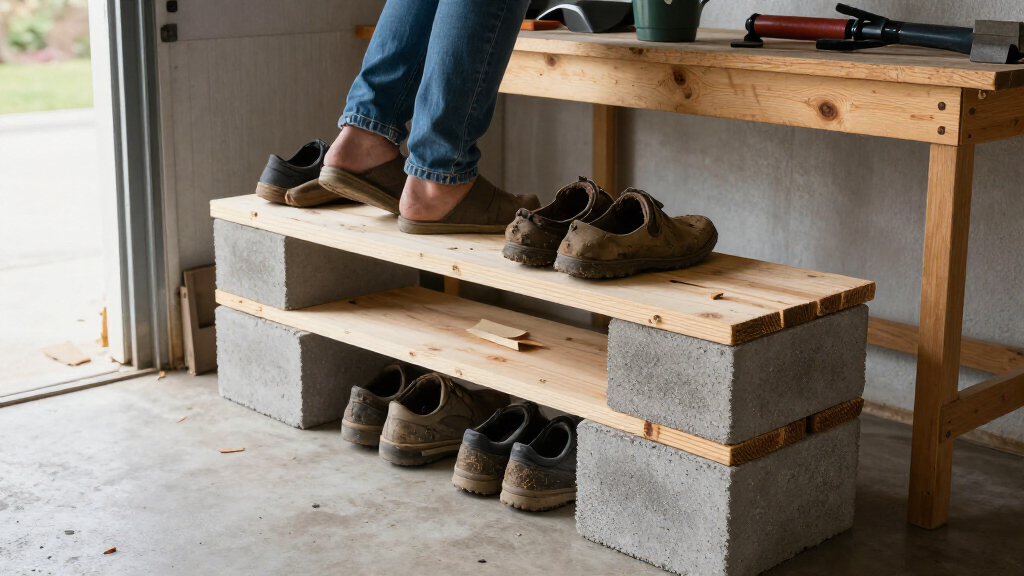
In the described layout, two blocks support each end of the bottom board, with their openings facing forward. A second board rests across those supports. The remaining blocks are laid at either end of that board with their openings facing inward, and the last board forms the top. Hunker suggests using the bottom levels for shoes and reserving the top for decor, or adding containers or a short curtain to conceal footwear.
“It should be sturdy even without it.”
— Hunker, reporting on the BEHR Paint-shared DIY
DIY shoe rack with concrete blocks
As an affiliate, we earn on qualifying purchases.
As an affiliate, we earn on qualifying purchases.
Load Capacity and Stability Are Untested
No tested weight limit is supplied in the source, and it does not report whether the finished shelf was assessed for tipping, movement or long-term wear. It also gives no dimensions for the plywood length, no specifications for board thickness, and no guidance on securing the unit to a wall. Those details can affect how the shelf performs and whether it suits a particular home.
The project’s final cost is also uncertain. The source names example materials and cites a block price from a retailer, but prices and availability can change, and plywood, paint, stain, tools or optional adhesive add to the total. The article does not say how the design performs on uneven floors or in households with children or pets.
As an affiliate, we earn on qualifying purchases.
Check Materials Before Building
Readers considering the project can measure the intended location, select plywood that fits the blocks securely, and confirm the local cost of all materials before starting. Paint and stain should be allowed to dry as directed on their labels. During assembly, place the unit on a level surface and check that each board is seated evenly on its supports before adding shoes or other items.
Hunker’s report does not identify a follow-up test or an official product evaluation. Until such information is available, the design should be treated as a DIY storage idea rather than furniture with a verified capacity; avoid overloading it and seek additional anchoring or professional advice if the setup needs to support substantial weight.
As an affiliate, we earn on qualifying purchases.
Key Questions
What materials does the shoe shelf use?
The Hunker instructions call for six 8-by-8-by-16-inch concrete blocks and three plywood boards about 16 inches wide. Board length can vary with the space and design.
Does the shelf require construction adhesive?
Hunker says adhesive is optional and describes the shelf as sturdy without it. The report does not provide a test or load rating to verify that claim, so check the fit and stability of the assembled unit before use.
Can the shoes be hidden?
Yes. The report suggests placing baskets or bins on the wooden levels, or using a tension rod and short curtain to cover the lower storage area.
How much weight can the shelf hold?
The source gives no tested weight limit. Capacity may depend on the board dimensions, thickness, support placement and assembly, so do not assume a maximum load from the article.
Source: rss
Fall yard work Picks
leaf blowers
As an affiliate, we earn on qualifying purchases.