
For a versatile best jobsite digital thermometer, I’d start with the Klein Tools IR07: its infrared readings and probe let one tool handle surface checks and contact measurements. The UEi PDT655 stands out for HVAC work that calls for differential readings, while the General Tools DT310LAB suits jobs that need an extended probe. The key tradeoff is between a compact pocket thermometer for quick spot checks and a specialized tool that measures more types of temperatures. Probe design, display visibility, mounting, and the measurement method all affect how useful a thermometer will be on site. Read on for how the seven options compare and which one fits your work.

Get business pricing on tools and workshop supplies
- Business-only prices and quantity discounts
- Tax-exempt purchasing
- Multiple users, one account, clear invoices
Complete the kit


Key Takeaways
- The Klein Tools IR07 is the most versatile pick in this group because it combines infrared surface checks with a probe for contact readings.
- The UEi PDT655 is the focused HVAC choice for differential temperature work, with a backlit display and magnetic mount that favor hands-on service tasks.
- The Klein ET10 and ET05 prioritize pocket carry; they make more sense for straightforward contact checks than for buyers needing infrared or differential functions.
- The General Tools DT310LAB’s eight-inch probe serves a different job from the pocket models, reaching farther into materials or equipment while adding bulk.
- Folding designs and compact bodies trade reach for portability; choose based on whether the probe must access recessed areas or the thermometer needs to stay on you all day.
| Klein Tools ET10 Magnetic Digital Pocket Thermometer |  | Best Overall for Vent Checks | Temperature range: -40 to 572°F (-40 to 300°C) | Temperature units: Fahrenheit and Celsius | Display: Backlit digital | VIEW LATEST PRICE | See Our Full Breakdown |
| Klein Tools ET05 Digital Pocket Thermometer, Fahrenheit and Celsius |  | Best for Straightforward HVAC Checks | Measurement range: -40 to 482°F (-40 to 250°C) | Accuracy: ±27°F (±15°C) | Display: Backlit digital | VIEW LATEST PRICE | See Our Full Breakdown |
| UEi Test Instruments PDT650 Folding Pocket Digital Thermometer – Yellow | 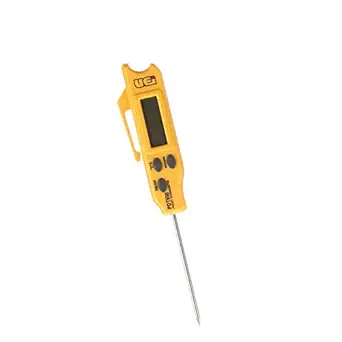 | Best for Fast, Hands-Free Readings | Temperature range: -58 to 572°F (-50 to 300°C) | Accuracy: ±1.8°F (±1°C) across -22 to 302°F | Probe length: 3.5 inches | VIEW LATEST PRICE | See Our Full Breakdown |
| Klein Tools IR07 Dual Infrared and Probe Thermometer |  | Best Dual-Mode Pick | Temperature range: -40 to 752°F (-40 to 400°C) | Measurement modes: Infrared and probe | Distance-to-spot ratio: 8:1 | VIEW LATEST PRICE | See Our Full Breakdown |
| UEi PDT655 Differential Temperature Folding Pocket Thermometer |  | Best for Differential HVAC Diagnostics | Temperature range: -58 to 572°F | Probe length: 5 inches unfolded | Folded dimensions: 6 × 1.5 × 0.75 inches | VIEW LATEST PRICE | See Our Full Breakdown |
| Lang Tools 13800 Digital Pocket Thermometer |  | Best for Hands-Free Automotive Checks | Model: 13800 | Temperature range: -58°F to 572°F | Resolution: 0.1°F | VIEW LATEST PRICE | See Our Full Breakdown |
| General Tools DT310LAB Digital Thermometer with 8-Inch Stainless Steel Probe |  | Best for Reach and Reading Hold | Model: DT310LAB | Probe length: 8 inches | Probe material: Stainless steel | VIEW LATEST PRICE | See Our Full Breakdown |
| jobsite digital thermometer | Response time | Power | Temperature range | Display |
|---|---|---|---|---|
| Klein Tools ET10 Magnetic Digi | 1 second | 2 LR44 batteries, included | -40 to 572°F (-40 to 300°C) | Backlit digital |
| Klein Tools ET05 Digital Pocke | 1 second | 2 LR44 batteries, included | — | Backlit digital |
| UEi Test Instruments PDT650 Fo | 500 milliseconds | 1 AB13/LR44 battery, included | -58 to 572°F (-50 to 300°C) | — |
| Klein Tools IR07 Dual Infrared | 500 milliseconds | 2 AAA batteries, included | -40 to 752°F (-40 to 400°C) | Backlit LCD |
| UEi PDT655 Differential Temper | 500 milliseconds | Battery powered; auto shut down and low-battery warning | -58 to 572°F | Large backlit digital display |
| Lang Tools 13800 Digital Pocke | 500 milliseconds | Battery powered; four batteries included | -58°F to 572°F | Digital |
| General Tools DT310LAB Digital | 500 milliseconds | One LR44 battery included | -58°F to 302°F (-50°C to 150°C) | — |
More Details on Our Top Picks
Klein Tools ET10 Magnetic Digital Pocket Thermometer
The Klein Tools ET10 earns the lead spot for HVAC technicians who need a quick contact reading and a simple way to keep the probe positioned at a vent. Its magnetic stainless-steel probe can attach to air vents, while the backlit screen and max/min, hold, and average functions help when readings are awkward to watch in real time. The range reaches -40 to 572°F, matching the upper limit of the UEi PDT650 and exceeding the ET05’s stated maximum. At 1.5 ounces, it stays easy to carry between service calls. Its tradeoff is a 3-inch immersion depth and contact-only approach: unlike the Klein Tools IR07, it does not offer infrared surface readings. It is also explicitly not for people or animals.
Pros:- Magnetic stainless-steel probe can attach to air vents for hands-free readings.
- Wide -40 to 572°F range covers common HVAC work and hotter applications.
- Backlit display with max/min, hold, and average functions supports field readings.
- Lightweight 1.5-ounce body is easy to keep in a pocket or tool pouch.
Cons:- The 3-inch immersion depth limits reach into deeper ducts or materials.
- Contact-only measurement lacks the IR07’s infrared surface-reading mode.
- Not intended for use on people or animals.
Best for: HVAC technicians who routinely check vent temperatures and want a lightweight contact thermometer with a magnetic probe and useful reading functions.
Not ideal for: Technicians who need non-contact surface checks, a probe longer than 3 inches, or a thermometer for human or animal temperatures.
- Temperature range:-40 to 572°F (-40 to 300°C)
- Temperature units:Fahrenheit and Celsius
- Display:Backlit digital
- Response time:1 second
- Resolution:0.1°F or 0.1°C
- Probe:Stainless steel; 3-inch immersion depth
- Power:2 LR44 batteries, included
- Size and weight:6.5 inches; 1.5 ounces
Our verdict“Choose the ET10 for portable HVAC contact checks where magnetic vent attachment and a broad temperature range matter more than infrared capability.”
Klein Tools ET05 Digital Pocket Thermometer, Fahrenheit and Celsius
The Klein Tools ET05 suits technicians who want a compact pocket thermometer with familiar HVAC functions, without paying for a magnetic mount or dual-mode measurement approach. Its backlit display, max/min, hold, and average functions make readings easier to track in dim mechanical spaces, and the stainless-steel sheath doubles as a handle for extra reach. Against the ET10, it gives up the magnetic probe base and tops out at 482°F rather than 572°F; the UEi PDT650 also offers a broader stated range and faster 500-millisecond response. The ET05’s listed ±27°F accuracy is a major limitation for work where close measurements matter, so its feature set is more compelling than its precision credentials. Its 3-inch immersion depth also restricts access to deeper measurement points.
Pros:- Backlit display remains readable in low-light service areas.
- Max/min, hold, and average functions help track readings during checks.
- Stainless-steel sheath protects the probe and doubles as an extended handle.
- Compact 1.4-ounce design is convenient for everyday carry.
Cons:- Stated accuracy of ±27°F is too loose for precision temperature work.
- Three-inch immersion depth limits reach into deeper ducts or liquids.
- Its 482°F upper limit is lower than the ET10 and UEi PDT650 ranges.
Best for: HVAC workers who need a basic pocket contact thermometer for general checks and value a protective sheath that can act as a handle.
Not ideal for: Technicians who need tight measurement accuracy, deeper probe reach, magnetic hands-free positioning, or a range above 482°F.
- Measurement range:-40 to 482°F (-40 to 250°C)
- Accuracy:±27°F (±15°C)
- Display:Backlit digital
- Functions:Max/min, hold, average, auto power off
- Response time:1 second
- Probe depth:3-inch immersion depth
- Power:2 LR44 batteries, included
- Size and weight:6.5 inches; 1.4 ounces
Our verdict“Pick the ET05 for basic HVAC contact checks if its loose stated accuracy is acceptable and you prefer a protected, simple pocket tool.”
UEi Test Instruments PDT650 Folding Pocket Digital Thermometer – Yellow
The UEi PDT650 is the strongest fit here for technicians who want to position a thermometer and keep both hands available. Its all-angle magnetic mount and folding probe support hands-free readings in HVAC and refrigeration work, while the 500-millisecond response is quicker than the one-second ET10 and ET05. It also covers -58 to 572°F and lists ±1.8°F accuracy across -22 to 302°F, a useful stated precision detail not provided for those Klein models. The 3.5-inch probe and large backlit LCD make it a more field-oriented choice than a basic pocket stick. The tradeoffs are a single LR44 battery and no data logging or Bluetooth; unlike the Klein Tools IR07, it also lacks infrared measurement.
Pros:- All-angle magnetic mount supports hands-free positioning in the field.
- 500-millisecond response is quicker than the ET10 and ET05 response times.
- Folding 3.5-inch probe and backlit display suit compact service work.
- Lists ±1.8°F accuracy across -22 to 302°F and includes a 3-year limited warranty.
Cons:- Uses a single LR44 battery and has no rechargeable option.
- No Bluetooth or data logging for storing and sharing measurements.
- Contact measurement only, unlike the Klein Tools IR07’s dual infrared and probe modes.
Best for: HVAC and refrigeration technicians who need quick contact readings, magnetic hands-free positioning, and a folding probe for service work.
Not ideal for: Buyers who need wireless records, infrared surface readings, rechargeable power, or documented accuracy across the full temperature range.
- Temperature range:-58 to 572°F (-50 to 300°C)
- Accuracy:±1.8°F (±1°C) across -22 to 302°F
- Probe length:3.5 inches
- Response time:500 milliseconds
- Resolution:0.1°
- Mount and display:All-angle magnetic mount; large backlit LCD
- Power:1 AB13/LR44 battery, included
- Weight and warranty:1.7 ounces; 3-year limited warranty
Our verdict“Choose the PDT650 for fast, hands-free contact readings in HVAC or refrigeration work, but skip it if wireless logging or infrared checks are part of the job.”
Klein Tools IR07 Dual Infrared and Probe Thermometer
The Klein Tools IR07 stands apart from the contact-only pocket models by combining a probe with infrared surface measurement. That makes it the more flexible choice when a technician needs both an air or liquid reading and a quick check of a surface without touching it. Its 8:1 distance-to-spot ratio, target laser, differential temperature calculation, and 500-millisecond response add diagnostic options that the ET10 and UEi PDT650 do not provide. The broad -40 to 752°F range is also the highest upper limit among these five picks. The tradeoff is its indoor-use specification, and infrared readings are not a substitute for probe measurements when contact readings are required. It is not intended for people or animals, either.
Pros:- Combines infrared surface readings with probe measurements.
- 8:1 distance-to-spot ratio and target laser help aim non-contact checks.
- Differential temperature calculation supports comparisons between readings.
- 500-millisecond response, backlit LCD, and included pouch suit field carry.
Cons:- Specified for indoor use, limiting its fit for outdoor jobsite work.
- Infrared mode cannot replace probe readings where direct contact is required.
- Not intended for use on people or animals.
Best for: HVAC technicians working indoors who need one pocket tool for both contact readings and quick checks of surface temperatures.
Not ideal for: Outdoor crews, buyers who need only a simple probe thermometer, or anyone seeking a thermometer for people or animals.
- Temperature range:-40 to 752°F (-40 to 400°C)
- Measurement modes:Infrared and probe
- Distance-to-spot ratio:8:1
- Response time:500 milliseconds
- Display:Backlit LCD
- Functions:Target laser; differential temperature calculation
- Power:2 AAA batteries, included
- Size and weight:6.5 inches; 1.44 ounces
Our verdict“Choose the IR07 if indoor HVAC work calls for both probe measurements and non-contact surface checks in one compact tool.”
UEi PDT655 Differential Temperature Folding Pocket Thermometer
The UEi PDT655 is the most diagnosis-focused contact option in this group. Its differential temperature function compares T1 and T2, giving HVAC technicians a direct way to evaluate temperature differences, while the 5-inch folding probe reaches farther than the ET10, ET05, or PDT650 probes. A magnetic mount and large backlit display also help when readings need to stay visible while hands are occupied. Compared with the PDT650, the PDT655 adds the stated T1-T2 function and longer probe, but it is heavier at 3.2 ounces and its product data specifies indoor use. Its 500-millisecond response is quick, though the description also mentions one-second readings. Battery power means replacements are part of ownership, and a single probe may still fall short in larger ducts.
Pros:- T1-T2 differential function supports HVAC temperature comparisons.
- Five-inch folding probe reaches farther than the probes listed for the other pocket models.
- Built-in magnetic mount and backlit display assist hands-free work in dim spaces.
- 500-millisecond response and min/max function support quick field checks.
Cons:- Indoor-use specification limits its suitability for outdoor jobsite conditions.
- A single probe may not reach far enough into larger ducts.
- At 3.2 ounces, it is heavier than the ET10, ET05, PDT650, and IR07.
Best for: Indoor HVAC technicians who compare supply and return temperatures and want a longer folding probe with magnetic hands-free mounting.
Not ideal for: Outdoor crews, workers who need two-probe simultaneous differential measurements, or technicians reaching into large ducts that call for a longer probe.
- Temperature range:-58 to 572°F
- Probe length:5 inches unfolded
- Folded dimensions:6 × 1.5 × 0.75 inches
- Display:Large backlit digital display
- Functions:Differential temperature (T1-T2); min/max
- Response time:500 milliseconds
- Power:Battery powered; auto shut down and low-battery warning
- Weight and usage:3.2 ounces; indoor use
Our verdict“Pick the PDT655 for indoor HVAC work where a longer folding probe and T1-T2 comparisons matter more than minimum weight or outdoor versatility.”
Lang Tools 13800 Digital Pocket Thermometer
The Lang Tools 13800 is aimed at automotive work where a thermometer needs to stay put while you check a reading. Its integrated magnet can hold it against a metal surface, while the folding probe reads from any position—useful around coolant, cabin air, A/C registers, and tire surfaces. Compared with the General Tools DT310LAB, it has a much higher stated upper limit of 572°F and a faster-feeling jobsite workflow thanks to its 500-millisecond response specification, but it lacks the General’s listed min/max memory and data hold. Its folding format is more pocketable than an 8-inch fixed probe, though the General may suit measurements that need a longer reach. The main drawback is power: this model requires four batteries, rather than the single included LR44 listed for the General.
Pros:- Integrated magnet supports hands-free readings on suitable metal surfaces
- Probe reads from any folding position
- Wide stated range reaches 572°F
- 500-millisecond response time supports quick spot checks
Cons:- Requires four batteries
- Does not list min/max memory or data hold
- Folding probe may not provide the reach of the General Tools DT310LAB’s 8-inch probe
Best for: Automotive technicians who take recurring coolant, A/C, cabin-air, or tire-surface readings and want a magnetic hands-free option.
Not ideal for: Users who need min/max memory or data hold, or who prefer a thermometer with fewer batteries to manage.
- Model:13800
- Temperature range:-58°F to 572°F
- Resolution:0.1°F
- Response time:500 milliseconds
- Display:Digital
- Power:Battery powered; four batteries included
- Weight:22.68 g
- Warranty:3-year limited
Our verdict“Choose the Lang Tools 13800 for magnetic, quick automotive spot checks; pick the General Tools DT310LAB instead if probe reach and recorded min/max readings matter more.”
General Tools DT310LAB Digital Thermometer with 8-Inch Stainless Steel Probe
The General Tools DT310LAB suits jobs where a short pocket probe cannot reach the target comfortably. Its 8-inch stainless steel probe can access farther into ducts or equipment, while minimum/maximum memory and data hold help capture readings when the display is not easy to watch. That gives it a different advantage from the Lang Tools 13800, which folds for compact carry and offers a magnet, but does not list memory or hold functions. The DT310LAB also switches between Fahrenheit and Celsius and includes a protective sheath and LR44 battery. Its tradeoff is the shorter upper range: 302°F versus the Lang’s 572°F, making the Lang a stronger fit for hotter surface checks. The longer probe can also be less convenient to carry than a folding pocket design.
Pros:- 8-inch stainless steel probe reaches farther into equipment and ducts
- Minimum/maximum memory helps track changing readings
- Data hold can preserve a reading for easier viewing
- Includes a protective sheath and LR44 battery
Cons:- Maximum range of 302°F is lower than the Lang Tools 13800’s 572°F limit
- Long probe is less compact than a folding pocket thermometer
- Requires an LR44 battery
Best for: HVAC and maintenance workers who need an extended probe, min/max capture, and data hold for readings in less accessible spots.
Not ideal for: Technicians measuring very hot surfaces above 302°F or prioritizing a compact folding thermometer with a magnetic mount.
- Model:DT310LAB
- Probe length:8 inches
- Probe material:Stainless steel
- Temperature range:-58°F to 302°F (-50°C to 150°C)
- Resolution:0.1 degrees
- Response time:500 milliseconds
- Features:Minimum/maximum memory, data hold, °F/°C switch, automatic shutoff
- Power:One LR44 battery included
- Weight:1.6 ounces
Our verdict“Choose the DT310LAB when probe reach and held or recorded readings matter more than compact carry or a higher temperature ceiling.”

How We Picked
I compared these seven thermometers by the work they can perform, not by treating every added feature as an automatic advantage. The main criteria were measurement approach, probe reach and storage, display usability, jobsite handling, and how well each tool’s functions match common field tasks. A compact contact thermometer can be a better daily carry than a more capable instrument if the extra modes would rarely be used.
The ranking gives the highest place to tools that cover more jobsite needs without losing practical usability. That puts the Klein Tools IR07 first for its combination of infrared and probe measurement, with the UEi PDT655 close behind for HVAC-focused differential work. Pocket models rank as simpler, more portable choices, while the long-probe General Tools DT310LAB earns a place for a specific reach requirement. I treat specialized capability as a benefit only when it addresses a distinct work need.
| jobsite digital thermometer | Temperature range | Display |
|---|---|---|
| Klein Tools ET10 Magnetic Digi | -40 to 572°F (-40 to 300°C) | Backlit digital |
| Klein Tools ET05 Digital Pocke | — | Backlit digital |
| UEi Test Instruments PDT650 Fo | -58 to 572°F (-50 to 300°C) | — |
| Klein Tools IR07 Dual Infrared | -40 to 752°F (-40 to 400°C) | Backlit LCD |
| UEi PDT655 Differential Temper | -58 to 572°F | Large backlit digital display |
| Lang Tools 13800 Digital Pocke | -58°F to 572°F | Digital |
| General Tools DT310LAB Digital | -58°F to 302°F (-50°C to 150°C) | — |
Factors to Consider When Choosing Best Jobsite Digital Thermometer
Before choosing a model, match the thermometer to the measurement you actually need to make. A feature that sounds useful can add bulk or complexity without helping your regular tasks.
Choose Contact, Infrared, or Both
A contact probe measures the temperature where its sensor touches, which suits many material and air checks when the probe can reach the target. Infrared readings are faster and can help with surfaces that are moving, hot, or difficult to access, but they do not replace contact measurements for every task. Surface finish, distance, and the size of the target can affect infrared results, so a reading from nearby equipment may not represent the precise spot you intended. A dual-mode tool is useful when both kinds of checks are routine, not simply because it has more features. If your procedures require a specific contact method, confirm that an infrared reading is acceptable before relying on it.
Match Probe Shape and Reach to the Work
Probe length affects where you can take a reading, but longer is not always better. A short folding probe is easier to protect and carry, while an extended probe can reach farther into ducts, materials, or equipment. Check whether the probe can reach the target without forcing you to lean over hot or moving components. Also think about how the probe is stored: folding designs protect the tip during transport, while a separate long probe needs room and care. Avoid choosing by length alone; consider access, safe handling, and where the thermometer will live between readings.
Decide Whether Differential Readings Matter
HVAC troubleshooting may call for comparing temperatures at two points rather than recording one value. A differential thermometer can speed that workflow and reduce the need to compare separate readings manually. If you mostly check individual surface or air temperatures, the added capability may go unused and a simpler pocket model can be easier to carry. Confirm that the tool supports the measurement procedure your work requires, including the appropriate sensor arrangement. Buyers should also think through how often paired readings occur on a typical job, not just whether the feature might be handy once in a while.
Prioritize Readability and Hands-Free Placement
On a jobsite, a readable display matters when you are working in dim mechanical spaces or need to check a value quickly. Backlighting helps in low light, but it cannot compensate for a screen that is poorly positioned or awkward to view while holding the probe. Magnetic mounting can free a hand when working around compatible metal surfaces, although it will not help on every installation. Think about where you will stand and where the thermometer can safely rest during a measurement. If readings are usually taken in bright, open areas, portability and simple controls may matter more than extra display features.
Check the Measurement Range Against Your Tasks
Match the stated temperature range to the materials, systems, and environments you routinely measure. A broad range can be reassuring, but it does not by itself establish accuracy or suitability for a particular procedure. Check the manufacturer’s accuracy information and any operating limits alongside the range, especially for work near the ends of the scale. A common mistake is to buy for an unusual extreme while overlooking the everyday measurement conditions. If readings support safety or compliance decisions, follow the applicable work procedure and use an instrument that meets its requirements.
Balance Jobsite Features With Carry and Care
Magnetic mounts, folding probes, and multiple measurement modes can reduce friction during certain jobs, but each can add size, parts, or steps to routine use. A thermometer that stays in a pocket may be more useful than a more elaborate unit left in a toolbox. Consider how exposed the tool will be to dust, impacts, and frequent transport, and check its care instructions before buying. Probe tips need protection, and infrared sensors need a clear, clean view of the target. Choose the feature set that fits your daily workflow, then verify the tool’s handling and maintenance requirements rather than assuming every digital thermometer tolerates the same conditions.
Frequently Asked Questions
Should I choose the Klein Tools IR07 or a dedicated pocket thermometer?
Choose the IR07 if you regularly need both quick surface checks and contact readings from a probe. A dedicated pocket model such as the Klein ET05 or ET10 is a simpler fit when nearly all your measurements use contact readings and you want a compact tool. Infrared capability does not make a thermometer better for every task; distance and surface conditions can affect what it reads. Consider the methods your work procedures allow before paying for a dual-mode design. If you would rarely use infrared, the simpler pocket format may suit your day-to-day work better.
When does a differential thermometer make sense for HVAC work?
A differential model makes sense when your regular troubleshooting involves comparing temperatures at two points as part of one job. The UEi PDT655 is the standout in this roundup for that HVAC-oriented use, with a backlit display and magnetic mount suited to field handling. If you only need occasional individual temperature checks, a standard pocket thermometer may be easier to carry and operate. Review the measurement method required by your service procedure before choosing a differential tool. The extra function has the most value when it fits work you perform repeatedly.
Is a folding probe better for everyday jobsite carry?
A folding probe can make daily carry more convenient because the sensor stows within the body instead of remaining exposed. It is a good fit when readings are frequent but probe reach is modest. A separate long probe, like the eight-inch design on the General Tools DT310LAB, can reach targets that a compact folding model may not. That added reach comes with more space and probe protection to manage. Choose by the access your jobs require rather than assuming folding or long-probe designs are universally better.
Do I need a backlit display or magnetic mount?
These features help most when you take readings in dim spaces or need to keep your hands available near equipment. The UEi PDT655 pairs both features, which makes its setup more suited to HVAC service than a basic pocket model. A backlight is less valuable in bright work areas, and a magnet only helps where there is a compatible surface and a safe place to attach the tool. Consider your usual working position and lighting before making these features a priority. They support the measurement process but do not replace the right probe or measurement method.
What should I check before using an infrared thermometer on a job?
Confirm that infrared measurement is suitable for the target and the procedure you are following. The size of the target relative to the sensor’s viewing area matters, as does the distance from the tool to the surface. Reflective or unusual surfaces can produce readings that do not match the temperature you need to know. Keep the sensor’s view clear and compare with a contact method when the task requires a more direct measurement. For controlled or safety-related work, follow the instrument’s instructions and the applicable job procedure.
Conclusion
For one tool to cover varied field checks, I’d choose the Klein Tools IR07 as the best overall pick because its infrared and probe modes serve different measurement situations. The Klein Tools ET05 or ET10 are the best value-style choices for buyers who need straightforward pocket contact readings; pick the ET10 if its magnetic design fits your workflow, or the ET05 for a simple Fahrenheit-and-Celsius option. For a premium, HVAC-focused feature set, I’d point to the UEi PDT655 for differential readings, backlighting, and magnetic mounting. Beginners who want a direct, compact tool can start with a pocket thermometer rather than paying for modes they may not use. For specific needs, choose the General Tools DT310LAB when extended probe reach matters, or the UEi PDT650 when a folding pocket format suits your work better. Match the measurement method and probe access to your regular jobs, and the right pick becomes clear.