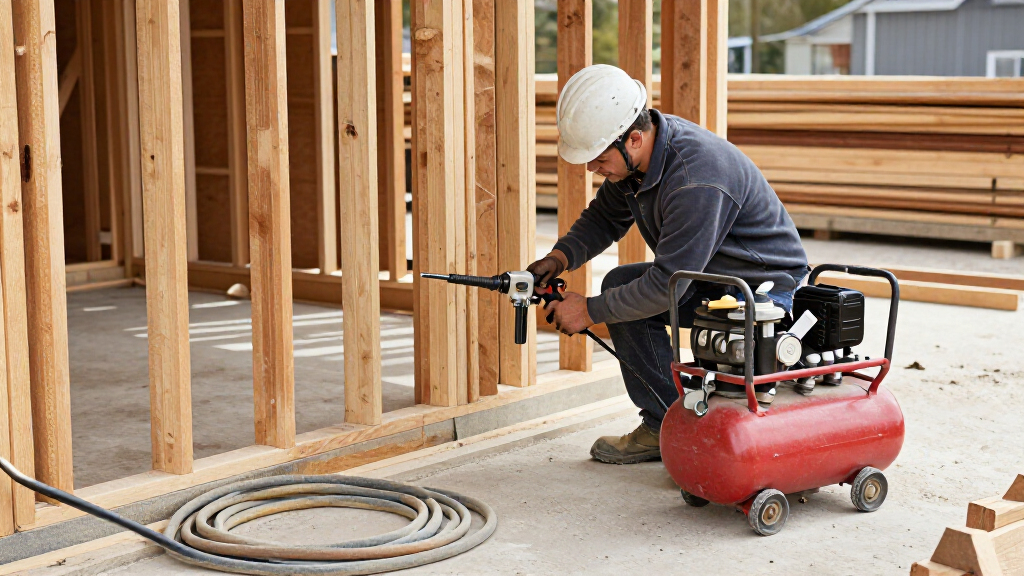

The best construction site portable air compressor for most crews is the Klutch 29-gallon model, whose larger tank and 5.1 CFM at 90 PSI better suit repeated tool use than small pancake compressors. For indoor or noise-sensitive work, the Metabo HPT EC28M is a quieter, compact alternative, while the Albott gas-powered 8-gallon model fits sites without dependable electrical access. The main tradeoffs are airflow and tank capacity versus portability, noise, power source, and maintenance needs. A compressor that runs a nailer intermittently may fall short when several tools demand air throughout the day. Read on for the full breakdown of where each model fits and what to check before choosing.

Get business pricing on tools and workshop supplies
- Business-only prices and quantity discounts
- Tax-exempt purchasing
- Multiple users, one account, clear invoices
Complete the kit


Key Takeaways
- Klutch leads for sustained site work in this lineup because its 29-gallon tank and 5.1 CFM at 90 PSI offer more reserve than the compact pancake and one-gallon options.
- Small and quiet are separate advantages: the Metabo HPT EC28M is a one-gallon option for noise-sensitive, light-duty work, while the three-gallon ultra-quiet model offers more storage but still has a 115 PSI ceiling.
- Six-gallon pancake compressors prioritize portability over extended air delivery; ECOMAX, Craftsman, and Metabo HPT models differ in pressure capacity, included accessories, and stated specifications.
- Pressure alone does not predict tool compatibility. Airflow at the tool’s required PSI matters, so the DeWALT‘s 225 PSI maximum should not be mistaken for a guaranteed high CFM output.
- The Albott‘s gas engine fills a distinct job-site niche where electricity is unavailable, but it brings fuel, exhaust, noise, and engine upkeep that electric compressors avoid.
| Klutch 29-Gallon Air Compressor, 2.5 HP, 120V, 175 PSI, 5.1 CFM at 90 PSI |  | Best for Longer Work Sessions | Voltage: 120V | Motor: 2.5 HP | Tank capacity: 29 gallons | VIEW LATEST PRICE | See Our Full Breakdown |
| Metabo HPT Quiet Air Compressor, Portable 1 Gallon Oil-Free, EC28M |  | Best for Quiet Interior Work | Voltage: 120V | Tank capacity: 1 gallon | Maximum pressure: 125 bar | VIEW LATEST PRICE | See Our Full Breakdown |
| Ironton Oil-Free Pancake Air Compressor, 0.3 HP, 3 Gallon, 110 PSI |  | Best Compact Pancake Pick | Motor: 0.3 HP | Tank capacity: 3 gallons | Maximum pressure: 110 PSI | VIEW LATEST PRICE | See Our Full Breakdown |
| ECOMAX 6 Gallon 150 PSI Pancake Portable Oil-Free Air Compressor with Accessories Kit |  | Best Ready-to-Start Kit | Tank capacity: 6 gallons | Maximum pressure: 150 PSI | Horsepower: 1.5 HP | VIEW LATEST PRICE | See Our Full Breakdown |
| DeWALT Air Compressor, 225 PSI Max, Hand Carry with Wheels, 4.5 Gallon |  | Best for Multi-Nailer Performance | Maximum pressure: 225 PSI | Tank capacity: 4.5 gallons | Airflow: 5.4 SCFM at 90 PSI | VIEW LATEST PRICE | See Our Full Breakdown |
| 3-Gallon Ultra Quiet Air Compressor with Two Quick Couplers, 1.2HP, 115 PSI |  | Best for Quieter, Light-Duty Site Tasks | Tank capacity: 3 gallons | Maximum pressure: 115 PSI | Motor power: 1.2 HP | VIEW LATEST PRICE | See Our Full Breakdown |
| Craftsman 6 Gallon 150 PSI Oil-Free Pancake Air Compressor |  | Best Familiar Pancake-Style Workhorse | Tank capacity: 6 gallons | Maximum pressure: 150 PSI | Air delivery: 2.6 SCFM at 90 PSI | VIEW LATEST PRICE | See Our Full Breakdown |
| Metabo HPT Portable Pancake Air Compressor, 6 Gallon, 200 PSI |  | Best for Higher-Pressure, Multi-Tool Work | Tank capacity: 6 gallons | Maximum pressure: 200 PSI | Airflow: 4 CFM | VIEW LATEST PRICE | See Our Full Breakdown |
| Albott 6.5HP Gas Powered 8-Gallon Portable Air Compressor |  | Best for Sites Without Electrical Service | Maximum pressure: 115 PSI | Power source: Gas powered | Outlet size: 1/4-inch NPT | VIEW LATEST PRICE | See Our Full Breakdown |
| construction site portable air compressor | Maximum pressure | Tank capacity | Noise level | Voltage |
|---|---|---|---|---|
| Klutch 29-Gallon Air Compresso | 175 PSI | 29 gallons | 81 dB | 120V |
| Metabo HPT Quiet Air Compresso | 125 bar | 1 gallon | 59 dB | 120V |
| Ironton Oil-Free Pancake Air C | 110 PSI | 3 gallons | — | — |
| ECOMAX 6 Gallon 150 PSI Pancak | 150 PSI | 6 gallons | 75 dB | 120V |
| DeWALT Air Compressor | 225 PSI | 4.5 gallons | 78 dB | 120V |
| 3-Gallon Ultra Quiet Air Compr | 115 PSI | 3 gallons | Approximately 70 dB | 120 volts |
| Craftsman 6 Gallon 150 PSI Oil | 150 PSI | 6 gallons | 82 dB | 120 volts |
| Metabo HPT Portable Pancake Ai | 200 PSI | 6 gallons | 73 dB | 120 volts |
| Albott 6.5HP Gas Powered 8-Gal | 115 PSI | — | 70 dB | — |
More Details on Our Top Picks
Klutch 29-Gallon Air Compressor, 2.5 HP, 120V, 175 PSI, 5.1 CFM at 90 PSI
For a construction crew that needs more air on hand between recovery cycles, I’d put the Klutch 29-gallon ahead of the smaller-tank options here. Its 5.1 CFM at 90 PSI and large tank suit repeated nailing and a broader mix of pneumatic tasks better than the ECOMAX 6-gallon, whose smaller reserve is more suited to intermittent work. The oil-free pump cuts routine upkeep, while large wheels help move this 127-pound unit around a site. That weight still makes loading it into a vehicle or carrying it up stairs a two-person job for many buyers. At 81 dB, it is also loud, and its 175 PSI maximum does not make it an industrial-duty substitute. I’d choose it for wheeled site use, not frequent hand-carrying.
Pros:- 29-gallon tank provides a larger air reserve for sustained site tasks.
- 5.1 CFM at 90 PSI supports a wider range of pneumatic work than compact, low-output units.
- Oil-free design reduces routine pump maintenance.
- Large wheels help move the 127-pound unit across a work area.
Cons:- At 127 pounds, it is difficult to lift or load without help.
- 81 dB operation can be disruptive in noise-sensitive areas.
- 175 PSI maximum pressure may not meet demanding industrial requirements.
Best for: Crews doing repeated nailing or mixed pneumatic work who can keep a heavy compressor on wheels at ground level.
Not ideal for: Solo contractors who regularly load equipment into a truck, work upstairs, or need a quieter compressor near occupied spaces.
- Voltage:120V
- Motor:2.5 HP
- Tank capacity:29 gallons
- Maximum pressure:175 PSI
- Airflow:5.1 CFM at 90 PSI
- Weight:127 pounds
- Noise level:81 dB
- Dimensions:23.2 x 21.1 x 45.3 inches
Our verdict“Choose the Klutch when a large tank and useful tool airflow matter more than easy lifting or quiet operation.”
Metabo HPT Quiet Air Compressor, Portable 1 Gallon Oil-Free, EC28M
The Metabo HPT EC28M gives up tank capacity to make indoor or occupied-site work more tolerable: its 59 dB noise level is a clear contrast with the Klutch 29-gallon at 81 dB. At 25.2 pounds, it is also much easier to carry between rooms or up a flight of stairs than the larger wheeled models. The universal quick coupler makes tool changes straightforward, and the oil-free design keeps maintenance simple. Its one-gallon tank and light-task orientation are the limits: this is a sensible match for intermittent nailing, not continuous demand or several air-hungry tools. The Ironton pancake offers a three-gallon reserve, but it cannot match the EC28M’s stated quiet operation. I’d favor this model when noise and hand portability outrank runtime.
Pros:- 59 dB operation is substantially quieter than the larger Klutch listed here.
- 25.2-pound weight makes it practical to carry between work areas.
- Universal quick coupler speeds up changes between compatible tools.
- Oil-free pump limits routine maintenance.
Cons:- One-gallon tank limits runtime before the compressor needs to recover.
- Best suited to light or intermittent tasks rather than continuous tool use.
- Its compact capacity is a poor fit for crews needing several tools supplied at once.
Best for: Finish carpenters, remodelers, and punch-list crews who need a carryable compressor for intermittent nailing in occupied buildings.
Not ideal for: Crews running continuous air tools or needing a larger tank reserve for repeated work away from a power source.
- Voltage:120V
- Tank capacity:1 gallon
- Maximum pressure:125 bar
- Maximum horsepower:0.5 HP
- Weight:25.2 pounds
- Noise level:59 dB
- Dimensions:14 x 14 x 13.5 inches
- Power source:Corded electric
Our verdict“Pick the EC28M for quiet, portable nailing in occupied spaces, but skip it if your work depends on sustained airflow.”
Ironton Oil-Free Pancake Air Compressor, 0.3 HP, 3 Gallon, 110 PSI
I’d shortlist the Ironton 3-gallon pancake for crews that want a simple compressor for stapling, inflation, and occasional nailing without hauling a large unit. Its 20.6-pound weight and low-profile base make it easier to place and carry than the ECOMAX 6-gallon, though that lighter footprint comes with half the tank capacity. The fold-down handle, cord wrap, and hose retainer help keep a compact setup manageable when moving between small work areas. Its 0.3 HP motor, 110 PSI maximum, and modest reserve make it a light-duty choice, not a match for sustained pneumatic work. Compared with the quieter Metabo HPT EC28M, the Ironton offers a larger tank but no stated noise advantage. I’d pick it for basic site tasks where compactness matters more than output.
Pros:- 20.6-pound weight is easy to carry around a small site.
- Three-gallon tank offers more reserve than the one-gallon Metabo HPT EC28M.
- Low-profile pancake design provides a stable footprint.
- Oil-free pump avoids routine oil changes.
Cons:- 0.3 HP output makes it a light-duty option.
- Small tank can require frequent recovery during repeated tool use.
- 110 PSI maximum may limit compatibility with higher-pressure tasks.
Best for: DIY builders and small repair crews who need a light, stable compressor for intermittent stapling, inflation, and occasional nailing.
Not ideal for: Contractors running air tools continuously or needing higher pressure and airflow for demanding construction tasks.
- Motor:0.3 HP
- Tank capacity:3 gallons
- Maximum pressure:110 PSI
- Weight:20.6 pounds
- Style:Pancake
- Pump type:Oil-free
- Additional features:Fold-down handle, cord wrap, and hose retainer
Our verdict“Choose the Ironton for compact, occasional site jobs, not for a crew that needs sustained tool performance.”
ECOMAX 6 Gallon 150 PSI Pancake Portable Oil-Free Air Compressor with Accessories Kit
The ECOMAX 6-gallon pancake is the kit-oriented pick: its included accessories and 25-foot hose can help a buyer get started without assembling a separate collection of basic gear. A six-gallon tank and 150 PSI maximum give it more reserve and pressure headroom than the Ironton 3-gallon, making it the more flexible choice for varied light-duty work. At 34.17 pounds, it remains easier to transport than the 88-pound DeWALT, though it is not as easy to carry as the smaller Ironton or Metabo HPT. Its stated airflow is listed as 3 cubic inches per minute, an unusual unit that does not allow a reliable comparison with CFM-rated models. The 75 dB noise level and short-for-large-sites hose also limit its appeal. I’d choose it for portable, intermittent tasks where the accessory bundle matters.
Pros:- Six-gallon tank offers more reserve than the Ironton’s three-gallon tank.
- 150 PSI maximum pressure provides more headroom than the Ironton’s 110 PSI.
- Included accessories and a 25-foot hose support a ready-to-start setup.
- Oil-free pump reduces routine maintenance.
Cons:- 75 dB operation may be intrusive in occupied or noise-sensitive areas.
- The 25-foot hose can restrict placement across larger workspaces.
- Listed airflow unit is cubic inches per minute, making output difficult to compare with CFM-rated models.
Best for: Home renovators and small crews who want a portable compressor with accessories for inflation, light painting, and occasional pneumatic work.
Not ideal for: Contractors who need verified high airflow for sustained tool use or must cover a large work area from one compressor position.
- Tank capacity:6 gallons
- Maximum pressure:150 PSI
- Horsepower:1.5 HP
- Power:180 watts
- Voltage:120V
- Airflow:3 cubic inches per minute (as listed)
- Hose:0.25-inch diameter, 25 feet long
- Weight:34.17 pounds
- Noise level:75 dB
Our verdict“Choose the ECOMAX for a portable light-duty setup with included accessories, but not when dependable high airflow is the priority.”
DeWALT Air Compressor, 225 PSI Max, Hand Carry with Wheels, 4.5 Gallon
For crews whose priority is keeping nailers working, the DeWALT 4.5-gallon makes a stronger case than its tank size suggests: its 5.4 SCFM at 90 PSI is the clearest stated airflow figure in this group and is designed to support multiple nailers. Its 225 PSI maximum also exceeds the Klutch 29-gallon, though pressure alone does not make it a better choice for long runs; the Klutch has a much larger tank reserve. Wheels and a collapsible handle help with site movement, but 88 pounds is still heavy for frequent lifting. The oil-free pump cuts upkeep, while 78 dB operation remains loud around occupied areas. I’d choose this DeWALT for nailer productivity and mobility across a work zone, not for quiet work or extended use without recovery breaks.
Pros:- 5.4 SCFM at 90 PSI is suited to supporting multiple nailers.
- 225 PSI maximum exceeds the listed pressure of the Klutch 29-gallon model.
- Wheels and a collapsible handle help move it around a site.
- Oil-free pump reduces routine maintenance.
Cons:- At 88 pounds, it remains cumbersome to lift and load.
- The 4.5-gallon tank holds less reserve than the Klutch’s 29-gallon tank.
- 78 dB operation can be disruptive in quiet or occupied work areas.
Best for: Framing and trim crews who need strong stated airflow for multiple nailers and can roll, rather than carry, the compressor.
Not ideal for: Workers who need a large reserve for long continuous runs, frequently lift equipment into vehicles, or operate near noise-sensitive occupants.
- Maximum pressure:225 PSI
- Tank capacity:4.5 gallons
- Airflow:5.4 SCFM at 90 PSI
- Voltage:120V
- Motor:1.6 HP
- Weight:88 pounds
- Dimensions:28 x 24 x 16 inches
- Noise level:78 dB
Our verdict“Pick the DeWALT when nailer airflow and wheeled site mobility matter more than tank reserve, low weight, or quiet operation.”
3-Gallon Ultra Quiet Air Compressor with Two Quick Couplers, 1.2HP, 115 PSI
For crews working indoors or near occupied spaces, this model’s approximately 70 dB operation is a meaningful advantage over the louder Craftsman 6 Gallon Pancake Compressor. Its 3-gallon steel tank, wheels, and handle make it easier to move between small work areas, while the stated 50-second refill to working pressure can reduce waiting during intermittent nailing or inflation jobs. Two quick couplers are useful when switching between tools, though the modest tank is better suited to short bursts than sustained air demand. Compared with the Metabo HPT 6 Gallon, 200 PSI, it offers less pressure and capacity but prioritizes quieter, compact operation. I’d choose it for punch-list work, not continuous heavy-duty use.
Pros:- Approximately 70 dB operation is quieter than the Craftsman 6 Gallon model.
- Steel tank and wheeled, handled design support movement around smaller work areas.
- Two quick couplers allow convenient tool changes.
- Reported 50-second refill to working pressure can help with intermittent tasks.
Cons:- Three-gallon capacity limits runtime for sustained tool use.
- Maximum pressure of 115 PSI rules it out for applications needing higher pressure.
- No accessories are included, so compatible hoses and tools must be supplied separately.
Best for: Contractors handling intermittent nailing, tire inflation, or light finishing work in indoor or noise-sensitive areas.
Not ideal for: Crews running air-hungry tools for long stretches or needing more than 115 PSI; the 3-gallon tank and limited pressure are restrictive.
- Tank capacity:3 gallons
- Maximum pressure:115 PSI
- Motor power:1.2 HP
- Noise level:Approximately 70 dB
- Voltage:120 volts
- Maximum current:9.2 A
- Power source:Corded electric
- Dimensions:17.32 × 6.3 × 17.91 inches
Our verdict“Choose this compressor for portable, quieter light-duty work, but step up to a larger, higher-pressure model for sustained site production.”
Craftsman 6 Gallon 150 PSI Oil-Free Pancake Air Compressor
The Craftsman is a straightforward choice for crews who want a 6-gallon tank and 150 PSI maximum in a compact pancake format. Its 2.6 SCFM at 90 PSI gives it a clear capacity advantage over the 3-gallon, 115 PSI quiet compressor for common nailing and inflation jobs, while its 30.8-pound weight keeps it manageable to carry between nearby work areas. Oil-free construction cuts routine maintenance, and dual quick couplers make tool changes simple. The tradeoff is noise: at 82 dB, it is considerably louder than the smaller quiet model and the Metabo HPT 6 Gallon. I’d favor it for general site and workshop tasks, but not where low noise or high sustained airflow matters most.
Pros:- Six-gallon tank offers more reserve than the 3-gallon ultra-quiet model.
- 150 PSI maximum pressure supports a range of common pneumatic tasks.
- Oil-free design reduces routine maintenance.
- Dual quick couplers make connecting or changing tools convenient.
Cons:- At 82 dB, it is louder than the Metabo HPT 6 Gallon and the 3-gallon quiet compressor.
- The 2.6 SCFM at 90 PSI output may not keep up with sustained high-demand tools.
- A 6-gallon tank still limits runtime compared with larger shop compressors.
Best for: Small crews and remodelers who need a carryable compressor for framing or finish nailers, inflation, and varied workshop tasks.
Not ideal for: Contractors working in noise-sensitive occupied spaces or running multiple air-hungry tools continuously; its 82 dB noise level and 2.6 SCFM output may be limiting.
- Tank capacity:6 gallons
- Maximum pressure:150 PSI
- Air delivery:2.6 SCFM at 90 PSI
- Motor power:1 HP
- Noise level:82 dB
- Weight:30.8 pounds
- Voltage:120 volts
- Dimensions:15.8 × 16.4 × 17 inches
Our verdict“Pick the Craftsman for portable, general-purpose site work when a practical tank size matters more than quiet operation or high airflow.”
Metabo HPT Portable Pancake Air Compressor, 6 Gallon, 200 PSI
Among the electric pancake models here, the Metabo HPT stands out for pairing a 200 PSI maximum with stated airflow of 4 CFM. That combination gives a crew more headroom for demanding nailing work and running multiple nailers than the Craftsman’s 2.6 SCFM at 90 PSI, while the 6-gallon tank keeps the unit compact enough to move between work areas. At 41 pounds, it is heavier than the Craftsman, but still portable for many job-site setups. The 73 dB noise figure is lower than the Craftsman’s, though it is not a quiet-room solution. Compared with the gas-powered Albott, it is far lighter and uses corded electricity, but it cannot serve a site without suitable power.
Pros:- 200 PSI maximum pressure exceeds the Craftsman’s 150 PSI rating.
- Stated 4 CFM airflow is higher than the Craftsman’s 2.6 SCFM at 90 PSI.
- Six-gallon pancake format balances air reserve with job-site portability.
- At 73 dB, it is quieter than the Craftsman model.
Cons:- At 41 pounds, it is heavier than the Craftsman 6 Gallon compressor.
- Corded electric power limits use where a suitable outlet is unavailable.
- The 6-gallon tank is still modest for prolonged high-demand applications.
Best for: Framing and finish crews with access to 120-volt power who want higher pressure and airflow for multiple nailers or demanding pneumatic work.
Not ideal for: Crews needing a compressor for remote sites without electrical service, or buyers who prioritize the lightest carry; it weighs 41 pounds and requires corded power.
- Tank capacity:6 gallons
- Maximum pressure:200 PSI
- Airflow:4 CFM
- Motor power:1.3 HP
- Noise level:73 dB
- Weight:41 pounds
- Voltage:120 volts
- Power source:Corded electric
Our verdict“Choose the Metabo HPT when electric portability and stronger pressure and airflow matter more than minimum carry weight or long-duration capacity.”
Albott 6.5HP Gas Powered 8-Gallon Portable Air Compressor
The Albott fills a different job-site role from the electric pancake compressors: its 6.5 HP gas engine means it does not depend on a 120-volt outlet, and its dual outlets can supply two connected tools. The 8-gallon tank also gives it more stored air than the Craftsman or Metabo HPT 6-gallon models. Those benefits come with a major mobility compromise: at 166 pounds and nearly four feet long, this is not a compressor a worker can casually carry from floor to floor. Its 115 PSI maximum is also lower than the Metabo HPT’s 200 PSI, so gas power does not make it the higher-pressure choice. I’d reserve it for outdoor or remote work where electric access is the deciding factor.
Pros:- Gas-powered engine operates without a 120-volt electrical connection.
- Eight-gallon tank is larger than the 6-gallon tanks on the Craftsman and Metabo HPT.
- Dual air outlets allow connection of two pneumatic tools.
- Cast-iron construction is suited to demanding work environments.
Cons:- At 166 pounds, transport may require help or suitable handling equipment.
- Maximum pressure of 115 PSI is well below the Metabo HPT’s 200 PSI.
- No electric start option is listed in the supplied product details.
Best for: Construction crews working outdoors or at remote sites without reliable electrical service who need gas-powered operation and two air outlets.
Not ideal for: Workers who must frequently carry a compressor upstairs or load it alone; its 166-pound weight is far less manageable than either electric pancake model.
- Maximum pressure:115 PSI
- Power source:Gas powered
- Outlet size:1/4-inch NPT
- Noise level:70 dB
- Dimensions:47.6 × 17.7 × 36.8 inches
Our verdict“Choose the Albott for remote or outdoor jobs where gas operation and dual outlets outweigh its substantial transport burden and lower pressure ceiling.”

How We Picked
I ranked these compressors around the demands of construction work: whether the machine can supply the tools a buyer plans to run, how easy it is to move between tasks, and whether its power source fits the site. Tank size and stated airflow help indicate how often a compressor may need to recover, while maximum pressure alone does not tell the full story. I also weighed noise, oil-free versus gas-engine upkeep, and practical features such as wheels, hand-carry form, couplers, and included accessories.
The Klutch ranks first for its comparatively large tank and stated 5.1 CFM at 90 PSI, a useful combination for crews needing more reserve than a small trim compressor can provide. The remaining order reflects narrower strengths and limitations: quiet, compact units suit lighter tasks and noise-sensitive areas; pancake models balance portability with general site use; the wheeled DeWALT offers a different mobility and pressure profile; and the gas-powered Albott is most compelling when grid power is absent. Specifications provided for several models do not include airflow at 90 PSI, so I avoid treating their PSI ratings as proof of equal tool-running capacity.
Factors to Consider When Choosing Best Construction Site Portable Air Compressor
Before choosing a compressor, start with the work pattern rather than the biggest number on the label. A unit that suits one nailer used in short bursts can be a poor match for a crew running multiple air-hungry tools. These factors help separate a portable compressor that fits a specific task from one that will slow the job down.
Match Airflow to the Tool, Not Just PSI
Check each tool’s required CFM at its working pressure, then compare that figure with the compressor’s delivered airflow at the same pressure. A high maximum PSI does not tell you how much air the pump can supply over time. If the compressor’s airflow is below the tool’s demand, the tank can cover brief bursts, but the pump may run frequently and work can pause while pressure recovers. For more than one tool, account for simultaneous demand rather than assuming every tool will be used one at a time. When a listing omits CFM at a relevant pressure, treat capacity as uncertain and verify the manufacturer’s specifications before buying.
Think About Duty Cycle and Work Rhythm
Tank capacity acts as an air reserve; it does not replace pump output. A small tank may be easy to carry and adequate for intermittent fastening, but repeated or continuous air use can empty that reserve quickly. Larger tanks can reduce how often the pump cycles for burst work, yet the pump still needs enough airflow to keep up with sustained demand. Consider how often tools fire, how long each task lasts, and whether another crew member will use the compressor at the same time. Buying extra tank volume without enough pump capacity may not solve a production bottleneck.
Plan for the Site’s Power and Ventilation
Confirm the available outlet, circuit capacity, and extension-cord needs before selecting an electric compressor; a compatible plug alone does not guarantee reliable operation on a long, heavily loaded circuit. If a site has no dependable electricity, a gas-powered unit can provide independence, but it needs fuel and outdoor operation because engine exhaust must not collect in enclosed or poorly ventilated spaces. Noise rules and nearby occupants may also affect where and when a compressor can run. A quieter electric model may be more practical indoors, even if it gives up tank capacity or sustained output. Choose for the actual job-site conditions, not only the compressor’s portability label.
Count the Full Moving and Setup Burden
Portable can mean hand-carried, wheeled, or simply smaller than a stationary shop compressor; those are different kinds of mobility. Check the unit’s weight and dimensions against stairs, rough ground, vehicle storage, and whether one person must move it. Wheels help across open areas but may not solve transport into an upper floor or a tight room. Also account for hoses, fittings, power cords, and accessories, since a compact compressor is less convenient if essential connections are missing. For a crew that relocates frequently, ease of loading can matter more than a modest gain in tank size.
Weigh Noise Against Maintenance Needs
Noise is more than a comfort issue on occupied sites: it can affect communication, nearby work, and the hours when a compressor is usable. Quiet models can make indoor or residential work easier, though their compact tanks may limit the tasks they can support. Oil-free electric designs generally avoid routine pump-oil changes, while gas engines add engine maintenance and fuel handling. Check the manufacturer’s maintenance schedule, operating instructions, and replacement-part support rather than assuming every oil-free pump is maintenance-free. Paying more for reduced noise or simpler upkeep can make sense when those benefits matter on every job.
Leave Headroom for the Next Tool
Buying only for the tool on today’s task can leave a crew with a compressor that cannot support future work. List current tools, their air requirements, and likely additions, then look for a realistic capacity margin rather than choosing by tank size alone. The largest machine is not automatically the best choice if its weight, electrical draw, noise, or fuel demands make it difficult to deploy. Conversely, choosing the smallest unit to save space can lead to frequent recovery pauses and premature replacement. Spend more when the extra capability solves a known workload or site constraint, not simply because a specification looks larger.
Frequently Asked Questions
Can a six-gallon pancake compressor run a framing nailer on a construction site?
It may suit intermittent framing-nailer use, but the answer depends on the nailer’s air demand and the compressor’s delivered CFM at its operating pressure. Tank capacity gives a reserve for bursts; it does not guarantee that the pump can keep up during rapid or extended fastening. Compare the tool’s specifications with the compressor’s airflow data, and allow for recovery pauses if the compressor is undersized. If several people will use air tools at once, a small pancake model is a less dependable choice. The six-gallon models in this roundup should not be treated as interchangeable just because their tank sizes are similar.
Is maximum PSI a reliable way to choose between these compressors?
No. Maximum PSI describes the upper pressure the compressor can reach, not the volume of air it can deliver while a tool is running. A tool’s CFM requirement at a specified PSI is a better comparison point for work rate. The DeWALT’s 225 PSI maximum, for example, does not by itself prove it can outpace a compressor with a lower pressure rating. Use maximum pressure to check that the unit meets a tool’s pressure requirement, then compare airflow and recovery performance separately. If airflow figures are missing, ask the manufacturer rather than inferring capacity from PSI.
Should I choose a gas-powered compressor if the site has no outlet?
A gas-powered compressor can make sense when a suitable electrical supply is unavailable, which is the Albott’s clearest role in this lineup. That freedom comes with fuel storage, engine upkeep, added noise, and exhaust, so it is not a universal upgrade over an electric model. Do not run a combustion engine compressor indoors or where exhaust can collect; follow its operating instructions and site safety rules. If work takes place in enclosed spaces, a properly powered electric unit is usually a more suitable direction. For outdoor remote work, compare the gas model’s actual airflow and runtime with the tools you plan to use.
When is a quiet one-gallon compressor a better choice than a larger model?
A quiet one-gallon unit can be the better fit for brief, light-duty tasks in occupied buildings or noise-sensitive areas, where reduced sound and easy handling matter more than long air reserves. It is not a substitute for a larger compressor when tools run continuously or demand substantial airflow. A small tank can empty quickly, leading to frequent pump cycles and pauses if the workload exceeds its capacity. Compare the EC28M’s tool compatibility with the three-gallon ultra-quiet option rather than assuming either can handle general construction work. For frequent fastening across a large site, a higher-capacity choice is usually more practical.
What should I verify before buying a compressor for several workers?
Start by listing every air tool that may run at the same time and adding their CFM requirements at the relevant working pressure. Then check the compressor’s delivered airflow, power supply, and recovery capability; a larger tank alone does not guarantee support for multiple users. Confirm hose and coupler compatibility, since mismatched fittings can add setup delays or restrict airflow. Also account for noise, where the machine will sit, and how crews will move it as work shifts. If the compressor specification does not show airflow at the required pressure, treat it as an unanswered capacity question before committing.
Conclusion
For a broad range of site work, I’d choose the Klutch 29-gallon compressor as the best overall here because its tank and stated 5.1 CFM at 90 PSI give it a stronger case for repeated tool use than the compact options. As a value-oriented pick, the Craftsman 6-gallon pancake is a straightforward electric choice for buyers whose tools need moderate, intermittent air, though I would verify its airflow against the workload. The best premium fit depends on the job: consider the Metabo HPT 6-gallon, 200 PSI when its higher pressure rating matches your tools, but do not treat PSI as a substitute for CFM. For beginners doing light tasks, the Ironton 3-gallon keeps the setup compact; for noise-sensitive work, look at the Metabo HPT EC28M or the three-gallon quiet model. If you need to work without grid power, the Albott gas-powered unit fills that specific role, provided outdoor operation and engine upkeep suit your site. Match airflow to the tools first, then choose the size and power source that fit the way your crew works.