Shopping for a worksite digital thermometer usually comes down to two competing priorities: rugged simplicity versus smarter diagnostics. If you spend your days on HVAC, refrigeration, or field service calls, you already know the tool has to survive a tool bag, read quickly in awkward spots, and hold its accuracy across a wide temperature span. After comparing the field of folding pocket thermometers, two models from UEi stand out as the clear leaders in 2026: the UEi PDT650, my pick for best overall worksite thermometer thanks to its stainless build and magnetic hands-free mount, and the UEi PDT655, the better choice for techs who need differential temperature readings and a backlit display for dark mechanical rooms. The main tradeoff between them is straightforward — the PDT650 favors durability and everyday simplicity, while the PDT655 favors diagnostic capability at the cost of a mostly plastic body and a harder-to-find battery. In this guide, I break down exactly who each model serves so you can match the tool to the work you actually do.

Get business pricing on tools and workshop supplies
- Business-only prices and quantity discounts
- Tax-exempt purchasing
- Multiple users, one account, clear invoices
Complete the kit


Key Takeaways
- The UEi PDT650 is the best overall pick for most tradespeople because its stainless steel construction, ±1.8°F accuracy, and magnetic mount handle daily jobsite abuse without fuss.
- The UEi PDT655 earns its spot by calculating T1–T2 differential temperature automatically, a feature that saves techs real time on supply/return and condenser checks.
- The PDT655’s backlit display makes it the only choice of the two for dark plenums, attics, and under-slab mechanical spaces.
- Both models share the same −58 to 572°F range and fast response, so the decision rests on build, display, and whether you need differential math.
- The PDT655 uses a nonstandard battery and has a plastic housing, which are the two tradeoffs to weigh against its smarter feature set.
| UEi Test Instruments PDT650 Folding Pocket Digital Thermometer, Yellow | 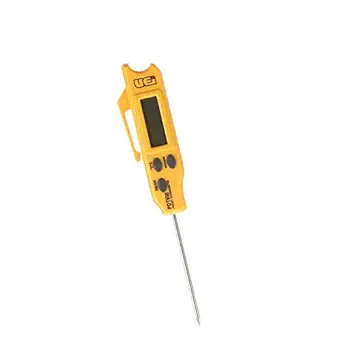 | Best Overall | Temperature Range: −58 to 572°F (−50 to 300°C) | Accuracy: ±1.8°F (±1°C) from −22 to 302°F | Resolution: 0.1° | VIEW LATEST PRICE | See Our Full Breakdown |
| UEi PDT655 Differential Temperature Folding Pocket Thermometer |  | Best for Differential Diagnostics | Temperature Range: −58 to 572°F | Response Time: 500 milliseconds, 1-second refresh | Probe Length: 5 inches, folding | VIEW LATEST PRICE | See Our Full Breakdown |
| worksite digital thermometer | Temperature Range | Response Time | Probe Length | Display |
|---|---|---|---|---|
| UEi Test Instruments PDT650 Fo | −58 to 572°F (−50 to 300°C) | 500 milliseconds | 3.5 inches, folding | Large LCD, non-backlit |
| UEi PDT655 Differential Temper | −58 to 572°F | 500 milliseconds, 1-second refresh | 5 inches, folding | Digital LCD with backlight |
More Details on Our Top Picks
UEi Test Instruments PDT650 Folding Pocket Digital Thermometer, Yellow
The UEi PDT650 earns my top spot because it gets the fundamentals right where it counts: build, accuracy, and hands-free convenience. Its stainless steel probe folds flat against the body, and unlike cheaper stick thermometers, it takes readings at any angle — open or closed — which means you are not fighting the probe position when you are wedged next to a duct or reaching into a condensing unit. The built-in magnet is the feature that quietly changes daily workflow: stick it to the duct or cabinet while you work, glance at the large LCD, and keep both hands on the job.
Accuracy is rated at ±1.8°F (±1°C) across −22 to 302°F with 0.1° resolution, which is plenty for HVAC and refrigeration diagnostics, and the Min/Max memory captures peak highs and lows so you can walk away from a running system and still see what happened. Compared with its sibling, the PDT655, the PDT650 gives up the backlit display and the automatic differential calculation, but it compensates with a more forgiving stainless-steel-and-housing construction and a standard, long-life LR44 button cell that you can replace at any hardware store. The roughly one-hour auto power-off protects that battery from the classic dead-meter-at-the-truck problem.
The tradeoffs are real, though. There is no backlight, so reading supply temperatures inside a dark return plenum means squinting or grabbing a flashlight. And if differential temperature is central to your commissioning work, you will be doing the subtraction yourself. For most techs, those are minor inconveniences set against a tool backed by a 3-year limited warranty from a company with a long history in test and measurement.
Pros:- Stainless steel probe construction survives daily tool-bag abuse
- Magnetic mount allows hands-free readings on ducts and equipment
- Wide −58 to 572°F range with ±1.8°F accuracy and Min/Max memory
- Standard LR44 battery and 3-year limited warranty keep ownership simple
Cons:- No backlit display, which is limiting in dark attics and plenums
- No differential temperature function, so T1–T2 math is manual
- Fixed 3.5-inch probe may be short for deep duct or tank measurements
Best for: HVAC and refrigeration techs, food service inspectors, and field service workers who want a rugged, accurate everyday thermometer with hands-free mounting.
Not ideal for: Techs who regularly work in dark mechanical spaces or who need automatic T1–T2 differential readings for commissioning and efficiency checks.
- Temperature Range:−58 to 572°F (−50 to 300°C)
- Accuracy:±1.8°F (±1°C) from −22 to 302°F
- Resolution:0.1°
- Response Time:500 milliseconds
- Probe Length:3.5 inches, folding
- Display:Large LCD, non-backlit
- Power:1 LR44 (AB13) button cell, included
- Mounting:Built-in magnet and pocket clip
- Warranty:3-year limited
Our verdict“The PDT650 makes the most sense as a do-everything worksite thermometer that prioritizes durability and simplicity over smart features.”
UEi PDT655 Differential Temperature Folding Pocket Thermometer
The UEi PDT655 is the smarter sibling in this two-horse race, and its defining feature is the one the PDT650 lacks entirely: automatic differential temperature calculation. Store a reading as T1 at the supply, take a second as T2 at the return, and the meter does the subtraction for you. For anyone who performs commissioning checks, verifies heat exchanger performance, or documents temperature rise across a system, that single function eliminates the mental math — and the mental math mistakes — that come with juggling readings.
The second advantage over the PDT650 is practical rather than computational. The PDT655 has a backlit display, which is genuinely useful if your work takes you into attics, crawlspaces, or the dim interior of an air handler cabinet. It also carries a longer 5-inch folding probe versus the PDT650’s 3.5 inches, giving you better reach into deep registers and duct runs, and it refreshes readings every second. The magnetic mount carries over from its sibling, so hands-free operation on steel ductwork is equally easy.
Where the PDT655 gives ground is durability and upkeep. The outer construction leans on plastic where the PDT650 leans on stainless, so a hard drop onto concrete is a bigger concern. It also runs on a nonstandard battery type, which is the kind of detail you discover at the worst possible moment — plan ahead and keep a spare in the van. This pick makes the most sense for the diagnostic-focused technician; if your thermometer use is mostly quick point checks and you work mostly in lit spaces, the PDT650’s tougher build is the better long-term companion.
Pros:- Automatic T1–T2 differential temperature calculation saves field math
- Backlit display is readable in dark attics, plenums, and crawlspaces
- Longer 5-inch folding probe reaches deeper into ducts and registers
- Compact 6-inch folded size with magnetic mount for hands-free use
Cons:- Nonstandard battery type is harder to source in a pinch
- Plastic outer construction is less rugged than the PDT650’s stainless build
- Advanced functions add learning curve for techs who only need point readings
Best for: HVAC technicians, commissioning agents, and service techs who need T1–T2 differential readings and visibility in dark workspaces.
Not ideal for: Tradespeople who want maximum physical durability, standard battery availability, and don’t need differential math or a backlight.
- Temperature Range:−58 to 572°F
- Response Time:500 milliseconds, 1-second refresh
- Probe Length:5 inches, folding
- Display:Digital LCD with backlight
- Special Functions:Differential temperature (T1 − T2), Min/Max
- Power:1 nonstandard battery
- Folded Dimensions:6 x 1.5 x 0.75 inches
- Weight:3.2 ounces
- Extras:Magnetic mount, auto shutdown, low battery warning
Our verdict“The PDT655 is the right call when differential temperature readings and low-light visibility matter more than outright ruggedness.”

How We Picked
Because a worksite thermometer lives or dies by how it behaves on the job — not on a spec sheet — I judged both models against the criteria that matter most to tradespeople. First, I looked at durability and build: a thermometer that rides in a tool pouch next to wrenches and pipe fittings needs a housing and hinge that survive contact, so material choices weighed heavily. Second, I evaluated accuracy and range. Both contenders cover −58 to 572°F, which handles everything from freezer coils to hydronic loops, so the differentiator became rated accuracy and reading refresh speed. Third, I considered jobsite ergonomics: magnetic mounting, probe length, folding behavior, pocket carry, and whether the display is readable in the dark spaces where HVAC techs often work. Fourth, I weighed diagnostic capability — specifically whether the tool just reports a temperature or actually helps with field calculations like differential readings. Finally, I factored in long-term ownership: battery type, warranty length, and how easy the tool is to keep in service. Where the two models diverged on these points, I assigned roles rather than declaring one universally superior, because a refrigeration tech and an HVAC installer genuinely want different things from the same category of tool.
| worksite digital thermometer | Temperature Range | Display |
|---|---|---|
| UEi Test Instruments PDT650 Fo | −58 to 572°F (−50 to 300°C) | Large LCD, non-backlit |
| UEi PDT655 Differential Temper | −58 to 572°F | Digital LCD with backlight |
Factors to Consider When Choosing Best Worksite Digital Thermometer
Before choosing between these two thermometers — or any worksite digital thermometer — it helps to understand what actually separates a field-ready tool from a kitchen gadget in a yellow case. These are the factors I would weigh before spending money.Temperature Range and Accuracy
Both models here cover −58 to 572°F, which is the sweet spot for HVAC and refrigeration work: low enough for freezer evaporator coils, high enough for supply air off a furnace or a hydronic loop. What varies is the rated accuracy band. The PDT650 specifies ±1.8°F across its core working range, so you know what tolerance to expect. For most diagnostic work — checking temperature split, superheat-adjacent air measurements, or food safety — one degree of uncertainty is acceptable. If your work demands tighter tolerances, a pocket thermometer of any brand is the wrong instrument class, and a calibrated meter with a thermocouple input is the better investment.
Build Quality and Probe Design
On a worksite, the thermometer will be dropped, wedged, and carried loose in a pouch. The PDT650’s stainless steel construction is built for exactly that treatment, while the PDT655’s plastic housing trades toughness for a lighter feel and room for the backlight. Probe design matters just as much: a folding probe protects the tip in transit and lets the meter sit flat, and a longer probe like the PDT655’s 5 inches gives reach into deep ducts that a shorter tip simply cannot access. Check whether the tool reads at any probe angle, because a thermometer that only reads correctly fully open becomes a nuisance in tight equipment compartments.
Display and Readability
A number you cannot read is not a measurement. Large digits help in bright sun, but the bigger differentiator is a backlight — a feature only the PDT655 offers here. If your average job site is a finished mechanical room with good lighting, skip the backlight and prioritize other features. If you regularly work in attics, under houses, or inside air handler cabinets, the backlight moves from luxury to necessity. Also look for 0.1° resolution so small changes register, and Min/Max memory if you want the tool to track extremes while you are elsewhere on the job.
Hands-Free Features and Mounting
Both of these models include a built-in magnet, and it is easy to underestimate how much this changes daily use. Being able to stick the thermometer to a duct or cabinet and read it while your hands stay busy means fewer set-down-and-lose-it moments and faster readings. A pocket clip matters too, especially for techs moving between rooms or climbing ladders. If you are comparing against other thermometers on the market, treat magnetic mounting as a baseline requirement for field work, not a bonus.
Battery and Long-Term Ownership
Battery type is the least glamorous consideration and one of the most annoying to get wrong. The PDT650 runs on a common LR44 button cell available anywhere batteries are sold. The PDT655 uses a nonstandard cell, which means planning spares in advance. Auto power-off — present on both — prevents a dead meter after a forgotten pocket-powered weekend. Finally, warranty length signals how seriously the manufacturer stands behind the tool; UEi’s 3-year coverage on the PDT650 reflects the confidence you want in gear that gets used hard.
Frequently Asked Questions
What is differential temperature, and do I actually need it?
Differential temperature is the difference between two measured points — most often supply and return air, or inlet and outlet on a heat exchanger — and it is one of the core numbers HVAC techs use to verify system performance. If you regularly document temperature split, check furnace temperature rise, or commission systems, a meter like the PDT655 that stores T1 and calculates T1 − T2 automatically saves time and reduces transcription errors. If your thermometer work consists mostly of quick point checks — is this line hot, is this walk-in cold — you can do the subtraction in your head or on your phone, and the PDT650’s simpler operation is the better fit.
Can I use these thermometers for food or body temperature?
For food service, yes — both models cover the range needed for checking holding temps, refrigeration, and cooking surfaces, and the stainless probe on the PDT650 in particular is well suited to that environment. For people or animals, no. UEi explicitly states these are measurement instruments, not medical devices, and they are not intended for use on humans. Body temperature requires a validated clinical thermometer with appropriate accuracy and probe design, so keep these tools on equipment, ducts, liquids, and surfaces only.
How important is the backlit display on the PDT655?
That depends entirely on where you work. If your jobsites include attics, crawlspaces, return plenums, or the interiors of air handler cabinets, a backlight is genuinely valuable — you will take readings in spaces where overhead light does not reach, and pulling out a headlamp for every temperature check gets old quickly. If you work mostly in well-lit mechanical rooms, commercial kitchens, or outdoor equipment, the backlight becomes a feature you forget exists. In that case the PDT650’s tougher construction matters more day to day than the PDT655’s illumination.
Which model survives jobsite abuse better?
The PDT650 is the more durable of the two. Its stainless steel construction and simpler design give it an edge against drops, impacts, and the general rough handling that comes with life in a tool bag. The PDT655 relies more heavily on plastic in its housing, which keeps it light but makes a drop onto concrete a bigger risk. Neither is indestructible, and a folding probe is a hinge — treat it accordingly — but if your gear takes a beating and you want the thermometer most likely to shrug it off, the PDT650 is the safer bet.
Are these accurate enough for professional HVAC work?
Yes, for the air and surface measurements that make up most residential and light commercial diagnostics. The PDT650 is rated at ±1.8°F across its main working range with 0.1° resolution, and the PDT655 delivers comparable performance with a one-second refresh. That level of uncertainty is acceptable for temperature split checks, supply/return differentials, and general troubleshooting. If you are doing laboratory-grade verification or need certified calibration for compliance documentation, a pocket thermometer is the wrong tool class — you will want a calibrated bench or logging instrument instead. For everyday fieldwork, both of these hold their own.
Conclusion
With only two models in this matchup, the right choice comes down to matching the tool to your workflow rather than ranking one above the other in every scenario. For the general tradesperson — the HVAC tech, refrigeration mechanic, or field service worker who wants one dependable thermometer that survives the tool bag and takes quick, accurate readings — the UEi PDT650 is my recommendation: stainless build, magnetic hands-free mounting, a standard battery, and a 3-year warranty make it the best overall worksite pick. For the diagnostic-focused technician who commissions systems, documents temperature rise, or regularly works in dark mechanical spaces, the UEi PDT655 justifies its place with automatic T1–T2 differential calculation, a backlit display, and a longer probe — just budget for a spare battery and treat it a little more gently. And if you are genuinely torn, ask one question: do you subtract two temperatures on most jobs? If yes, buy the PDT655. If no, buy the PDT650 and enjoy the tougher tool.
Fall yard work Picks
leaf blowers
As an affiliate, we earn on qualifying purchases.