
TL;DR

Get business pricing on tools and workshop supplies
- Business-only prices and quantity discounts
- Tax-exempt purchasing
- Multiple users, one account, clear invoices
Effective toolbox talks focused on near misses use one specific event, honest worker discussion, and corrective actions tied to today’s work. In 10 to 15 minutes, you can identify what happened, find weak controls, assign ownership, and verify that the fix works.
A wrench can fall six stories and miss a worker by inches. Nobody gets hurt, but the jobsite just handed you a warning with a loud metallic ring.
Near misses—also called near hits or close calls—are unplanned events that cause no injury, illness, damage, or loss but could have. This guide shows you how to conduct effective toolbox talks focused on near misses, from choosing the right example to confirming that the fix actually changed the work.
You will learn how to lead a focused 10- to 15-minute discussion, ask questions that uncover system problems, and turn “be more careful” into a real control your crew can use before the next shift.
Choose one specific near miss and describe the facts, hazard, and potential outcome without blaming a worker.
Ask what made the event possible, what stopped the harm, and whether the same exposure exists during today’s work.
Replace vague reminders with physical, procedural, or planning controls that have an owner and deadline.
Use demonstrations and worker explanations to confirm understanding instead of relying on a one-way lecture.
Measure completed actions, repeat events, participation, and verified field changes—not report count alone.
Field guide / safety leadership
Turn a near miss into a safer next shift.
An effective toolbox talk uses one specific event, honest worker discussion, and corrective actions tied to today’s work. In 10–15 minutes, your crew can identify what happened, find weak controls, assign ownership, and verify that the fix works.
A near miss is useful safety data—not proof that “nothing happened.”10–15 min
Short enough to hold attention. Focused enough to produce a decision.
From blame to control
Examine the conditions that made the event possible, not only the final action.
Verify the field change
Completion matters only when the new control changes the work.
01 / Start with evidence
Choose one event your crew can see in their own work.
Specificity creates a shared picture. A vague story gives workers nothing to inspect, question, or change.
Describe the scene
State the task, location, hazard, time, and the barrier that stopped harm. Keep the story narrow and observable.
Remove the trial
Remove names when needed. The purpose is honest learning, not a public trial that teaches workers to stay silent.
Bring it to today
Ask whether the same task, equipment, layout, crew, or condition exists during the current shift.
“At 9:20 Tuesday, a plumber carrying pipe stepped backward into an open floor penetration near the east stairwell. A spotter shouted, and the worker stopped before falling.”
Example: facts first, blame last02 / Ask better questions
Find the weak control—not just the person closest to the event.
Move from what happened to why it was possible, what stopped the harm, and what must change before work resumes.
What hazard was present?
Name the energy, object, movement, exposure, or condition that could cause harm.
What made it possible?
Look at planning, layout, equipment, communication, workload, and weather.
What stopped the harm?
Identify a guard, spotter, alarm, inspection, decision, or plain stroke of luck.
Could it happen here today?
Compare the event with the current crew, task, equipment, and work area.
Which control will change?
Choose a physical or process improvement—not a reminder to “pay attention.”
Who owns the action?
Put a name and deadline beside every commitment before the talk ends.
03 / Run the talk
A reliable 15-minute sequence keeps the crew involved.
Use worker explanations, short demonstrations, photos, diagrams, or hands-on inspections to confirm understanding.
Frame the facts
Explain the event without judgment or exaggeration.
Open the discussion
Ask what made it possible and what could have happened.
Connect today’s work
Walk through current tasks, changes, interfaces, and permits.
Assign the fix
Choose an owner, deadline, and control that addresses the hazard.
Confirm understanding
Ask workers to explain or demonstrate the key control.
Replace “be more careful” with a control.
A reminder depends on perfect attention. A stronger action changes the conditions that create exposure.
04 / Measure what matters
Report count is a signal—not a safety score.
A useful picture combines participation, completed actions, repeat events, and verified improvements in the field.
Illustrative scorecard: use your own baseline and trend these measures over time.
| Measure | Useful question | Signal |
|---|---|---|
| Action completion | Did owners close commitments? | ✓ Strong |
| Repeat events | Did the same exposure return? | ✗ Warning |
| Participation | Did workers contribute and explain? | ~ Watch |
| Field verification | Did the work actually change? | ✓ Strong |
Traceability / from warning to learning
Make every reported event travel to a visible improvement.
A talk earns credibility when workers can see what changed because someone reported the near miss.
Start With One Near Miss Your Crew Can See
Effective toolbox talks focused on near misses begin with one specific event that workers can recognize in their own work. Describe the task, location, hazard, and lucky break in plain language. A vague story about “a safety issue last month” gives people nothing to inspect, question, or change.
Pick an event from your site, a similar project, or the same type of work nearby. Remove names and identifying details when needed. The goal is honest learning, not a public trial. This distinction matters because a story framed as punishment encourages workers to defend themselves or stay silent; a story framed as evidence invites them to identify conditions that could affect anyone.
Say, “At 9:20 Tuesday, a plumber carrying pipe stepped backward into an open floor penetration near the east stairwell. A spotter shouted, and the worker stopped before falling.” That sentence gives the crew a place, a task, a hazard, and a control that worked. It also leaves room to ask whether the spotter was a reliable barrier or whether the opening should have been covered so the event did not depend on someone noticing it in time.
Keep the event narrow. A talk about one unguarded opening will usually change behavior more than a lecture covering falls, rigging, traffic, chemicals, and housekeeping at once. Narrow scope is not a limitation; it is what allows the crew to move from recognition to a decision about one exposure before attention fades.
A near miss is useful safety data, not proof that nothing happened.
construction safety toolbox talk guide
As an affiliate, we earn on qualifying purchases.
As an affiliate, we earn on qualifying purchases.
Tell the Story Without Blaming the Worker
Effective toolbox talks focused on near misses explain what happened without labeling anyone careless, reckless, or stupid. Start with observable facts: where the work occurred, what the crew was doing, what condition existed, and what stopped the event from becoming an injury.
Then ask what could have happened under slightly different circumstances. A worker who missed a trench edge by one step may have suffered a serious fall if the ground was wet, the lighting was weaker, or the spotter had looked away. Discussing the changed circumstance helps the crew understand potential severity without exaggerating the outcome or treating luck as a control.
Use the near miss as a window into the job, not a spotlight on one person. Check for time pressure, poor housekeeping, confusing instructions, fatigue, incomplete training, defective equipment, weak supervision, or simultaneous work by another crew. These factors matter because correcting only the final action may leave the conditions that make the same action likely. The tradeoff is that a broader discussion takes slightly longer, but it produces controls that protect more than the individual involved.
For example, a forklift nearly strikes a laborer at a blind corner. The immediate action may be that the driver failed to stop. The deeper causes may include a blocked sightline, no marked pedestrian route, a delivery deadline, and a radio call that never reached the crew. Disciplining the driver might satisfy an immediate demand for accountability, but clearing the sightline, separating routes, and improving communication reduce the chance that another driver and pedestrian will repeat the pattern.
- State the facts: describe actions and conditions you can verify.
- Ask about the system: examine planning, equipment, layout, staffing, and communication.
- Protect good-faith reporting: workers need to know that reporting a near miss will not automatically bring punishment.
As an affiliate, we earn on qualifying purchases.
Use These Questions to Find the Weak Control
Effective toolbox talks focused on near misses ask workers to find the missing or weak control, not simply repeat the incident story. The strongest questions move from the event to today’s exposure: what happened, why it was possible, what stopped the harm, and what must change before work resumes.
- What hazard was present? Name the energy, object, movement, exposure, or condition that could cause harm.
- What made the event possible? Look at planning, layout, equipment, communication, workload, and weather.
- What stopped it from becoming an incident? Identify a spotter, guard, alarm, inspection, decision, or plain stroke of luck.
- Could it happen here today? Compare the event with the current crew, task, equipment, and work area.
- Which control will change? Choose a physical or process improvement, not a reminder to “pay attention.”
- Who owns the action, and when will it be done? Put a name and deadline beside every commitment.
The order matters. If the crew jumps directly to a solution, it may choose a convenient response that treats the symptom rather than the hazard. Asking what stopped the harm also prevents a false conclusion that the existing process worked when the outcome actually depended on luck.
Suppose a worker almost contacts an energized conductor while moving a ladder. Ask whether the circuit was identified, whether power was shut off, whether the boundary was marked, and whether the job hazard analysis matched the actual work. The answers reveal whether the failure was a single missed step or a breakdown in planning and energy control. That distinction determines whether a reminder is enough or whether the work method must be redesigned.
For electrical work, stop the exposure, keep people clear, use appropriate PPE, and involve a qualified electrician. Follow your company procedure, permit rules, and local code requirements. A toolbox talk does not replace lockout/tagout or licensed professional work. The talk supports the control process; it cannot authorize workers to improvise around it.
hazard identification safety poster
As an affiliate, we earn on qualifying purchases.
As an affiliate, we earn on qualifying purchases.
Connect the Near Miss to Today’s Work
Effective toolbox talks focused on near misses matter most when the crew can spot the same hazard during today’s shift. After discussing the event, walk through the current tasks, changing conditions, new workers, weather, equipment, contractors, permits, and emergency arrangements.
Think of the near miss as a jobsite weather report. It tells you where the pressure is building, but you still need to check the sky above your own work area. A lesson from yesterday is useful only if the conditions that created it are compared with the conditions people face now.
If yesterday’s close call involved a dropped wrench, inspect today’s overhead work. Are tools tethered? Is the exclusion zone wide enough? Does another crew need to pass below? Is the barricade visible from both directions? The answers may show that the original control is technically present but ineffective because the work sequence, route, or access point changed.
Make the connection specific. Say, “The steel crew starts above the south entrance at 8:00. No one walks under that bay. We will move the pedestrian route to the west gate, install toe boards, and inspect the drop zone before lifting.” This converts a general lesson into a temporary operating plan. It may add walking distance or setup time, but that cost is visible and manageable; an uncontrolled overhead exposure transfers the cost to whoever happens to be underneath.
- Review today’s tasks and work locations.
- Check for new or temporary workers.
- Discuss weather, lighting, noise, and changing ground conditions.
- Coordinate with contractors working nearby.
- Confirm required permits, controls, and emergency access.
As an affiliate, we earn on qualifying purchases.
Replace “Be Careful” With Controls That Work
Effective toolbox talks focused on near misses finish with specific controls that reduce exposure. “Be more careful” is not a corrective action because it depends on perfect attention during a busy shift. Choose a change that makes the safer action easier or blocks the hazard altogether.
Use the hierarchy of controls as a practical filter. First ask whether you can remove the hazard. If you cannot, change the material or method, add a guard or barrier, improve the procedure, and then select PPE for the remaining exposure. Higher-level controls usually require more planning or expense, but they protect people even when attention is divided. Lower-level controls can be faster to implement, but they depend more heavily on consistent human behavior and therefore need stronger supervision and verification.
A crew that nearly slips on hydraulic oil needs more than a reminder to watch its step. Fix the leak, place absorbent material, improve inspection frequency, and review how the equipment gets parked. The worker still needs slip-resistant footwear, but footwear should not carry the whole solution. If the leak remains, PPE can reduce consequences without preventing the fall, so closing the source and checking that the repair holds are the more important actions.
| Weak response | Stronger response |
|---|---|
| Be more careful around the opening. | Install a rated cover, secure it, mark it, and inspect it before each shift. |
| Watch for forklifts. | Separate pedestrian and equipment routes with signs, barriers, and a defined crossing. |
| Use PPE correctly. | Remove the exposure where possible, verify the right PPE, and train workers on its limits. |
| Communicate better. | Hold a pre-task briefing, name the signal, and confirm the receiver repeats the instruction. |
Assign every action to a person with a deadline. “Maintenance will repair the guard before the next production run” can be tracked. “Someone should check it” disappears into the noise. Also state how completion will be verified, because an action marked complete may mean a part was ordered, not that the hazard was actually controlled in the field.
Run a Short Talk That Gets the Crew Talking
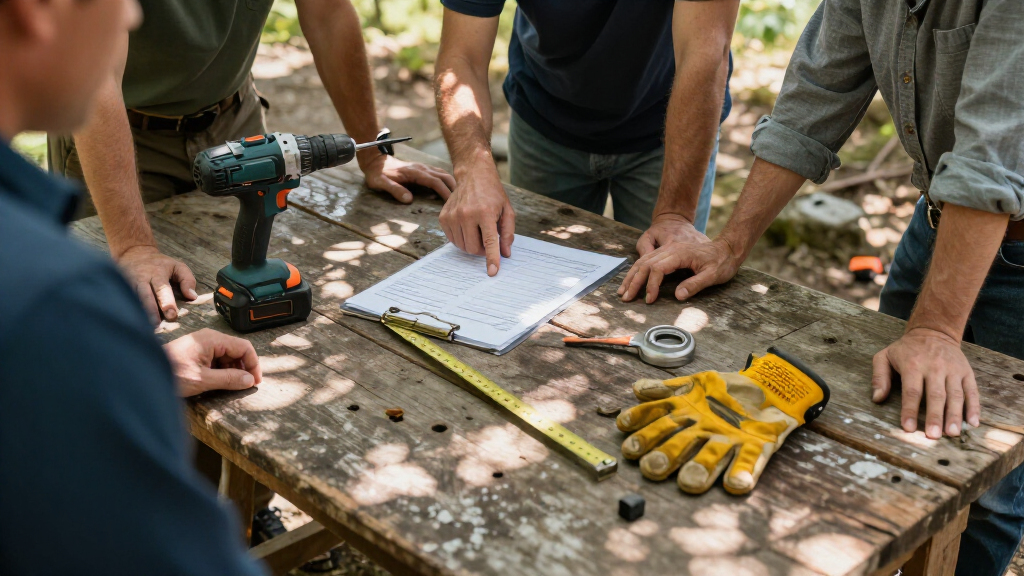
Effective toolbox talks focused on near misses usually take 10 to 15 minutes when you prepare one event, three questions, and a short action list. Keep the crew standing where they can see the hazard or a photo of it. A discussion beats a long speech because workers can test the proposed control against the realities of the task, although the leader still needs to manage time and prevent the conversation from becoming an unfocused investigation.
- State the objective: tell the crew what hazard they will prevent.
- Describe the event: give the location, task, sequence, and potential consequence.
- Invite worker input: ask what made the event possible and what controls were weak.
- Relate it to today: identify where the same exposure exists on this shift.
- Demonstrate the control: inspect the barrier, route, tool, PPE, or permit together.
- Assign actions: name the owner, deadline, and verification method.
- Confirm understanding: ask workers to explain the key control in their own words.
- Record and follow up: document attendance, decisions, and open items.
For example, instead of reading a slide about ladder safety, place the ladder beside the work area. Ask a worker to show the inspection points, the setup distance, and the location of the three-point-contact zone. Demonstration exposes misunderstandings that a nod or signed roster can hide, while also showing whether the equipment and setup are practical.
Watch who speaks. The quiet worker who performs the task every day may see a pinch point that supervisors miss. Invite that view directly, then thank the person by acting on useful information. Participation has a practical consequence: when workers help shape a control, they are more likely to identify problems with it and use it consistently. That benefit is lost if input is requested but never reflected in the final action.
Measure Whether the Talk Changed the Job
Effective toolbox talks focused on near misses work when the job changes afterward. Track completed actions, repeat events, worker participation, report quality, time to close high-risk items, and proof that controls were installed and used. Attendance alone tells you almost nothing because a person can be present without understanding the hazard or changing the work.
Do not treat a rise in reports as automatic evidence that safety got worse. More reports may show stronger trust, a reporting campaign, or easier mobile access. A sudden jump still deserves review by location, task, shift, equipment, contractor, and hazard type. Report volume is therefore a signal to investigate, not a score to reward or punish in isolation. Fewer reports can mean fewer hazards, but they can also mean workers have stopped reporting.
Imagine that your site records twelve reports about poor lighting near the laydown yard. The useful finding is not “twelve near misses.” It is that workers repeatedly encounter the same condition after dark. Add lighting, verify the foot traffic route, and check the area on the next night shift. The follow-up matters because a repair that looks complete during daylight may leave glare, shadows, or damaged fixtures unresolved when the exposure actually occurs.
Close the loop in front of the crew. Say what changed, who completed it, and how you checked the result. When workers see a report lead to a guard, route change, repair, or revised job hazard analysis, reporting gains credibility. If the proposed fix is delayed or rejected, explain why and identify the interim control; silence teaches workers that reporting produces paperwork without protection.
The best near-miss metric is not how many stories you collect. It is how many hazards you remove and how few repeat events return.
- Track the percentage of actions completed on time.
- Review repeat events and recurring hazards.
- Check worker confidence in the reporting process.
- Verify controls in the field, not only in a closed record.
Avoid the Habits That Make Near-Miss Talks Useless
Effective toolbox talks focused on near misses fail when they become blame sessions, paperwork exercises, or broad lectures with no owner. A talk loses value when the crew hears a problem but never sees a repair, barrier, route change, or procedure update. The visible follow-through is important because workers judge the reporting system by what happens after they speak, not by how polished the meeting appears.
One common mistake is focusing only on PPE. Gloves, glasses, hard hats, and fall protection matter, but they sit near the bottom of the control hierarchy. If you can eliminate the exposure or isolate it with a guard, do that before relying on perfect worker behavior. PPE may be the fastest interim measure, but treating it as the final answer can leave the source of the hazard unchanged and shift responsibility onto the person least able to control the work design.
Another mistake is using statistics without explaining what they mean. Ten reports from one area could signal danger, better reporting, duplicate entries, or a temporary project phase. Look for patterns and inspect the work before making a judgment. Numbers are valuable when they direct attention to a task or condition; they become misleading when they are used as a simple ranking of crews or as proof that one supervisor is safer than another.
Do not punish good-faith reporting. If workers believe every report brings discipline, the near misses vanish from the record while the hazards remain on the floor. Accountability still matters when someone knowingly violates a clear requirement, but separating reckless conduct from honest reporting preserves the information needed to improve the system.
- Do not discuss too many hazards at once.
- Do not use anonymous stories with no connection to the crew’s work.
- Do not close an action until someone verifies the fix.
- Do not confuse a signed attendance sheet with understanding.
- Do not blame one worker when planning, design, equipment, or supervision also shaped the event.
Frequently Asked Questions
What is the difference between a near miss and an unsafe condition?
A near miss is an event that happened without harm. An unsafe condition is a hazard that exists whether or not an event has already occurred, such as an unguarded opening or blocked exit.
Should every near miss be investigated?
Every near miss should be reported and reviewed. Match the depth of the review to the possible severity, recurrence, complexity, and available facts. A high-potential event deserves a deeper review even when nobody was hurt.
How do you encourage workers to report near misses?
Make reporting simple, respond quickly, protect good-faith reporters from retaliation, and share what changed. Offer open, confidential, and anonymous options when appropriate, then show the crew that reports lead to real action.
What if the near miss was caused by worker error?
Discuss the worker’s action, but also examine training, supervision, equipment, workload, layout, procedures, and site conditions. Blame may close a conversation; understanding the full set of contributing factors helps prevent a repeat.
How can you tell whether a toolbox talk worked?
Look for active worker participation, accurate explanations of the hazard, completed corrective actions, stronger field controls, and fewer repeat events. A signed roster proves attendance, not learning or risk reduction.
Conclusion
A near miss becomes valuable when you turn it into a better way to work. Pick one event, ask what made it possible, strengthen the control, assign the action, and return to the crew with proof that the fix happened.
Do that consistently, and the next warning may be a story told around the toolbox instead of an ambulance leaving the gate.
Fall Picks
fall essentials
As an affiliate, we earn on qualifying purchases.