
TL;DR

Get business pricing on tools and workshop supplies
- Business-only prices and quantity discounts
- Tax-exempt purchasing
- Multiple users, one account, clear invoices
Tracking crew skill development over time means recording what each person and team can demonstrate, when they demonstrated it, and where they still need practice. Use a competency matrix, behavior-based field observations, repeatable task checks, and delayed reassessments so your records show real job readiness rather than attendance.
A worker can carry a training card and still freeze when the trench shield shifts, the pump quits, or a lift starts to drift. Paper qualifications show completed requirements, but they do not always show current field proficiency. That gap matters when the job gets loud, muddy, crowded, and fast.
You need a tracking system that answers practical questions before the morning huddle ends. Who can run the task without help? Who needs a spotter or coach? Which crew skills are getting stronger, and which ones have gone rusty after 90 days without use?
This guide gives you a workable method built around observable behaviors, dated evidence, repeatable checks, and direct coaching. You will see how matrices, mobile forms, simulations, debriefs, and simple trend lines fit together. The goal is a clear development record that helps you assign work safely, build bench strength, and catch weak spots before the job exposes them.
Define each skill through observable actions and four clear levels: developing, competent, proficient, and ready to coach.
Keep course completion, qualification, currency, and demonstrated proficiency as separate records.
Show the evidence date, assessor, conditions, and source behind every matrix rating instead of relying on color alone.
Measure individual performance and team coordination separately so coaching reaches the real cause of a problem.
Turn every weak result into focused practice with an owner and reassessment date.
Tools and Techniques for Tracking Crew Skill Development Over Time
Build a record of what each person and team can demonstrate, under which conditions, and when the skill was last verified. The result is a clearer view of job readiness—not merely training attendance.
A reliable record connects every rating to a task, date, assessor, operating condition, result, and follow-up.
Separate independent readiness from work that still requires a spotter, coach, or controlled practice.
If a rating cannot point to an observed action, it should not drive a high-stakes assignment.
Turn broad skills into observable behavior
Start with the work the crew actually performs. Define actions that two trained evaluators can see, hear, and score in the same way.
Developing
Performs parts of the task with instruction, prompting, or close supervision.
Competent
Completes the task safely under normal conditions without prompting.
Proficient
Adapts to changing conditions, detects errors, and explains the reason behind each step.
Ready to Coach
Performs consistently, gives useful feedback, and develops capability in others.
Technical execution
Correct sequence, tools, tolerances, controls, and protective equipment.
Communication
Clear directions, confirmed critical information, and closed-loop exchanges.
Problem-solving
Detects change, pauses when needed, and selects an approved response.
Work management
Plans materials, controls the work area, and prepares the next operation.
Give every tracking tool one clear job
No single application or score can show the full performance picture. Combine administrative records, field evidence, practice results, and operational outcomes.
| Tool | Best use | Field proficiency | Primary caution |
|---|---|---|---|
| Learning management system | Courses, cards, tests, completion dates, and expirations | ✗ Indirect evidence | Completion can be mistaken for competence |
| Skills matrix | Fast coverage view by worker, role, task, project, or shift | ~ Depends on source data | Colors can hide old or weak evidence |
| Mobile observation form | Dated behavior checks with notes, signatures, and evidence | ✓ Direct evidence | Long forms encourage rushed ratings |
| Digital portfolio | Work samples, checklists, coaching notes, and corrective practice | ✓ Supporting evidence | Files fail without consistent labels |
| Video or simulation | Rare, complex, abnormal, or hazardous scenarios | ✓ Repeatable evidence | Control realism, access, retention, and privacy |
Make development visible across time
A baseline, comparable observations, focused coaching, and delayed reassessment turn scattered notes into a trend the worker and supervisor can trust.
Set the baseline
Observe a normal task and record crew size, equipment, conditions, complexity, and prompting.
Capture evidence
Record actions, timing, errors, recoveries, work samples, and the source of the evidence.
Debrief promptly
Ask the worker to explain the event, connect feedback to the standard, and correct unsafe misunderstandings.
Practice narrowly
Target one or two weak behaviors. Increase complexity only after performance becomes steady.
Recheck later
Use comparable conditions after a delay to reveal retention rather than short-term memory.
Currency weakens when a skill goes unused
Do not treat the example percentages as universal thresholds. Use your own repeated observations to identify decay, determine reassessment intervals, and distinguish a one-off result from a recurring pattern.
Triangulate performance before assigning work
Keep individual execution and team coordination distinguishable. A technically qualified group can still fail through weak handoffs, role confusion, or poor recovery.
Qualified observation
Behavior-based field notes, task conditions, amount of prompting, errors, and recovery actions.
Repeatable task checks
Comparable scenarios and rubrics that reveal improvement, consistency, and increasing complexity.
Operational outcomes
Work quality, recurring errors, near misses, handoffs, rework, and transfer from practice to the job.
Task execution
Technical proficiency, decision-making, communication, situational awareness, and workload control.
Crew coordination
Role clarity, cross-checking, information sharing, mutual support, adaptability, and error recovery.
Rating traceability
Competency, level, date, assessor, conditions, evidence link, confidence, owner, and next check.
Display the evidence date, assessment type, conditions, and confidence beside every rating. Keep course completion, qualification, currency, and demonstrated proficiency as separate records.
Build Skill Standards Your Foremen Can Actually Score
Tracking crew skill development over time starts with a list of tasks and behaviors that an evaluator can see, hear, and record. Replace fuzzy labels such as good attitude or strong judgment with specific actions, defined proficiency levels, and evidence requirements that two trained foremen can apply the same way.
Start with the work your crew performs, not a generic list pulled from a binder. A concrete crew may need standards for form setup, placement signals, vibrator use, finishing, curing, and cleanup. A utility crew may need excavation setup, competent-person inspections, pipe grade checks, equipment spotting, and lockout/tagout execution.
Give each competency four useful levels: developing, competent, proficient, and ready to coach. Competent might mean a worker completes the task safely under normal conditions with no prompting. Proficient might mean that person also handles changing conditions, catches another worker’s mistake, and explains the reason behind each step.
- Technical execution: Uses the right sequence, tools, tolerances, and protective equipment.
- Communication: Gives clear directions, repeats critical information, and closes the loop.
- Problem-solving: Spots a change, pauses when needed, and selects an approved response.
- Work management: Plans materials, controls the work area, and keeps the next operation moving.
For example, do not score a signal person on communication alone. Record whether the person maintained sight lines, used standard hand signals, stopped the lift after losing contact, and confirmed the next move. Those behavioral markers turn a broad opinion into usable evidence that supports coaching and assignment decisions.
Score what happened, not what you assume. If the record cannot point to an observed action, it should not drive a high-stakes assignment.
According to competency-based training research summarized by ForemanBrief [1], measuring demonstrated performance gives a stronger view of ability than counting course hours. This approach also makes skills across training easier to compare because every class, field check, and practice drill maps back to the same job behaviors.
As an affiliate, we earn on qualifying purchases.
Choose the Right Tool for Each Piece of Evidence
Tracking crew skill development over time works best when each tool has one clear job. Use an LMS for course records, a skills matrix for assignment readiness, observation forms for field behavior, and portfolios for supporting proof. No single app or score can show the whole performance picture.
| Tool | Best use | Watch for |
|---|---|---|
| Learning management system | Courses, cards, test results, expiration dates | Completion can be mistaken for competence |
| Skills matrix | Fast view of coverage by worker, role, and task | Colors can hide old or weak evidence |
| Mobile observation form | Dated field checks with notes, photos, and signatures | Long forms lead to rushed ratings |
| Digital portfolio | Work samples, checklists, coaching notes, and corrective practice | Files become useless without consistent labels |
| Video or simulation | Review of rare, complex, or hazardous events | Privacy rules and task realism need close control |
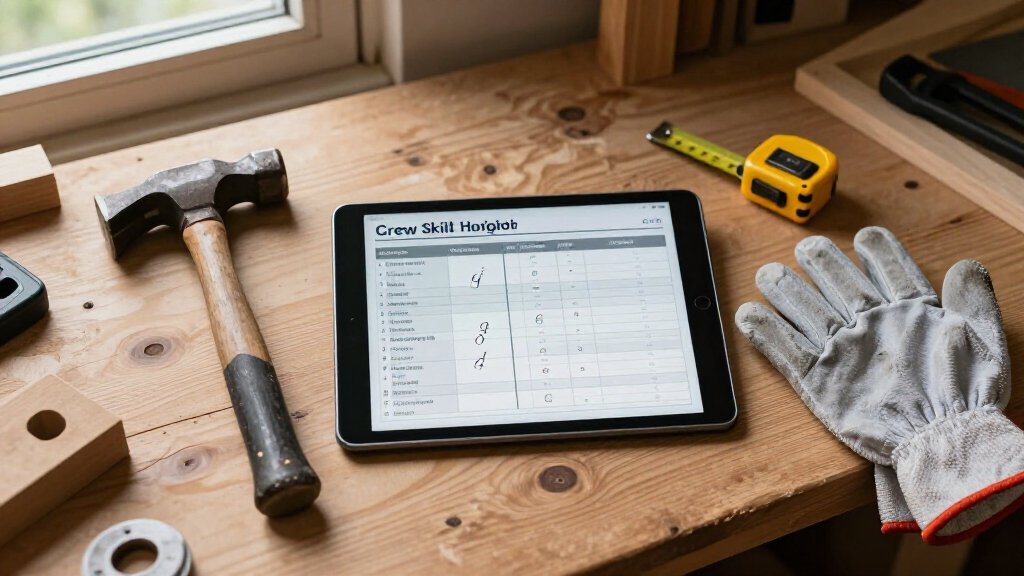
A small contractor does not need an expensive platform to begin. A protected spreadsheet can work well for tracking crew status when it includes the competency, current level, assessment date, assessor, evidence link, and next check date. Add filters by project, craft, and shift so the superintendent can find a gap in seconds.
Suppose the matrix shows three green cells for skid steer operation. One worker demonstrated the task last week, another did it eight months ago, and the third only completed online training. If the dashboard shows only green, it tells a comforting lie. Display the evidence date, assessment type, and confidence level beside every rating.
Mobile forms help during a noisy placement when paper turns soft under wet gloves. Keep the form short enough to finish in two or three minutes, with room for one observed strength and one next action. A form with 60 boxes often produces straight-line scoring because the evaluator starts tapping the same choice just to get done.
Recordings and sensor data can add detail, but they need limits. A time-stamped video may reveal a missed handoff that everyone forgot during the debrief, while a heart-rate reading cannot prove competence by itself. Set written rules for access, retention, correction, and permitted use so a coaching tool does not start to feel like constant surveillance.
field observation forms for construction
As an affiliate, we earn on qualifying purchases.
As an affiliate, we earn on qualifying purchases.
Run a Repeatable Five-Step Tracking Cycle
Tracking crew skill development over time needs a repeatable cycle: set a baseline, observe real work, score against fixed behaviors, coach one focused improvement, and check the skill again later. That rhythm turns scattered notes into a trend you can trust and a development plan the worker can follow.
- Set the baseline. Observe the worker on a normal task using the same rubric you will use later. Record conditions such as crew size, equipment type, weather, and task difficulty.
- Capture evidence. Write down actions, timing, errors, recoveries, and the amount of prompting needed. Attach a checklist, work sample, or approved recording when it adds value.
- Debrief promptly. Ask the worker to walk through what happened, then connect the discussion to the standard. Correct any unsafe misunderstanding on the spot.
- Assign focused practice. Pick one or two weak behaviors rather than repeating the entire task without a target. Increase difficulty only after performance becomes steady.
- Recheck after a delay. Test the skill under comparable conditions after enough time has passed to reveal retention rather than short-term memory.
Imagine a new pipe layer who misses grade twice during the baseline but corrects it after the foreman points to the laser reading. The next practice should focus on setup, reading, and independent verification. Two weeks later, repeat a similar run without prompts and compare accuracy, correction time, and consistency.
Use comparable checks, not surprise traps. Two trench scenarios can differ in soil, depth, or access while still testing the same core actions at a similar level. Record major differences because a clean score on a wide, dry site should not outweigh a slightly lower score earned in tight access with groundwater and active equipment nearby.
Trend lines beat snapshots. One weak day may reflect fatigue, unfamiliar equipment, or a rushed setup, while the same missed verification across four checks points to a real pattern. Track rate of improvement, recurring error types, time to correct errors, prompt frequency, and performance as complexity rises.
Structured debriefing makes the cycle useful instead of punitive. Ask what the worker noticed, what choice followed, and what changed the outcome. A sharp silence after a near miss can fill the trailer, but a calm review tied to one clear practice goal gives that moment somewhere productive to go.
As an affiliate, we earn on qualifying purchases.
See the Team Problems Individual Scores Miss
Tracking crew development must separate individual ability from team performance because qualified workers can still stumble together. Measure role clarity, information sharing, cross-checking, handoffs, error recovery, and response to changing conditions. Keep these team ratings beside individual records, not blended into one score.
Take a crane pick with an experienced operator, rigger, and signal person. Each worker may know the task, yet the lift can break down when the radio channel changes and nobody confirms it. The failure belongs to the coordination system, even if one person made the final missed call.
Watch for closed-loop communication. One worker states the direction, the receiver repeats it, and the first worker confirms the message. On a loud deck with backup alarms chirping and steel clanging, that short loop cuts through the noise like a bright stripe of paint.
- Role clarity: Each person knows who directs, checks, stops, and resumes the task.
- Cross-checking: Crew members verify critical readings, clearances, and sequence points.
- Handoffs: The incoming person receives status, hazards, changes, and unfinished work.
- Error recovery: The crew detects a miss, stops escalation, and returns to a safe state.
- Adaptability: The team resets the plan when equipment, weather, access, or staffing changes.
Run short scenarios that expose these behaviors. During a morning drill, tell the crew that the planned access road is blocked and the delivery arrives early. Observe who updates the plan, who confirms the new equipment path, and whether the change reaches the spotter and ground crew.
Keep the individual and team results distinguishable. A strong foreman can carry a confused crew through one exercise, hiding weak handoffs below the surface. A new worker can also receive a low personal rating when the real cause was an unclear plan. Separate scores protect fairness and point your coaching at the right level.
As an affiliate, we earn on qualifying purchases.
Catch Skill Decay Before the Next High-Risk Task
Skill development over time includes loss as well as growth. Track when each skill was last demonstrated, how often the worker uses it, and what happens during a delayed check. Rare, complex, or high-consequence tasks need earlier reassessment than familiar work repeated every week.
A worker may perform confined-space rescue steps cleanly at the end of training because the sequence is still fresh. Four months later, that same worker may hesitate over equipment checks or communication roles. The delayed check tells you more about retention under pressure than the score earned ten minutes after instruction.
Do not use one expiration period for every competency. Daily layout work may stay sharp through normal use, while emergency shutdown procedures can fade because the crew rarely performs them. Set check intervals by risk, task complexity, use frequency, and local error history, then adjust them when your own records show faster or slower decay.
Track more than pass or fail. Record time to begin the correct action, number of prompts, sequence errors, recovery time, and performance under added workload. A worker who passes but needs three hints has a different readiness level from someone who completes the same check independently and explains the hazards.
Research on recurrent and delayed assessment summarized by ForemanBrief [2] shows that immediate results can reflect short-term familiarity rather than lasting skill. A useful dashboard puts the last demonstrated date beside the current rating and flags skills that lack recent evidence. The date keeps yesterday’s success from pretending it happened this morning.
For example, a superintendent may schedule a 20-minute fall-rescue drill before a crew returns to elevated steel work after a winter break. That brief check can reveal tangled roles, forgotten connection points, or slow equipment setup. You can correct those gaps on the ground, where boots rest on solid gravel instead of open air.
Turn Every Score Into Better Work Next Week
Tracking crew skill development over time pays off only when the record changes coaching, practice, staffing, or assignment decisions. Every weak rating needs a next action, an owner, and a check date. Every strong rating should open a clear path toward harder work or coaching responsibility.
Use the debrief to convert evidence into a small practice target. If a worker repeatedly misses closed-loop radio calls, do not assign another broad communication class. Run three short lifting scenarios where the worker must state, repeat, and confirm each change, then observe the same behavior on the next live task.
Match assignments to proven readiness without turning the matrix into a permanent label. A developing operator might handle a routine load with a qualified coach nearby, while a proficient operator takes the tight setup beside an active roadway. The worker sees a route forward, and the foreman gets a practical staffing plan.
Keep developmental records separate from discipline where your policies allow it. Workers give better self-reports when every admitted weakness does not feel like a trapdoor. Written rules should explain what gets collected, who can see it, how long it stays, how workers request corrections, and which safety events require escalation.
Artificial intelligence can sort notes, flag repeated deviations, or suggest practice topics, but it should not make high-stakes judgments alone. Accents, jobsite noise, incomplete context, and biased training data can make a clean-looking score wrong. Keep qualified human review, show the evidence behind recommendations, and test automated outputs against actual field results.
Consider a monthly review where the superintendent sees that four workers need more practice with equipment handoffs. Instead of blaming four individuals, the team rewrites the handoff card, coaches foremen on the new check, and observes the next six changes. The data becomes a wrench, not a hammer: a tool for fixing the work rather than punishing whoever stands closest.
A score without a next action is paperwork. A score tied to focused practice, a responsible coach, and a reassessment date becomes development.
Frequently Asked Questions
What is the difference between qualification, currency, and proficiency?
Qualification means a worker met defined requirements, while currency means required activities occurred within a set period. Proficiency means the worker can perform the task to the required standard now. A person can hold a current card and still need practice before handling a difficult field assignment alone.
How often should you reassess crew skills?
Set the interval by risk, complexity, frequency of use, and consequences of failure. A rarely used rescue procedure may need quarterly practice, while a routine task may produce enough daily evidence to support less frequent formal checks. Use local error and retention records to adjust the schedule.
Can a small contractor track skills without special software?
Yes. A protected spreadsheet, a short observation form, and a folder for supporting evidence can create a strong low-cost tracking system. Include the task, proficiency level, date, evaluator, conditions, evidence link, coaching action, and next review date so the file shows more than a colored box.
What is the best way to reduce evaluator bias?
Use behavior-based scoring rules, train evaluators with the same examples, and compare ratings during regular calibration sessions. Review unusual patterns such as one foreman giving nearly everyone the highest score. Multiple observations across different jobs also keep one good or bad day from controlling the record.
Should self-assessments affect a worker’s skill rating?
Use self-assessments for reflection and coaching, not as standalone proof of competence. Compare a worker’s confidence with field observations, task results, and instructor evidence. A mismatch can be useful: high confidence with weak execution calls for direct feedback, while low confidence with strong execution may call for guided repetition.
Conclusion
The strongest tracking system is not the one with the most data. It is the one that gives you clear proof of current ability and points to the next useful action. Start with five high-risk or high-use tasks, define visible behaviors, set a baseline, and record the date and conditions each time a worker demonstrates them.
Then use the record in the trailer, at the huddle, and during assignment planning. When a red or yellow cell leads to focused practice instead of blame, people stop hiding weak spots and start fixing them. Build that habit, and your matrix stops gathering digital dust. It becomes a living map of who is ready today and who you are preparing for tomorrow.
Fall yard work Picks
leaf blowers
As an affiliate, we earn on qualifying purchases.