
TL;DR

Get business pricing on tools and workshop supplies
- Business-only prices and quantity discounts
- Tax-exempt purchasing
- Multiple users, one account, clear invoices
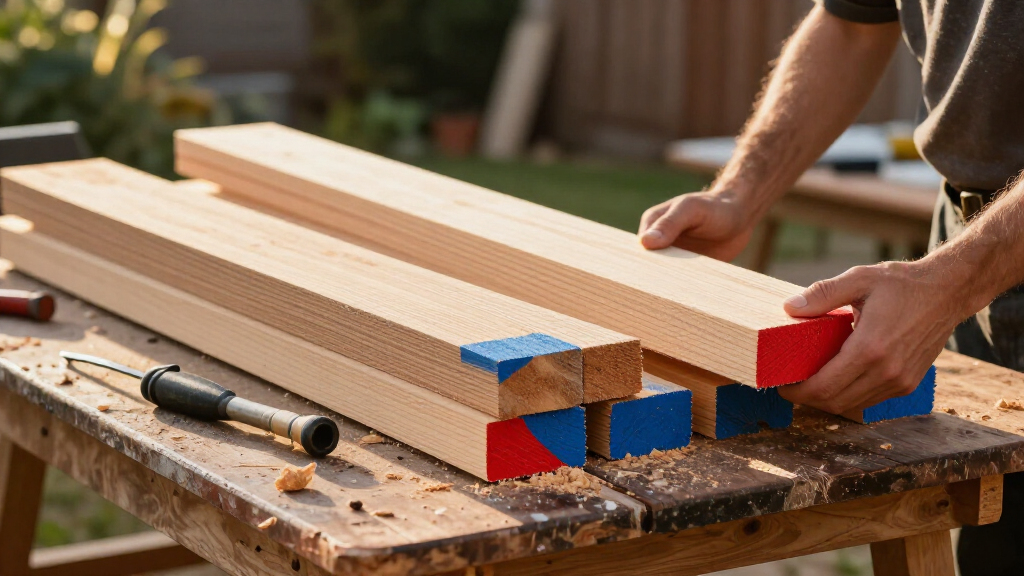
Painted ends on lumber can help slow moisture loss during drying and reduce end checking, or identify products within a mill or supplier’s system. There is no standard U.S. color code, so shoppers should not infer a board’s grade, species or length from paint alone.
End coatings are applied to freshly cut lumber to slow moisture loss through the exposed end grain. The ends can dry faster than the sides, and uneven drying can lead to cracks or splits known as end checks. The coating does not stop drying; it slows it at the ends so the wood can dry more evenly.
The report cites research by the U.S. Forest Service’s Forest Products Laboratory, which says end coatings are typically used to help prevent end checks during lumber drying. The research notes that these defects can result in a loss of valuable lumber. Timber Custom Woods describes a similar use on logs and slabs, where coating the ends is intended to reduce cracking as moisture leaves the wood.
Paint can also work as a product or inventory identifier. Mills and retailers may use colors to distinguish products, brands, grades or species, but those systems are not universal. Dunn Lumber, for example, sells framing lumber with its signature blue ends; that color identifies its own product line rather than a national category of lumber.
Why End Paint Can Mislead Shoppers
For shoppers sorting through boards, the paint may offer a clue about how the lumber was dried or how a supplier tracks its products, but it is not a substitute for checking the board itself. Color meanings vary by company, so a blue end at one yard may have no connection to a blue end sold elsewhere. The same caution applies to red, green or other colors.
That distinction matters when choosing material for a project. Buyers should check the board’s dimensions, grade and visible condition, and ask the supplier what a particular marking means. Paint alone does not establish that a board is straight, free of significant defects or suitable for a specific use.
Popular right now

Dyson W1 PencilWash Cordless Wet and Dry Floor Cleaner with Dock

KitchenAid Classic Series 4.5-Quart Tilt-Head Stand Mixer, Onyx Black

Vitamix Propel Series 750 Professional-Grade Blender, 4 Programs, Black
As an affiliate, we earn on qualifying purchases.
Drying Marks And Mill Codes
Wood loses moisture as it dries after cutting. Because the end grain provides a route for faster moisture loss than the board’s sides, the ends can be more prone to checking. Applying an end coating is one way producers try to slow that process and limit drying defects.
The identification use is separate: a mill or retailer can choose colors for its own operations or products. A Reddit discussion about blue-painted 2-by-4 ends included comments describing uses tied to particular lengths or suppliers, illustrating how local practices can differ. Such anecdotes do not establish a broader color standard; the report says no nationwide U.S. code governs what each color means.
““End coatings are typically used to help prevent end checks on sawn lumber during the drying process.””
— U.S. Department of Agriculture, Forest Service, Forest Products Laboratory
What The Paint Color Cannot Confirm
Without knowing the mill or supplier’s practices, the meaning of a specific color is unclear. The report does not identify a consistent nationwide mapping between colors and lumber lengths, species or grades. Even where a company uses a color for a particular product, that information applies to its own system and should not be assumed elsewhere.
The source material also does not establish whether a particular painted board has been coated to control drying, marked for identification, or both. Shoppers should ask the lumber yard rather than treating the end color as proof of the board’s properties.
Check The Board And Ask The Supplier
When buying lumber, inspect the board for straightness, knots and other visible defects, and confirm that its size and grade match the project. If the painted end appears to carry product information, ask the seller what its color means and whether it applies to that specific stock.
The report describes no change to industry standards or new national labeling system. For now, the practical guidance remains local: rely on the supplier for the meaning of its markings and on the lumber’s listed specifications and condition when making a selection.
Key Questions
Why are the ends of some boards painted?
Paint or another coating can slow moisture loss through the end grain during drying, helping limit cracks called end checks. A supplier may also use paint to identify products or manage inventory.
Does blue paint mean a board is a certain length or grade?
Not across the United States. There is no standard national color code for lumber ends. A blue mark may have a meaning within one mill or retailer’s system, but that meaning may not apply elsewhere.
Can end paint tell me the wood species?
Not reliably on its own. Some companies may use colors to distinguish species or other product details, but shoppers should ask the supplier rather than infer species from paint alone.
Does the coating stop wood from drying?
No. The coating is intended to slow moisture loss at the ends, allowing lumber to dry more evenly; it does not stop the drying process.
Source: rss