
TL;DR

Get business pricing on tools and workshop supplies
- Business-only prices and quantity discounts
- Tax-exempt purchasing
- Multiple users, one account, clear invoices
Melissa and Wyatt Shipman refreshed their basement half-bath for $203.76, close to their $200 budget, according to Apartment Therapy. They kept the existing toilet, countertop and oak vanity, while using paint, peel-and-stick flooring and other updates to change the room’s look.
Melissa and Wyatt Shipman updated their long-ignored basement half-bath for $203.76, using paint, peel-and-stick tile and modifications to existing fixtures rather than replacing the room’s main elements. Apartment Therapy reported that the couple set a $200 budget for the makeover, which changed the appearance of a bathroom they said had seen little use before Wyatt began working from home in the basement.
The bathroom had the look of the home’s early-1990s construction, with tan vinyl flooring, an oak vanity, poor lighting and a blue toilet and sink. The couple had renovated other parts of their home during the nine years they had lived there, but Melissa Shipman told Apartment Therapy they had put off this room because it was rarely used and replacing the blue fixtures seemed difficult to justify.
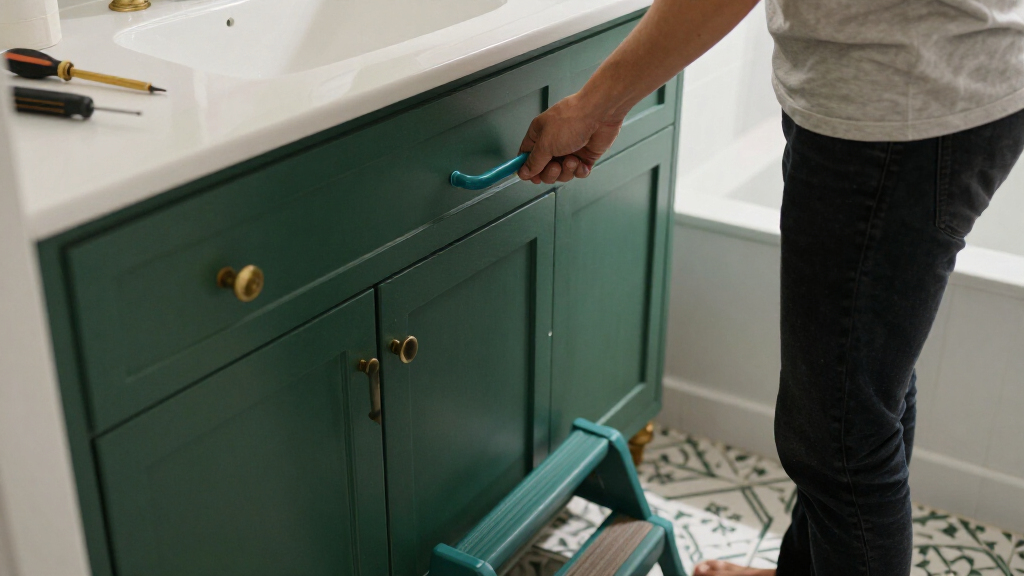
The work began with removing the popcorn ceiling and painting the walls white using paint left over from other projects. The couple did not replace the floor; they installed gray, white and black peel-and-stick tile instead. The oak vanity remained in place. Wyatt sanded down decorative edges on its doors, and Melissa painted it black with leftover paint.
They also installed a black faucet, a new mirror and more contemporary lighting, and added framed artwork made from pieces they already owned. The report says the couple spent $203.76 in total, slightly above their target. The countertop and toilet remained, with the darker vanity and faucet changing the visual contrast around them.
A Low-Cost Alternative to Replacement
The project offers a specific example of how homeowners can change a room’s appearance without replacing every dated fixture. By keeping the vanity, countertop and toilet, and using leftover paint and previously owned frames, the Shipmans concentrated their spending on the floor covering, faucet, mirror and lighting. Their reported total was just under $204, but it reflects this household’s project and materials, not a general estimate for similar renovations.
The account also shows how a room’s use can affect renovation priorities. The basement bathroom had been easy for the couple to ignore when it was rarely used. Wyatt’s move to working from home in the basement, and the couple’s children being home during the day, made the space more relevant to daily life, according to the report. The makeover was a cosmetic update; the source does not describe plumbing, electrical or structural work.
Popular right now

KitchenAid Classic Series 4.5-Quart Tilt-Head Stand Mixer, Onyx Black

Vitamix Propel Series 750 Professional-Grade Blender, 4 Programs, Black

Dyson Airwrap i.d. Multi-Styler for Straight and Wavy Hair
As an affiliate, we earn on qualifying purchases.
Why the Basement Bathroom Changed
Apartment Therapy’s report describes the half-bath as a feature of the Shipmans’ early-1990s home that they had left untouched while tackling other DIY work. Its tan floor, oak cabinetry and blue fixtures were among the dated elements they wanted to address, but Melissa said the cost and the challenge of deciding what to do with the blue toilet had discouraged a redo.
The shift in the room’s use changed that calculation. As the basement became Wyatt’s home office and the children spent more time at home, the bathroom was used more often. The couple then chose a limited-budget refresh rather than a full renovation. The source provides no independent cost comparison or information about the condition of the room’s underlying materials.
“I was basically ignoring this room because we never really used it, and I didn’t want to spend the money to upgrade a space that felt impossible.”
— Melissa Shipman, speaking to Apartment Therapy
Costs and Durability Remain Unreported
The report gives the total as $203.76, but does not provide a complete itemized breakdown, receipts or a detailed account of how the final figure was calculated. It also does not specify when the work took place, the square footage of the bathroom, or the brands and quantities of products used.
There is no follow-up information about how the peel-and-stick tile has held up, whether the vanity changes were made with particular tools or finishes, or whether the work affected resale value. The source presents the couple’s account of their project; it does not establish that the same budget or results would apply to other bathrooms.
No Further Work Is Specified
Apartment Therapy’s report does not identify a planned next phase, a scheduled follow-up or additional renovations to the bathroom. The couple’s described work is complete, and Melissa said she wished they had done it sooner. Whether they later replace the retained fixtures or flooring is not stated.
For readers considering a similar update, the reported total is best treated as a single project’s result, not a price promise. Room size, local costs and existing conditions can change what a makeover requires; the source does not provide enough detail to estimate those differences.
Key Questions
How much did the bathroom makeover cost?
Apartment Therapy reported a total of $203.76, slightly above the couple’s $200 target. The article does not include a full itemized expense list.
What did the couple change?
They removed the popcorn ceiling, painted the walls white, added gray, white and black peel-and-stick floor tile, modified and painted the existing oak vanity, and added a black faucet, mirror, lighting and framed art.
Did they replace the toilet, countertop or vanity?
No. The report says the toilet and countertop stayed, and the oak vanity was kept and updated rather than replaced.
When was the project completed, and how has it held up?
The source does not specify the project date or provide a later durability update, including how the peel-and-stick flooring has performed over time.
Source: rss